The Psychology of Queueing: Why the Other Line Always Moves Faster
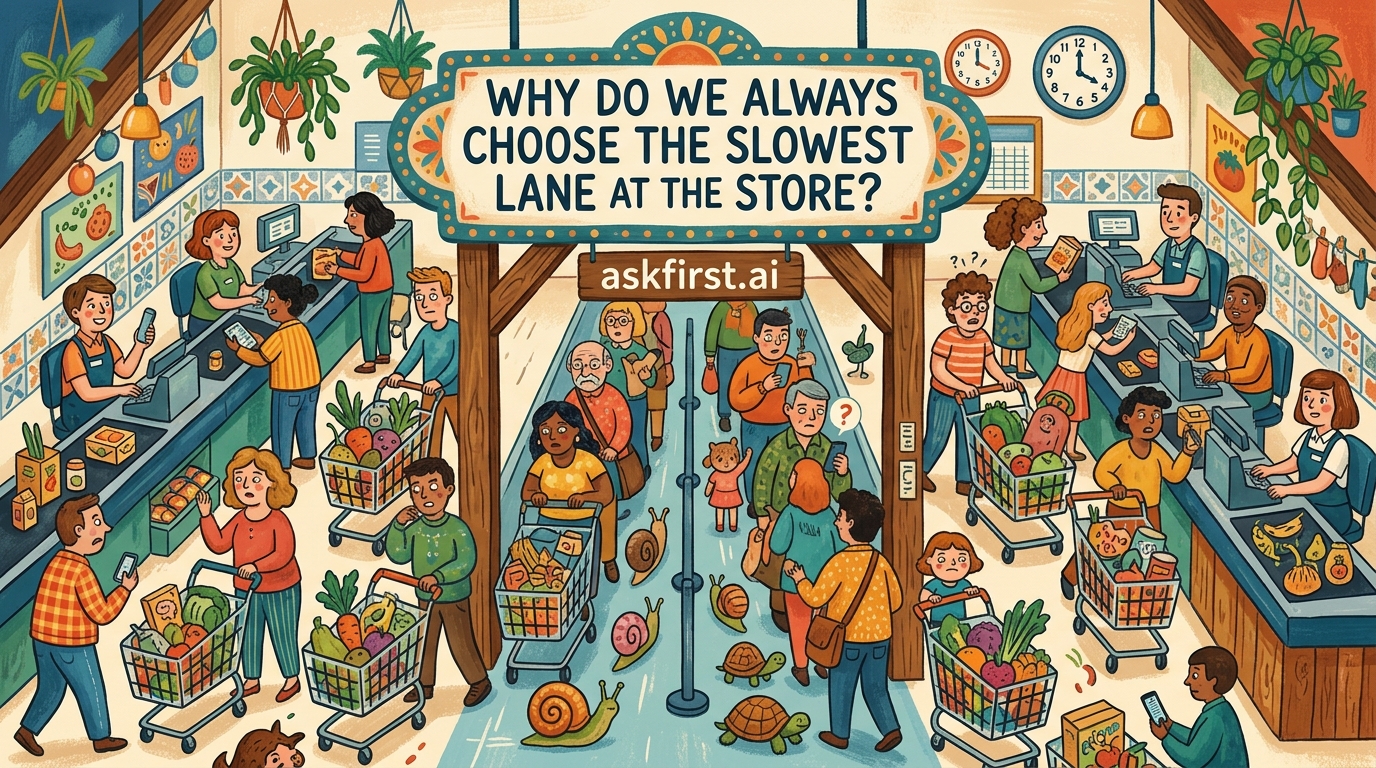
The phenomenon of the 'slowest lane' is a ubiquitous human experience that feels like a personal vendetta from the universe. However, this frustration is not merely a manifestation of bad luck; it is rooted in deep-seated cognitive biases, mathematical probability, and behavioral psychology. Understanding why we feel trapped in the slowest lane requires dissecting how human perception processes time and fairness.
1. The Illusion of Control and Cognitive Biases
At the heart of the queueing experience lies the Negativity Bias. Human beings are evolutionarily wired to pay more attention to negative experiences than positive ones. When a shopper successfully picks a fast line, it is perceived as 'normal' or expected, so the memory fades quickly. Conversely, when stuck in a slow lane, the experience is perceived as an injustice, creating a vivid, lasting memory. This creates a psychological imbalance where the memory of every slow lane stands out, while every fast lane is forgotten, leading to the confirmation bias that we are 'always' stuck.
Furthermore, the Availability Heuristic kicks in. Because the frustration of waiting is visceral and emotional, the brain recalls these moments more readily than the mundane, swift transactions. We believe we are prone to choosing the slow line because our brain keeps showing us a highlight reel of our greatest failures in the checkout aisle.
2. The Mathematics of Randomness
From a purely statistical standpoint, the feeling of choosing the slowest lane is often a result of Little’s Law and the variance inherent in queueing systems.
- The Multi-Server System: Most retail environments utilize a 'many-to-many' queue system, where there are multiple queues for multiple registers. If one person ahead of you has a complex transaction (e.g., price checks, coupon issues, or card malfunctions), the variance of that specific line increases significantly compared to a 'single-line, multiple-server' system (often found in banks or airports).
- The Probability Gap: In a multi-lane store, if there are ten lanes, there is a one-in-ten chance of choosing the fastest, and a nine-in-ten chance of being in a line that is average or slower. Statistically, you are far more likely to be in a line that is not the absolute fastest one, which creates a mathematical baseline for dissatisfaction.
3. Perception of Time (Waiting Psychologically)
Research by David Maister, a renowned expert on service management, established key principles regarding the 'psychology of waiting'. These principles explain why time feels longer than it actually is:
- Occupied time feels shorter than unoccupied time: If a shopper is looking at impulse-buy displays, reading a magazine, or checking a phone, the wait time is perceived as shorter. When standing idle, staring at the back of a stranger’s head, the brain focuses entirely on the passage of time.
- Uncertain waits are longer than known, finite waits: If a customer knows they have three people ahead of them, the anxiety is lower. The 'slow' line often feels slow because the end goal is unpredictable. Is the person ahead done? Are they paying by check? Is the cashier waiting for a supervisor?
- Anxiety makes the wait seem longer: When an individual is in a hurry, the physiological stress response heightens sensory awareness, causing the perception of time to stretch.
4. The Influence of 'Social Comparison Theory'
Humans are naturally competitive. When we join a line, we immediately begin to scan the neighboring lanes. According to Social Comparison Theory, we evaluate our own situation relative to others. If the line next to us moves, we perceive ourselves as having 'lost' a social contest. This comparative mindset transforms a neutral wait into a competitive failure. Even if the wait time is identical, seeing someone else finish first makes our own experience feel like a defeat.
5. Practical Strategies to Improve the Experience
While the human brain is hardwired for frustration, practical steps can mitigate the impact of the wait:
- Choose the Left-Hand Line: Research suggests that right-handed people, who make up the majority of the population, tend to subconsciously veer right when entering a store or choosing a checkout lane. By choosing the leftmost lanes, shoppers may encounter shorter queues simply because of crowd-flow patterns.
- Target the Male-Dominated Line: Studies have indicated that men are often more impatient than women in retail environments. A line filled with men who have fewer items might theoretically be faster, though this is a generalization.
- Select Lines with More Carts: A line with one person purchasing forty items is often faster than a line with three people purchasing only one item each. This is because the 'service time' (the fixed time to process payment) is constant for every customer, regardless of the number of items.
Ultimately, the 'slowest lane' is a psychological construct exacerbated by the design of retail systems. By understanding that the brain prioritizes frustration and that our perception of time is malleable, we can reclaim our patience in the checkout aisle. The next time you find yourself stuck, remember: you are not being singled out by fate; you are simply experiencing the fascinating, imperfect intersection of probability and human perception.