The Fundamental Architecture of Physical Reality: An Analysis of Matter
Matter, in its most fundamental definition, is anything that possesses mass and occupies space. It is the building block of the universe, ranging from the subatomic particles within an atom to the colossal clusters of galaxies that span the cosmos. While modern physics acknowledges more exotic states—such as plasma, Bose-Einstein condensates, and degenerate matter—the classical understanding of the physical world is anchored in three primary states: solids, liquids, and gases. Understanding these states requires an examination of kinetic molecular theory, which posits that all matter is composed of particles in constant motion, and that the state of a substance is determined by the balance between the kinetic energy of its particles and the strength of the intermolecular forces holding them together.
1. The Solid State: Structure and Rigidity
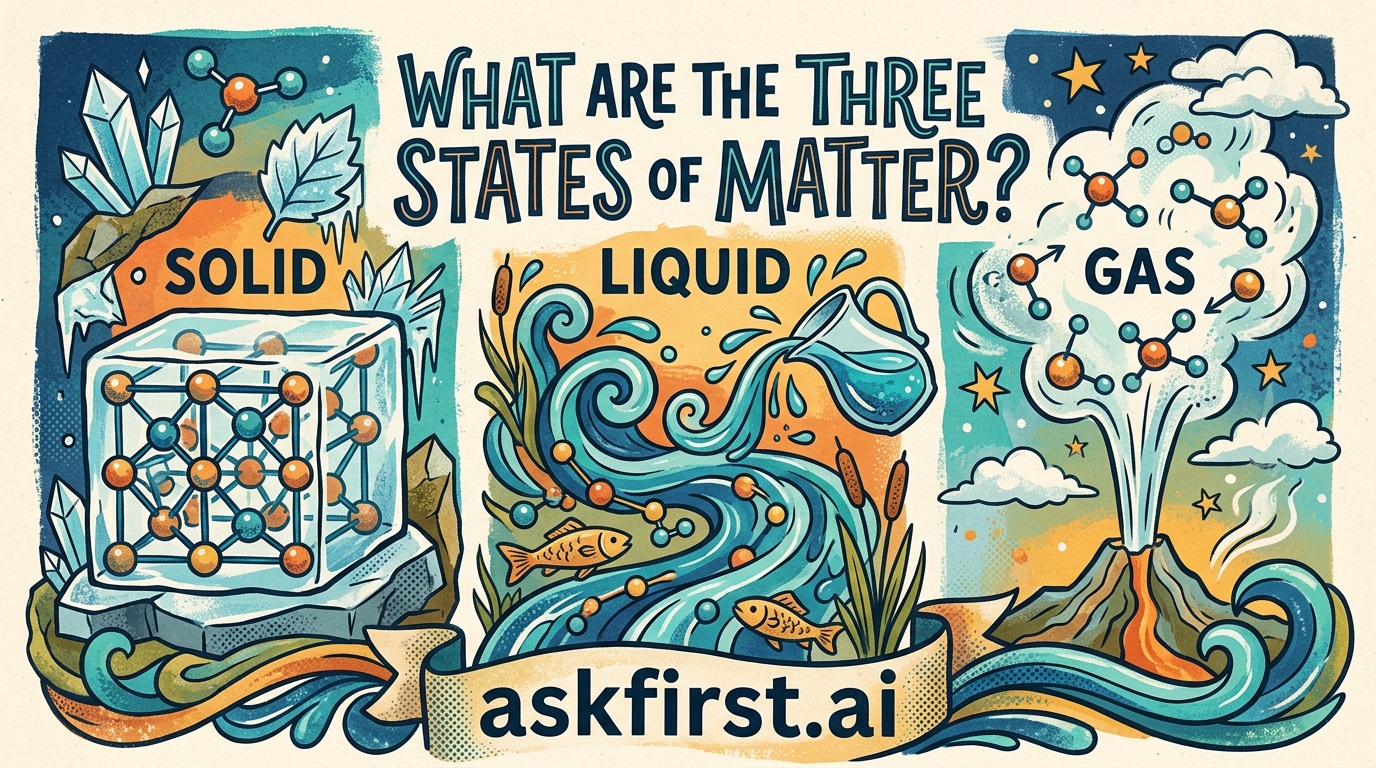
A solid is defined by its structural rigidity and resistance to changes in shape or volume. At the microscopic level, the particles (atoms, molecules, or ions) are packed closely together in a fixed, orderly arrangement. Because the kinetic energy of these particles is relatively low, they cannot move past one another; instead, they vibrate around fixed positions within a crystalline or amorphous lattice.
There are two primary categories of solids:
- Crystalline Solids: These possess a highly ordered, repeating internal structure. Examples include table salt (sodium chloride), diamonds, and quartz. In General Chemistry by Linus Pauling, the Nobel laureate explains that the geometric precision of these crystals is a direct result of the specific, repeating electrostatic forces between ions or atoms.
- Amorphous Solids: These lack a long-range order. While they retain a definite shape, their internal structure is disordered, similar to a liquid that has been "frozen" in place. Glass and many polymers are prime examples.
Because of this fixed structure, solids maintain their own shape regardless of the container they are placed in. They are largely incompressible, meaning that even under extreme pressure, their volume remains nearly constant.
2. The Liquid State: Fluidity and Cohesion
Liquids represent an intermediate state of matter where the kinetic energy of the particles is sufficient to overcome the rigid structure of a solid, yet not enough to completely escape the intermolecular forces that bind them. In a liquid, particles are still in close proximity, but they are free to slide past one another. This gives liquids the unique property of fluidity.
A liquid will conform to the shape of its container while maintaining a constant volume. If you pour a liter of water from a beaker into a tall cylinder, the shape changes to accommodate the new vessel, but the volume remains exactly one liter.
Two critical properties govern the behavior of liquids:
- Viscosity: This is a measure of a fluid's resistance to flow. As noted in University Physics by Sears and Zemansky, viscosity is essentially the "internal friction" of a liquid. Honey, for instance, has high viscosity due to strong intermolecular hydrogen bonding, while water flows easily due to its lower molecular attraction.
- Surface Tension: This is the tendency of liquid surfaces to shrink into the minimum surface area possible. This phenomenon allows insects like water striders to walk on a pond’s surface, as the cohesive forces between molecules at the surface are stronger than those in the bulk liquid.
3. The Gaseous State: Kinetic Freedom
The gaseous state is characterized by high kinetic energy and minimal intermolecular attraction. In a gas, the particles move rapidly and randomly, colliding with one another and the walls of their container. Unlike solids and liquids, gases have neither a definite shape nor a definite volume. They expand to fill the entirety of any available space.
The behavior of gases is described by the Ideal Gas Law ($PV=nRT$), a fundamental pillar of thermodynamics. This equation, which relates pressure ($P$), volume ($V$), the amount of substance ($n$), the gas constant ($R$), and temperature ($T$), assumes that gas particles are point masses that do not exert forces on one another—a concept explored extensively in The Feynman Lectures on Physics by Richard Feynman.
Because the particles in a gas are separated by vast distances relative to their size, gases are highly compressible. When you press down on the plunger of a bicycle pump, you are forcing gas molecules into a smaller volume, increasing the frequency of their collisions with the container walls, which manifests as an increase in pressure.
Conclusion: The Dynamic Equilibrium of Matter
The transition between these three states is governed by the addition or removal of energy. When energy is added to a solid, the vibrations of its particles increase until the lattice structure collapses, leading to melting. Conversely, when energy is removed from a gas, the particles slow down, allowing intermolecular forces to pull them together into a liquid state (condensation).
These states are not merely abstract concepts; they are the foundation of engineering, chemistry, and biology. From the way water circulates through the Earth’s atmosphere as vapor, liquid, and ice, to the way metals are forged for construction, the interplay between solids, liquids, and gases dictates the mechanics of our existence. By understanding the energy levels and molecular interactions that define these states, we gain the ability to manipulate the physical world to suit the needs of modern civilization.