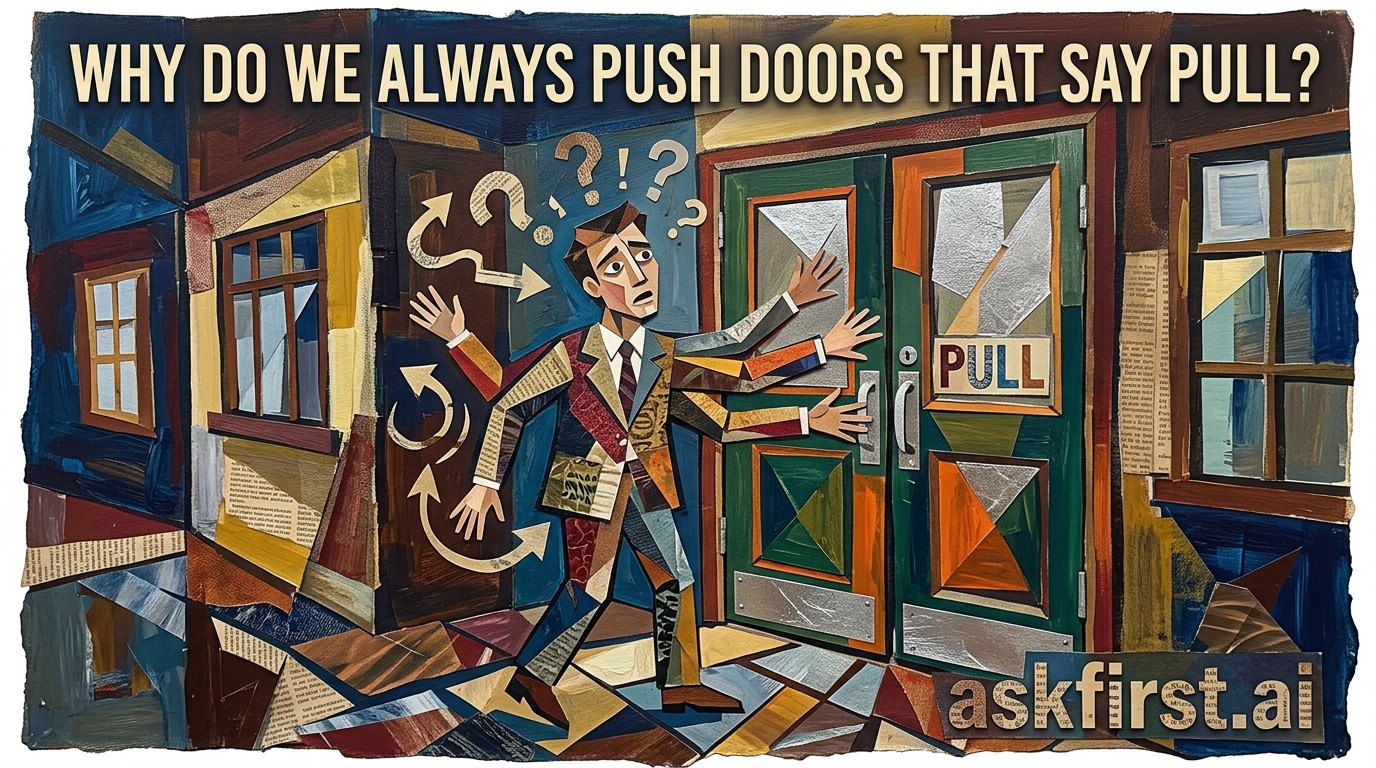
The phenomenon of pushing a door labeled 'pull' is a classic example of a design failure, commonly known as a Norman Door. Named after cognitive scientist Don Norman, author of the seminal work The Design of Everyday Things, these doors represent a breakdown in communication between the object and the user. The primary reason we fail to follow instructions is that humans rely on affordances—visual cues that suggest how an object should be used—rather than text-based labels. When a handle is designed in a way that implies a pushing motion, our subconscious mind ignores the sign entirely.
The Psychology of Affordance
At the core of this behavior is the concept of perceived affordance. An affordance is a property of an object that defines its possible uses. For instance, a flat metal plate on a door signals 'push' because it offers a surface to lean against. Conversely, a vertical bar or handle signals 'pull' because it provides a place to grasp. When designers place a handle—an object designed for pulling—on a door that actually requires pushing, they create a cognitive conflict. Our brains are hardwired to process visual shapes and textures faster than they process linguistic information like 'pull.' If the tactile affordance (the handle) contradicts the instruction (the sign), the tactile affordance usually wins.
The Hierarchy of Information
Humans process information in a specific hierarchy. We prioritize environmental cues over secondary information like written labels. In a high-speed world where we are constantly making split-second decisions, we rarely read the fine print on a door. We glance, interpret the shape of the hardware, and act. This is an evolutionary adaptation; our ancestors did not have time to read instructions when escaping a predator or navigating a landscape. Consequently, if a door looks 'pushable,' the brain prepares to push long before the eyes have registered the word 'pull.' This is why adding a 'push' sign to a plate-style door is often redundant, but adding a 'pull' sign to a handle-style door is a recipe for frustration.
Mapping and the Mental Model
Another factor is the concept of mapping. Good design uses natural mapping, where the controls logically correspond to the desired effect. If a door needs to swing outward, the most intuitive design would involve a mechanism that encourages outward movement. When we push a door marked 'pull,' we are suffering from a mismatch between our internal mental model of how a door functions and the actual physical reality. When we approach a threshold, we anticipate a certain interaction. If the physical hardware suggests 'pull' but the door is locked or requires a push, we perceive it as a failure of our intelligence, even though the error actually lies with the designer.
Why Instructions Fail
Labels are considered a form of 'remedial design.' If a product requires a sticker to explain how to use it, the design is arguably broken. Professionals in human-computer interaction (HCI) and ergonomics argue that objects should be self-explanatory. When a sign is necessary, it indicates that the design has failed to communicate its function clearly.
- Selective Attention: People often engage in inattentional blindness, where they filter out background information like text signs to focus on the primary task—opening the door.
- Habitual Behavior: If you interact with hundreds of doors a week, your movements become automated. Breaking that automation requires a significant amount of mental effort, which the brain is naturally optimized to conserve.
- Environmental Stressors: Rushing, carrying items, or being distracted significantly reduces the cognitive bandwidth available to process signs, leaving the brain reliant on instinct.
The Solution: Human-Centric Design
To eliminate the 'push-pull' frustration, architects and designers have moved toward universal symbols and hardware that dictate behavior.
- Replace handles with plates on doors that must be pushed.
- Use long, vertical bars exclusively on doors that must be pulled.
- Apply color coding or tactile markers to distinguish function.
In conclusion, pulling a door that says 'push' is not a mark of personal incompetence. It is an indictment of poor industrial design. By understanding the psychology of affordances and the way our brains prioritize visual form over text, we can better appreciate why these daily frustrations occur. When you encounter a confusing door, remember that your brain is working exactly as it should—it is simply interpreting the object's shape as the primary guide for action, and the physical world is failing to provide the correct visual vocabulary.