The Evolutionary Psychology of Social Memory
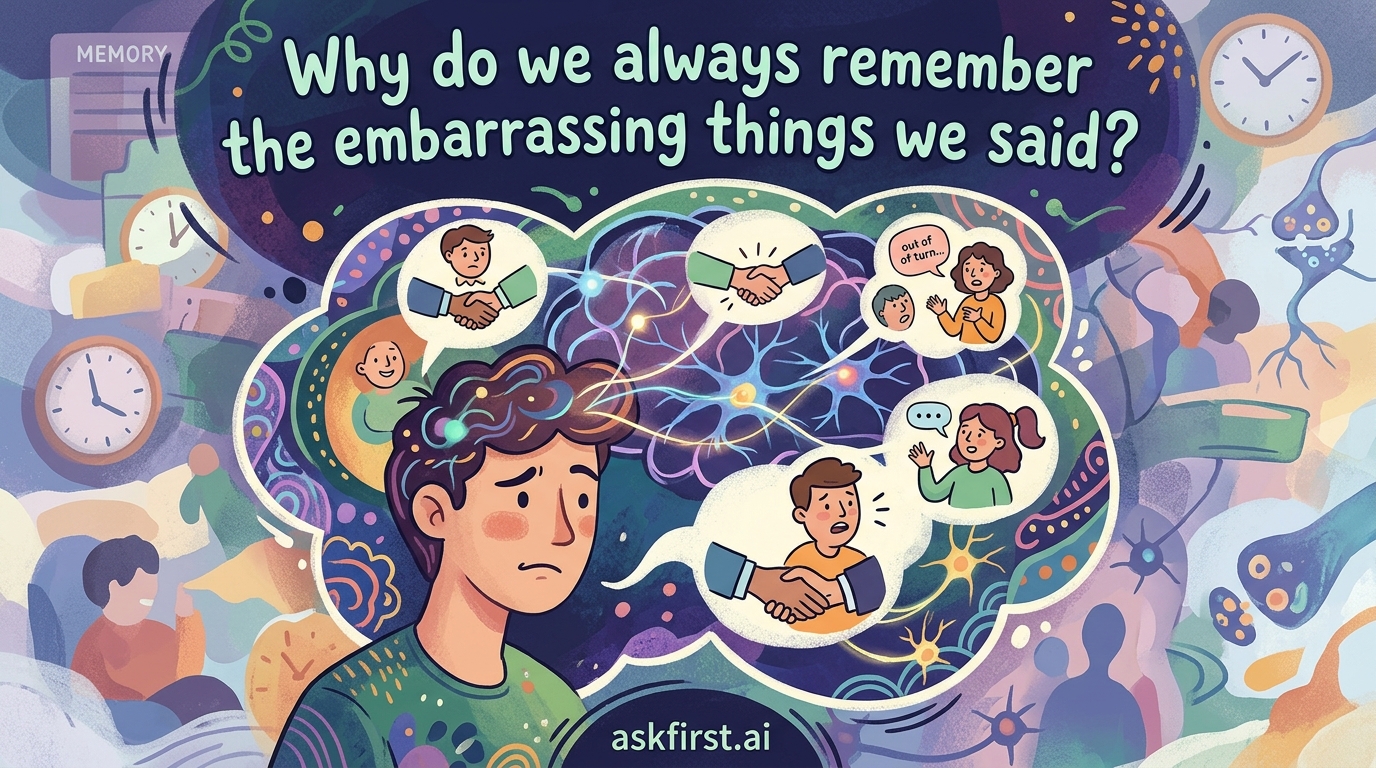
The phenomenon of ruminating on past social blunders is a deeply ingrained cognitive process rooted in human evolutionary history. Humans are inherently social creatures; our ancestors' survival depended heavily on group cooperation and social standing. Being ostracized from a tribe often meant certain death, which fostered a biological imperative to monitor our behavior constantly. This psychological mechanism is often referred to as the 'Social Monitoring System.' When a social transgression occurs—such as saying something awkward—the brain flags this memory with high emotional intensity to ensure the mistake is not repeated, as repetition could threaten one's status within the group.
The Role of Negative Bias
One primary driver of this memory retention is Negativity Bias. Psychologically, humans are hardwired to pay more attention to negative experiences than positive ones. Studies in neuroscience suggest that the amygdala, the brain's emotional processing center, reacts more vigorously to potential threats or failures. Embarrassment acts as a 'social threat,' triggering a stronger neurological response than a compliment or a successful social interaction. Consequently, the brain 'invests' more energy into storing these memories, effectively creating a high-definition mental file of the incident to prevent future social exclusion.
The Spotlight Effect
A major component of this rumination is the 'Spotlight Effect,' a psychological concept first coined by Thomas Gilovich. This occurs when individuals overestimate the extent to which their actions and appearance are noticed by others. In reality, most people are far too consumed with their own internal monologues and social anxieties to pay much attention to the minor awkwardness of someone else. However, because our own memory is so focused on our 'mistake,' we incorrectly assume everyone else’s memory is equally focused on it. This misperception exacerbates the feeling of shame long after the moment has passed.
The Anatomy of Rumination
Rumination refers to the repetitive dwelling on distressing thoughts. When the brain replays an embarrassing memory, it often engages in 'counterfactual thinking'—or the 'what if' game. The brain tries to rewrite history by imagining what should have been said instead. This is an attempt by the cognitive system to learn from the 'error' in a safe, simulated environment. Unfortunately, this repetitive cycle strengthens the neural pathways associated with that memory, making it easier to recall in the future and creating a feedback loop of discomfort.
Strategies to Mitigate Social Rumination
Understanding the biological purpose of these thoughts is the first step toward managing them. To break the cycle of fixation, consider the following evidence-based strategies:
- Perspective Taking: Practice 'de-centering' by viewing the situation through a neutral, third-party observer lens. Would a stranger care about this detail in ten years? Likely not.
- Cognitive Reappraisal: Instead of viewing an awkward comment as a character flaw, reframe it as a sign of humanity. Vulnerability and imperfection are universal experiences that often make individuals more relatable rather than less.
- Mindfulness Practices: Engaging in mindfulness helps anchor the brain in the present moment, effectively preventing the mind from drifting into the 'time machine' of past social errors.
- Radical Acceptance: Acknowledge that perfection is an illusion. Accepting that occasional social friction is an inevitable part of human connection reduces the intensity of the emotional reaction.
The Social Value of Mistakes
It is vital to recognize that social 'blunders' are often the catalyst for personal growth. The sting of embarrassment is an effective teacher; it forces us to refine our social intelligence, improve our active listening skills, and develop more empathy for the social anxieties of others. Those who have experienced and survived embarrassing moments often develop higher levels of emotional intelligence and resilience. The brain’s tendency to hoard these memories is not necessarily a design flaw, but a persistent, albeit uncomfortable, security feature designed to keep us socially calibrated. By understanding that these memories are merely 'safety warnings' rather than reflections of intrinsic worth, we can diminish their power and move forward with greater social confidence.