The Evolutionary Truth About Human Vision
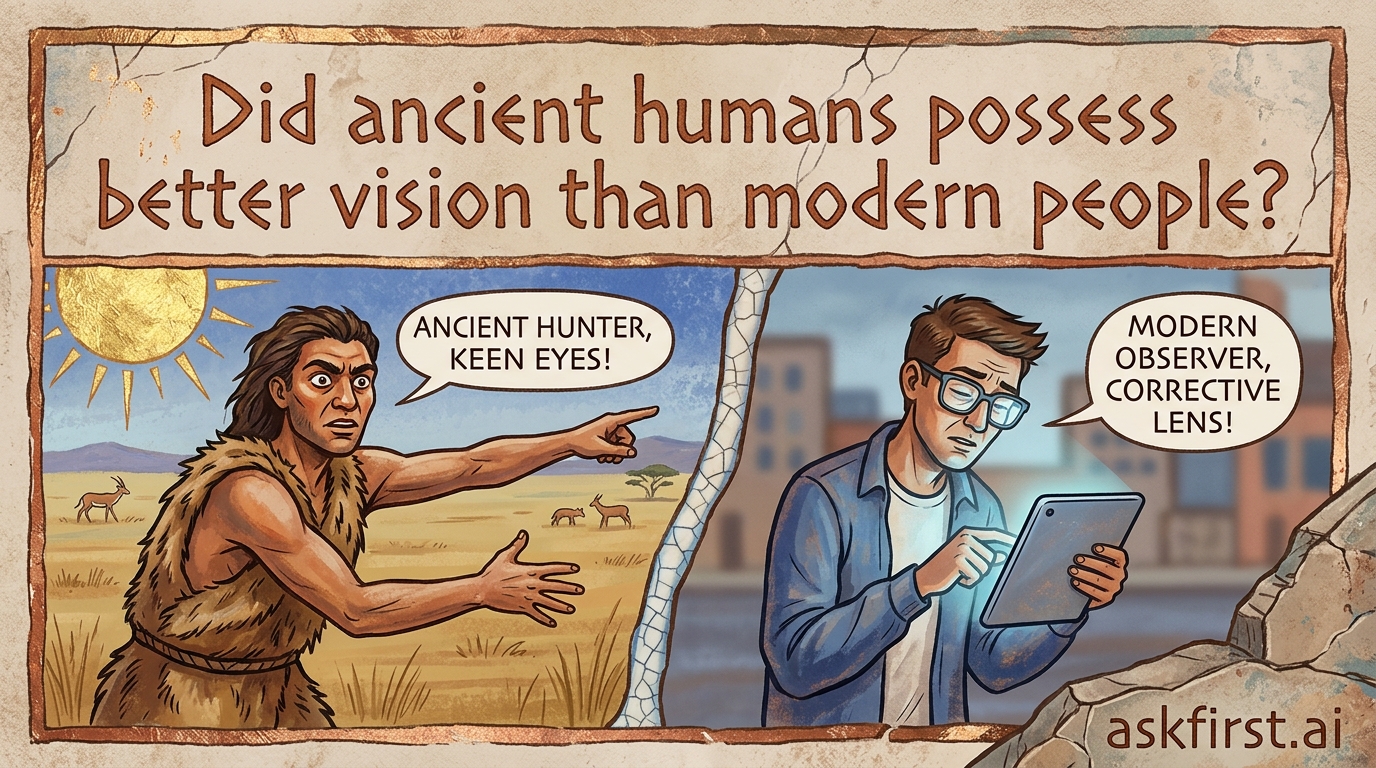
When contemplating the biological legacy of humanity, a persistent myth suggests that our ancestors roamed the earth with the visual acuity of predatory birds, spotting tiny prey from miles away, while modern humans are crippled by screens and artificial lighting. However, the scientific reality is far more nuanced, intriguing, and contrary to popular intuition. Whether ancient humans truly possessed superior vision involves examining the intersection of biological adaptation, environmental pressure, and the rapid onset of modern civilization.
The Biological Baseline of Human Acuity
In terms of raw physiological potential, there is no evidence that the basic structural hardware of the human eye has fundamentally changed in the last ten thousand years. The human eye operates on a complex mechanism involving the cornea, lens, and the high-density concentration of photoreceptor cells in the macula known as the fovea. Research into the skeletal remains of Paleolithic humans suggests that their orbits and general neurobiology remained consistent with those of modern humans. Essentially, a child born to a hunter-gatherer fifty thousand years ago would have the same optical potential as a child born in a modern metropolis today.
The Impact of Environmental Selection
While hardware remains constant, software—or the brain’s ability to process visual information—differs significantly based on environment. Ancient humans lived in environments that demanded extreme situational awareness. The survival of a hominid in the wild depended on the ability to detect motion, identify predators against complex backgrounds, and judge distances accurately. This does not necessarily mean 'better' vision in terms of 20/20 measurements, but rather 'better' visual cognition. The brain likely prioritized tasks related to pattern recognition and movement detection, processes honed by constant outdoor exposure.
The Myopia Pandemic: An Environmental Mismatch
The most dramatic difference between ancient and modern vision is the prevalence of myopia, or nearsightedness. Modern society is currently facing a 'myopia epidemic.' Studies indicate that the drastic increase in nearsightedness is not primarily genetic, but environmental. There are two primary drivers for this shift:
- Lack of Natural Light: Dopamine is released in the retina in response to sunlight, which inhibits the elongation of the eyeball. Modern humans spend significantly less time in daylight, which has been shown to contribute to eye growth that results in myopia.
- Excessive Near-Work: Constant focus on digital screens and books forces the ciliary muscles to remain in a state of tension. This 'near-work' environment encourages the eye to adapt to close distances, making it increasingly difficult for the eye to return to a relaxed state for distance vision.
Ancient humans spent nearly their entire lives engaged in activities that prioritized distance viewing, such as scouting, gathering, and navigating landscapes. This environmental consistency kept the focus mechanism of the eye healthy and flexible.
Was Vision 'Sharper' in the Past?
If one were to test the visual acuity of a Paleolithic hunter on a standard Snellen chart, they might score quite well, likely reaching 20/15 or 20/10 vision. Many people today possess this level of acuity, but fewer maintain it into adulthood. The 'superhuman' myth stems from the conflation of visual acuity (the ability to resolve detail) with visual expertise (the ability to interpret what is seen). A professional baseball player can see a fastball with incredible detail because they have spent thousands of hours training their visual system to track fast-moving objects. Similarly, an ancient hunter-gatherer likely possessed 'expert' vision—the ability to identify animal tracks, categorize edible plants, or spot subtle color variations that a modern, office-bound person would overlook.
The Role of Nutrition and Health
Another critical factor is systemic health. Ancient diets, rich in wild-caught fish, diverse vegetables, and fruits, provided high concentrations of lutein, zeaxanthin, and omega-3 fatty acids—all of which are essential for long-term retinal health. While modern nutrition often includes processed foods deficient in these nutrients, the average modern human also benefits from medical interventions that prevent cataracts, macular degeneration, and other age-related conditions that would have inevitably clouded the vision of elders in ancient times. In this sense, modern humans have arguably 'better' vision in old age, thanks to the accessibility of corrective lenses and surgical advances.
Conclusion: Adapting to a New Reality
Ultimately, ancient humans did not possess 'better' eyes in a biological sense; they possessed a visual system that was uniquely adapted to an outdoor, high-stakes, distance-focused environment. Modern humans possess a remarkably plastic visual system that is currently adapting to the digital, indoor age. While this adaptation has led to increased nearsightedness, it has also facilitated the development of high-resolution image processing and visual-task switching that were unnecessary for our ancestors. Vision is not a static trait; it is a dynamic process shaped by the world we inhabit. Our ancestors saw the forest, but we have evolved to see the pixels, and both are marvels of human biological engineering.