The Simulation Hypothesis: An Exploration of Reality
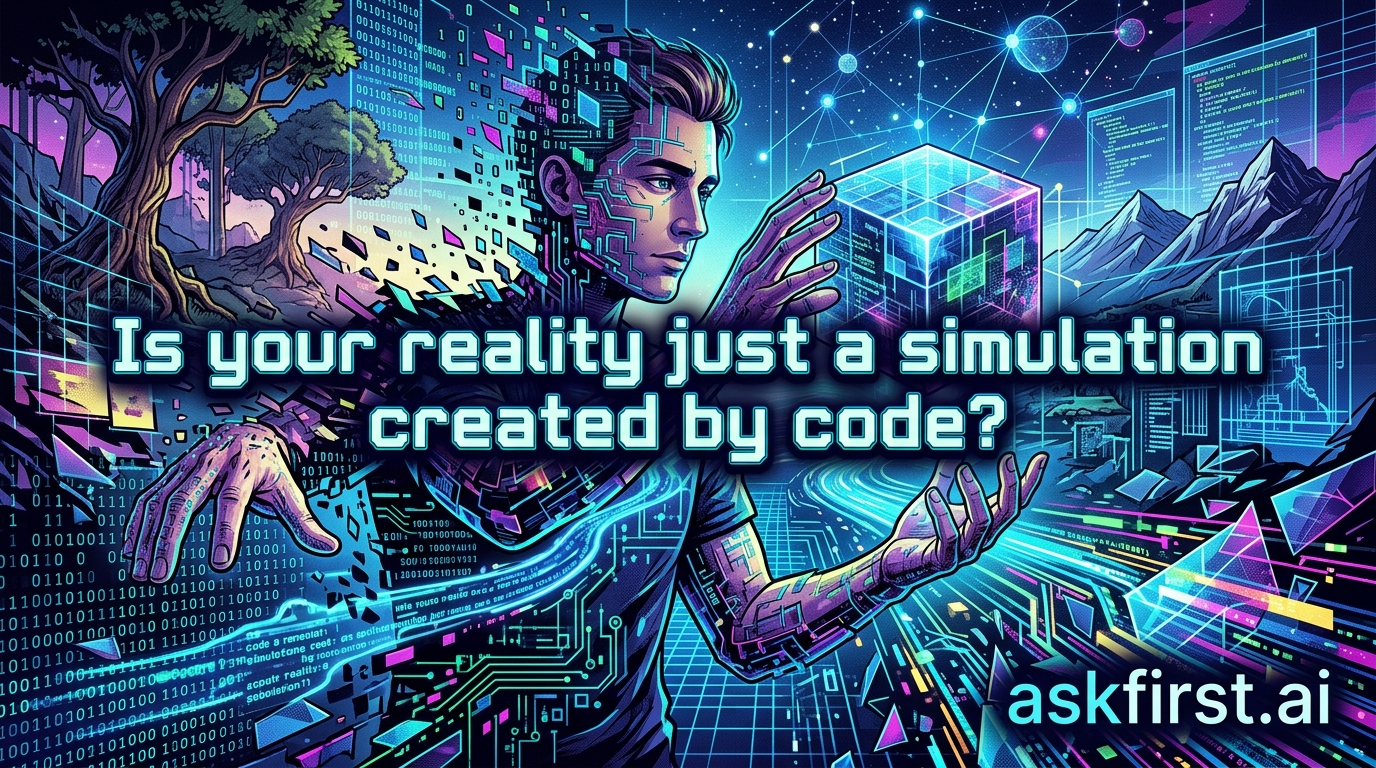
The Simulation Hypothesis posits that the universe, as perceived, is not a physical construct but rather a sophisticated, digital computation. This theory has moved from the pages of science fiction into the halls of academic physics and philosophy, popularized by thinkers like Nick Bostrom. The core premise is that if a civilization possesses enough computing power, it will eventually create "ancestor simulations." If such simulations exist, the statistical probability that any given observer is in the "base reality" versus a simulated one becomes remarkably low.
Theoretical Foundations of Simulated Reality
- Information Theory: Physicists such as John Wheeler have famously proposed the concept of "it from bit," suggesting that at the most fundamental level, the universe is built upon information. This view aligns with the notion that matter and energy are essentially outputs of binary code.
- Quantization of Spacetime: Observations in quantum mechanics reveal that energy levels are discrete rather than continuous. This discretization mirrors the pixelation or grid-like structure found in computer graphics, fueling arguments that the universe has a maximum resolution or "bit depth."
- Computational Limits: Just as software is bound by hardware constraints, the laws of physics may be perceived as the programmed limits or algorithms that govern the behavior of particles. The speed of light could be interpreted as the maximum processing speed for information exchange within the simulation.
The Mathematical Argument
Nick Bostrom’s trilemma presents a logical framework for evaluating this claim. The argument suggests that at least one of the following must be true: (1) civilisations go extinct before they achieve the technological maturity to create simulations; (2) advanced civilizations have no interest in running simulations of their ancestors; or (3) humanity is almost certainly living in a simulation. If one assumes that conscious beings are capable of being emulated, the volume of simulations would vastly outnumber the single base reality, making the statistical likelihood of occupying that base reality nearly zero.
Examining Potential Glitches
Observers of the simulation hypothesis often look for anomalies that might suggest a digital origin. Some speculate that quantum entanglement, where particles influence each other instantaneously across vast distances, is a method of saving processing resources—only rendering the state of a particle when it is being observed. This echoes the concept of "lazy loading" in video game development, where objects are only processed by the CPU when they enter the player's field of view.
Philosophical and Ethical Implications
- Determinism vs. Free Will: If reality is coded, does human agency truly exist? Proponents argue that complex simulations would be designed with stochastic elements, allowing for unpredictable emergent behavior rather than a rigid, linear script.
- The Nature of Consciousness: The challenge of the "hard problem of consciousness" remains central. Can software be sentient? If consciousness is merely an informational state, then digital substrates are as capable of subjective experience as biological neural networks.
- Scientific Inquiry: Regardless of whether the world is "real," scientific inquiry remains the method for uncovering the rules of the engine. Whether those rules are discovered in nature or programmed into an architecture, understanding them remains the pursuit of knowledge.
Conclusion: The Unfalsifiable Puzzle
While the simulation hypothesis is currently unfalsifiable—meaning there is no definitive experiment to prove or disprove it—it serves as a powerful lens for questioning the nature of existence. It compels observers to consider that reality might be layered, structural, and deeply algorithmic. As computing power continues to follow trends like Moore’s Law, the capability to create convincing worlds increases, bringing the hypothetical closer to a potential reality. Ultimately, the question shifts from "Is this real?" to "What does it mean to exist within a framework of information?" The mystery invites ongoing exploration, bridging the gap between ancient metaphysical inquiry and the frontiers of modern digital science.