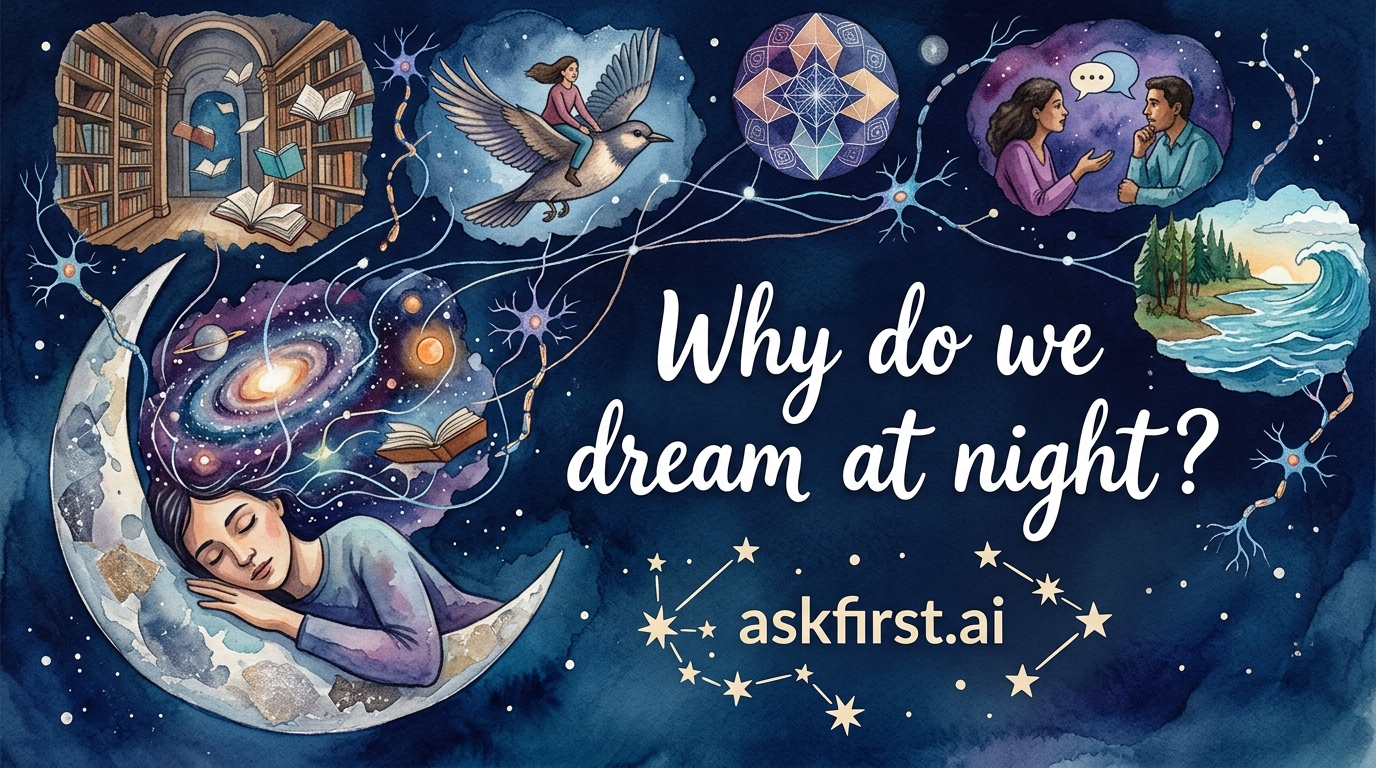
The Enigma of the Nocturnal Mind: Why We Dream
The phenomenon of dreaming—a surreal, vivid, and often bizarre subjective experience occurring primarily during sleep—remains one of the most profound mysteries in the study of human consciousness. While we spend approximately one-third of our lives asleep, the exact biological and psychological utility of the dream state has been debated for centuries, ranging from the ancient belief that dreams were messages from the divine to contemporary neuroscientific theories positing them as essential functions for emotional regulation and cognitive maintenance.
The Neurobiology of the Dream State: REM Sleep
To understand why we dream, one must first understand the architecture of sleep. The most intense dreaming occurs during Rapid Eye Movement (REM) sleep, a phase characterized by high-frequency brain activity that mirrors wakefulness, coupled with muscle atonia (paralysis) to prevent us from acting out our nocturnal narratives.
In his seminal work Why We Sleep, neuroscientist Matthew Walker of the University of California, Berkeley, explains that REM sleep acts as "nocturnal therapy." During this stage, the brain’s stress-related chemicals, specifically noradrenaline, are shut off. This creates a neurochemically calm environment where the brain can reprocess emotionally difficult memories without the accompanying physiological distress. By stripping the "emotional sting" from traumatic or challenging experiences, the brain ensures that we wake up with a more balanced perspective on our past encounters.
The Memory Consolidation Hypothesis
One of the most robust theories regarding the purpose of dreaming is the Memory Consolidation Hypothesis. Throughout the day, the hippocampus—the brain's short-term storage hub—is flooded with information. According to Robert Stickgold and Matthew Walker in their research published in Nature Reviews Neuroscience, the dreaming brain acts as a data-processing system.
During the night, the brain engages in a process of "offline" learning. It moves information from the hippocampus to the neocortex for long-term storage. Dreams, in this context, are the "flicker" of this data migration. The brain is essentially reviewing, pruning, and integrating new information with existing knowledge structures. For instance, if you spent the day learning a new language or practicing a complex musical piece, your brain may simulate these activities during REM sleep, effectively "rehearsing" the neural pathways to solidify the skill.
The Threat Simulation Theory (TST)
Evolutionary psychologists, most notably Antti Revonsuo of the University of Skövde, propose the Threat Simulation Theory (TST). This theory suggests that dreaming serves an ancestral survival function. In the harsh environments of our evolutionary past, the ability to rehearse responses to life-threatening situations—such as being hunted by a predator or navigating social conflict—offered a significant survival advantage.
Even in modern, safer environments, our dreams often feature scenarios of pursuit, failure, or social anxiety. Revonsuo argues that these dreams are not mere accidents; they are "biological simulations" that allow the brain to practice threat detection and avoidance in a safe, low-stakes environment. By experiencing these simulated dangers, we sharpen our reflexes and decision-making capabilities for the waking world.
The Activation-Synthesis Model
In 1977, psychiatrists J. Allan Hobson and Robert McCarley proposed the Activation-Synthesis Model, which shifted the focus from the hidden, symbolic meanings of dreams (as suggested by Freudian psychoanalysis) to the purely physiological mechanisms of the brain. They argued that dreaming is the brain's attempt to make sense of random neural activity originating in the brainstem.
As the brainstem fires signals to the cortex during REM sleep, the higher-order regions of the brain—specifically those responsible for logic and narrative construction—attempt to synthesize these random electrical pulses into a coherent story. This explains the characteristic bizarreness of dreams; the brain is forced to weave together disparate, nonsensical impulses into a narrative structure, resulting in the surreal transitions and impossible scenarios that define our night-time experiences.
Integrating Emotion and Creativity
Beyond survival and memory, dreaming is a crucible for creativity. Because the prefrontal cortex—the area responsible for logic and inhibition—is relatively deactivated during REM sleep, the brain is free to make associative connections that it would never permit during waking hours. This "associative freedom" allows for unique problem-solving. This is famously illustrated by the story of Dmitri Mendeleev, who claimed to have visualized the structure of the Periodic Table of Elements in a dream, or the melody of "Yesterday" coming to Paul McCartney in a dream state.
Conclusion
The question of why we dream does not have a single, monolithic answer. Rather, dreaming is a multifunctional process that serves as a cornerstone of human psychological health. It is a mechanism for emotional regulation, a tool for memory consolidation, a simulator for threat detection, and a playground for creative synthesis. As we continue to map the neural correlates of the sleeping brain, it becomes increasingly clear that dreams are not merely the "smoke" of a resting mind, but a vital, active process that ensures our cognitive and emotional integrity. We dream to process the past, prepare for the future, and maintain the delicate balance of the present.