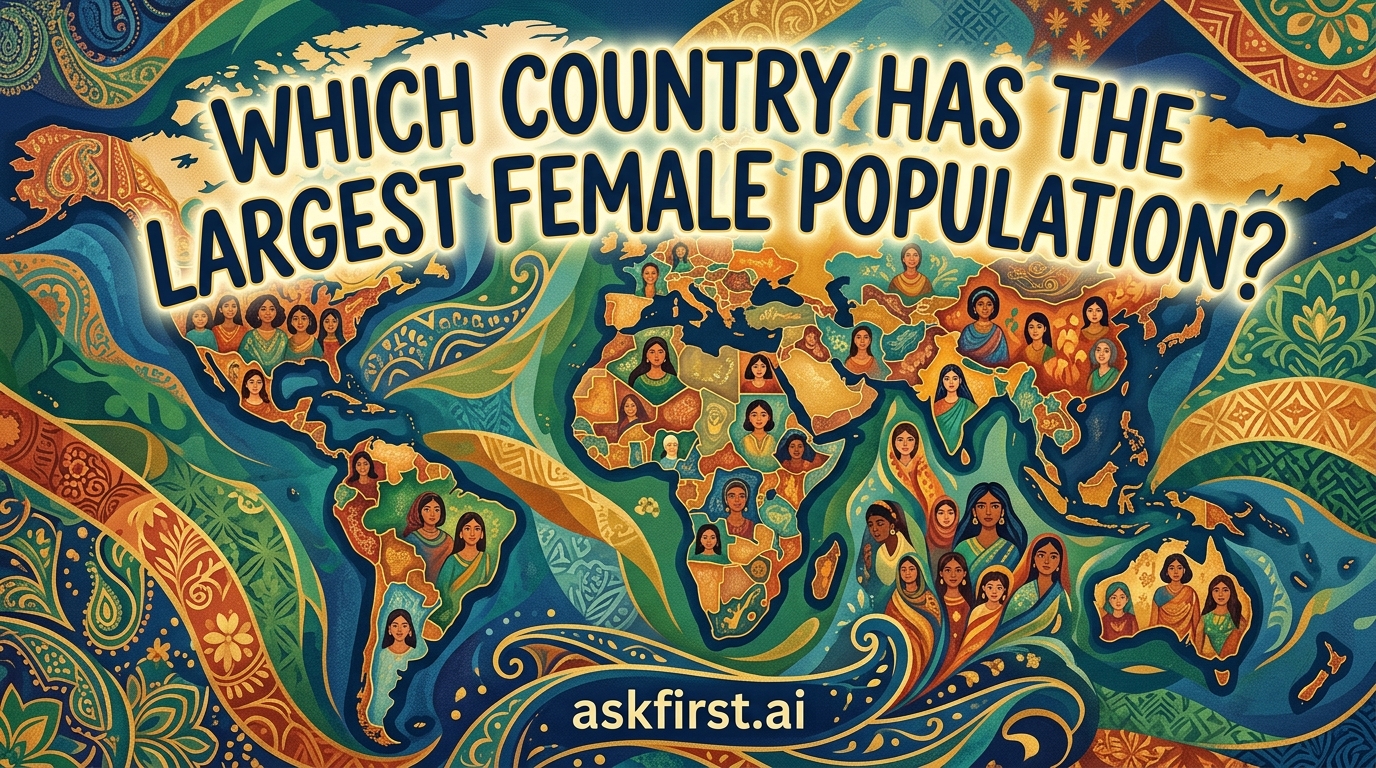
The Global Demographics of Gender: Identifying the Largest Female Populations
When analyzing global demographic trends, the question of which country hosts the largest female population is intrinsically linked to the overall size of a nation's citizenry. While ratios of men to women fluctuate due to cultural practices, life expectancy, and migration patterns, the sheer scale of the most populous nations dictates the answer. As of mid-2026, China and India remain the undisputed leaders in total population, and consequently, they hold the largest female populations on the planet.
The Statistical Dominance of China and India
For decades, China held the title of the world's most populous nation. However, demographic shifts tracked by the United Nations Department of Economic and Social Affairs (UN DESA) in their World Population Prospects reports have confirmed that India officially surpassed China in total headcount during 2023.
In India, the female population is estimated to be approximately 700 to 710 million. Despite historical challenges regarding sex ratios at birth—often discussed in works like Amartya Sen’s Development as Freedom, where he famously highlighted the "missing women" of Asia due to systemic gender bias—India’s massive demographic base ensures it maintains the highest absolute number of women.
China, conversely, maintains a female population of roughly 680 to 690 million. While China’s total population has begun a slow contraction due to low fertility rates and the long-term effects of the now-repealed "One Child Policy," the sheer size of its demographic pyramid ensures that it remains the second-largest repository of female inhabitants globally.
Factors Influencing Female Population Growth
To understand why these specific countries dominate the statistics, one must look at three primary drivers: total fertility rates, life expectancy, and sex ratios.
Life Expectancy: Biological reality dictates that, on average, women live longer than men across almost all human populations. According to the World Health Organization (WHO) in their World Health Statistics series, women generally enjoy a life expectancy advantage of five to seven years over men. In nations with large populations like India and China, this longevity "cushion" effectively inflates the female percentage of the total population, particularly in the elderly cohorts.
Sex Ratios at Birth: This is where the landscape becomes complex. In many South and East Asian nations, traditional cultural preferences for male children have historically skewed the sex ratio at birth. In his book Unnatural Selection: Choosing Boys Over Girls, and the Consequences of a World Full of Men, author Mara Hvistendahl details how modern technology has been used to alter birth ratios. However, as these nations modernize, these ratios have been slowly trending toward the biological norm of approximately 105 boys for every 100 girls.
Migration and Urbanization: While India and China have massive internal populations, other nations—such as the United States or Brazil—have significant female populations fueled partly by immigration. However, even with high immigration, these countries do not approach the raw numerical scale of the Asian giants.
The Global Context: Beyond the Top Two
While India and China occupy the top two spots, the rest of the top five is generally rounded out by the United States, Indonesia, and Pakistan.
- The United States: With a female population of approximately 170 million, the U.S. demonstrates how a developed economy maintains a stable, albeit much smaller, female demographic compared to the Asian giants.
- Indonesia: As the world’s fourth most populous country, Indonesia’s female population is growing steadily, driven by a younger median age and a more balanced sex ratio compared to its neighbors in East Asia.
It is vital to note that these figures are dynamic. The U.S. Census Bureau’s International Database provides regular updates that underscore how rapidly these numbers change. For instance, Nigeria is currently experiencing one of the fastest population growth rates in the world, and demographic projections suggest it will climb significantly in the global rankings for both total and female population by the year 2050.
Conclusion
The answer to which country possesses the largest female population is currently India, followed closely by China. These two nations are unique not just for their size, but for the profound impact they have on global gender statistics. While demographic trends in the West are defined by aging populations and declining birth rates, the sheer volume of human life in South and East Asia ensures that these regions remain the focal point of global demographic study.
As we look toward the future, the global distribution of the female population will continue to shift toward Africa and South Asia. For those interested in tracking these changes, the UN's World Population Prospects remains the gold standard for accurate, longitudinal data, providing the essential context required to understand how the world’s most significant demographic asset—its women—is distributed across the map.