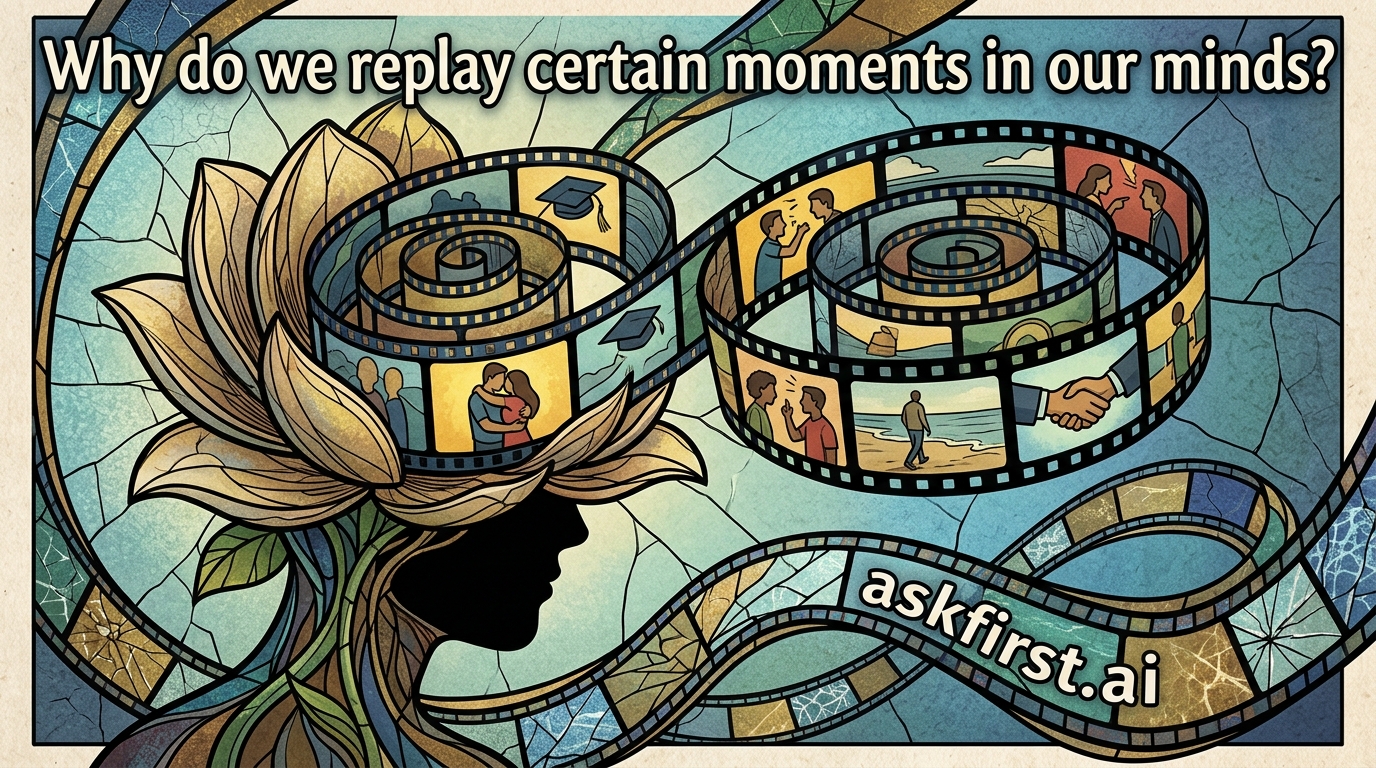
The phenomenon of mental rumination—the repetitive replaying of specific moments, conversations, or events—is one of the most complex features of human consciousness. While it often feels like a glitch in our cognitive programming, it is actually a sophisticated, albeit sometimes maladaptive, survival mechanism rooted in evolutionary psychology and neurobiology. To understand why we replay these moments, we must examine the interplay between memory consolidation, emotional regulation, and the brain’s constant search for predictive patterns.
The Evolutionary Imperative: The "Learning Loop"
From an evolutionary standpoint, the brain is designed to prioritize the retention of information that could impact future survival. When we experience an event—particularly one involving high stakes, social rejection, or physical danger—the amygdala (the brain’s emotional processing center) signals the hippocampus to "tag" that memory as high-priority.
In his seminal work, The Emotional Brain, neuroscientist Joseph LeDoux explains that the brain does not record memories like a video camera; rather, it reconstructs them. When we replay a moment, we are essentially running a simulation. By mentally revisiting a mistake or a traumatic interaction, the brain is attempting to "solve" the experience. It is asking a fundamental question: How could I have handled this differently to ensure a better outcome next time? This is known as the "Learning Loop." If we failed to read a social cue, our mind re-plays the conversation to analyze the nuance we missed, essentially practicing for future encounters.
The Role of the Default Mode Network (DMN)
Why do these replays often happen when we are trying to fall asleep or standing in the shower? This is due to the Default Mode Network (DMN). The DMN is a network of interacting brain regions that becomes active when the mind is at rest and not focused on the external environment.
According to research by Marcus Raichle, a pioneer in the study of the DMN, this network is responsible for autobiographical memory, thinking about others, and planning for the future. When we aren't occupied with a task, the DMN naturally shifts toward "self-referential processing." It pulls memories from the hippocampus and re-examines them. If a memory is emotionally charged—such as a moment of embarrassment or a significant achievement—the DMN is more likely to pull that file to the front of the queue, leading to the repetitive cycles of rumination we experience.
The "Zeigarnik Effect" and Unfinished Business
A significant portion of our mental replays stems from what psychologists call the Zeigarnik Effect. Named after Soviet psychologist Bluma Zeigarnik, this theory posits that people remember uncompleted or interrupted tasks better than completed ones.
If a conversation ended abruptly, or if we were unable to express our true feelings during a conflict, the brain perceives this as an "open loop." We replay the scene because, cognitively, it remains unresolved. The mind seeks "cognitive closure." Much like a computer program running in the background of an operating system, these unresolved emotional experiences consume mental RAM, forcing us to revisit the scene until the brain feels it has reached a resolution or a sense of understanding.
Emotional Regulation and Mood-Congruent Memory
We are also subject to "mood-congruent memory," a concept extensively documented by psychologist Gordon H. Bower. This principle suggests that our current emotional state acts as a filter for the memories we retrieve. If you are currently feeling anxious, your brain will preferentially retrieve memories of past mistakes or awkward social interactions that align with that anxiety.
This creates a feedback loop: the more you replay a negative event, the more your mood drops; the lower your mood, the more likely you are to replay other negative events. This is why "ruminative cycles" are so difficult to break. It is not just a recall of facts; it is a recall of the physiological state associated with those facts. You aren't just remembering what you said; you are re-experiencing the spike in cortisol and the racing heart that accompanied the original moment.
Strategies for Cognitive Integration
While replaying moments is natural, it can become detrimental if it morphs into chronic rumination. Psychologists like Susan Nolen-Hoeksema, in her book Women Who Think Too Much, emphasize that the goal is not to "stop" thinking, but to shift from ruminative, passive replaying to active, problem-solving reflection.
- Externalization: Writing down the memory can help move it from the fluid, chaotic realm of the mind to the concrete realm of language. This often helps the brain "close the file."
- Cognitive Reframing: Consciously asking, "What is the lesson here, and what can I change next time?" helps convert the energy of the replay into a productive outcome.
- Mindfulness: By focusing on the present sensory experience, we can quiet the DMN and break the cycle of mental time travel.
Conclusion
Replaying moments is a testament to the human drive for mastery. We are creatures obsessed with meaning, and our minds are constantly sifting through our personal archives to build a more robust, prepared version of ourselves. Whether it is a moment of profound joy or deep regret, the brain’s insistence on revisiting these scenes is an attempt to integrate the past into the future. By understanding that this is a biological function rather than a personal failing, we can learn to guide our mental processes toward reflection rather than mere repetition, ultimately gaining control over the internal narratives that shape our lives.