The Cognitive Science Behind the 'Norman Door' Phenomenon
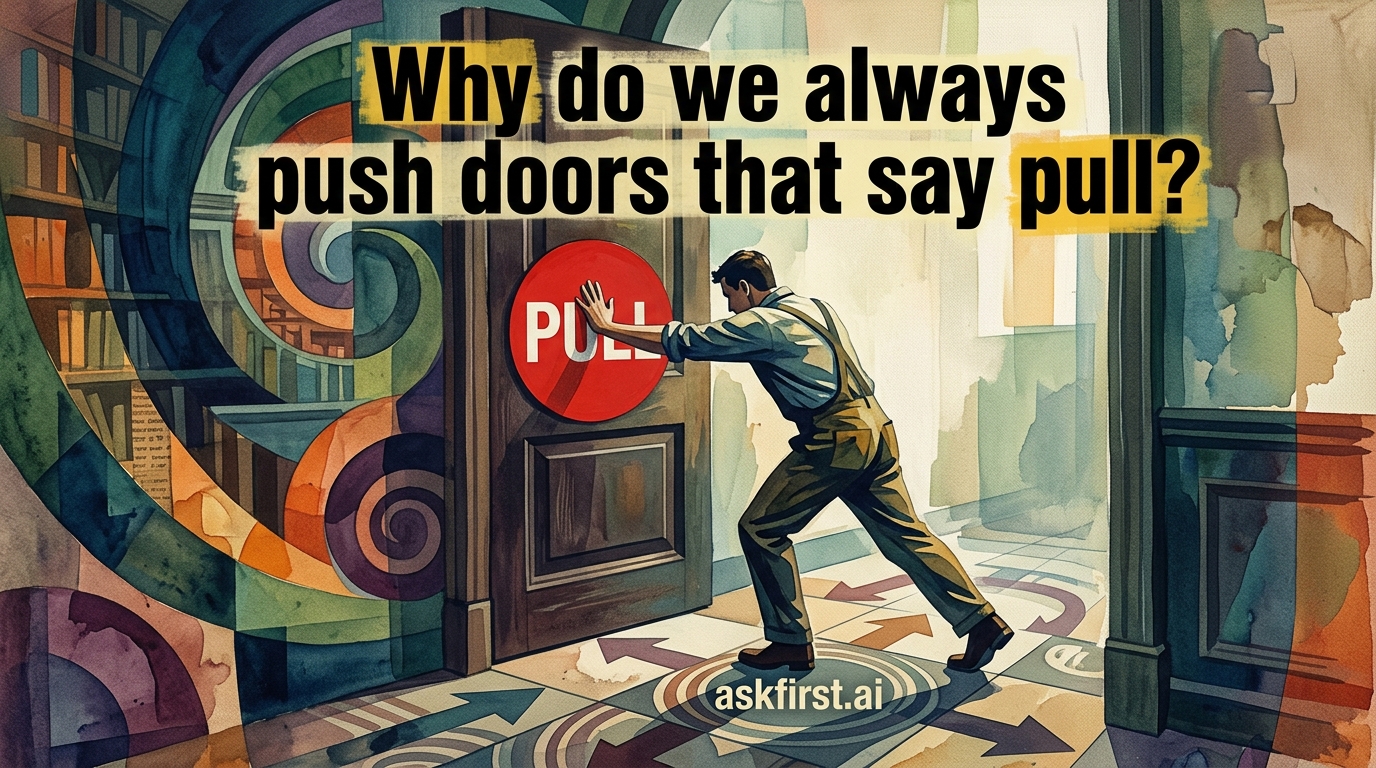
Human interaction with physical objects is governed by a subtle dance between learned habits, subconscious cues, and industrial design. The phenomenon of pushing doors marked 'pull'—or vice versa—is so prevalent that it has earned a specific nickname in the field of design: the 'Norman Door.' Named after cognitive scientist and usability expert Don Norman, these design failures highlight a fascinating gap between human perception and mechanical affordance. Understanding why this happens requires delving into the psychology of automatic behavior and the failure of visual communication.
The Role of Affordance and Signifiers
At the core of the problem lies the concept of affordance. In design theory, an affordance refers to the properties of an object that define how it can be used. A handle on a door provides an affordance for pulling; a flat plate provides an affordance for pushing. When a designer places a handle on a door that is meant to be pushed, they are providing a visual signal—a signifier—that contradicts the physical operation of the mechanism. The brain, processing millions of pieces of environmental data every second, relies on these visual shortcuts. When the mind sees a handle, it instinctively prepares the muscles for a pulling motion. The cognitive load required to stop and read a small, secondary sticker is often greater than the automated motor response triggered by the handle, leading to the infamous "push-pull error."
The Power of Habitual Behavior
Humans are creatures of habit, guided by a system often referred to in psychology as 'System 1' thinking. As described by Nobel laureate Daniel Kahneman, System 1 operates automatically and quickly, with little or no effort and no sense of voluntary control. Walking through a building is a low-attention activity. The brain effectively places the navigation task on autopilot. When an individual approaches a door, the brain uses past experiences to predict the interaction. Because the majority of door-opening experiences involve grasping a handle, the brain defaults to that schema. The signifier—the word 'pull'—requires 'System 2' thinking, which is slow, analytical, and effortful. If a person is distracted, tired, or in a hurry, they are significantly more likely to ignore the text and follow the heuristic of the hardware design.
The Evolution of Architectural Logic
Why do designers create these confusing entryways? Often, the blame lies in the conflicting requirements of architectural aesthetics versus building safety.
- Fire Safety Codes: In many jurisdictions, commercial buildings have strict exit requirements mandating that doors leading to the exterior must open outward for rapid evacuation during emergencies.
- Hardware Consistency: To maintain a uniform look throughout a lobby or hallway, an architect may choose identical handle hardware for every door, regardless of whether the door functions as an entrance or an exit.
- The Illusion of Symmetry: Modern architecture often favors clean, symmetrical lines. Placing a push-plate on one door and a handle on another can be viewed as aesthetically messy, leading designers to prioritize the visual 'cleanliness' of the space over the intuitive function of the hardware.
Can Design Fix the Flaw?
The solution to this common frustration is simpler than most realize: Eliminate the ambiguity through physical design cues. Expert designers suggest the 'Clearance Rule':
- Flat surfaces should be used exclusively for doors that require a push. A flat surface eliminates the 'grabbing' affordance entirely, leaving no room for manual error.
- Horizontal bars should be reserved exclusively for pushing.
- Vertical handles should be reserved exclusively for pulling.
When a door's physical form dictates its function, the need for written instructions disappears. If a user needs a label to tell them how to use a door, the design has inherently failed. This principle, known as 'poka-yoke' or 'mistake-proofing' in lean manufacturing, asserts that if a task can be done wrong, the system should be redesigned so that it cannot be done wrong in the first place.
Summary
The reason we push doors that say 'pull' is not a failure of intelligence or lack of attention; it is a testament to the power of environmental cues and the efficiency of human cognitive heuristics. The handle acts as a beacon for interaction, and when that beacon conflicts with a label, our automated motor systems frequently override our conscious processing. By moving toward intuitive, form-follows-function design, architects and building managers can minimize these micro-frustrations of daily life, creating spaces that feel natural, effortless, and perfectly synced with the way human beings actually move through the world.