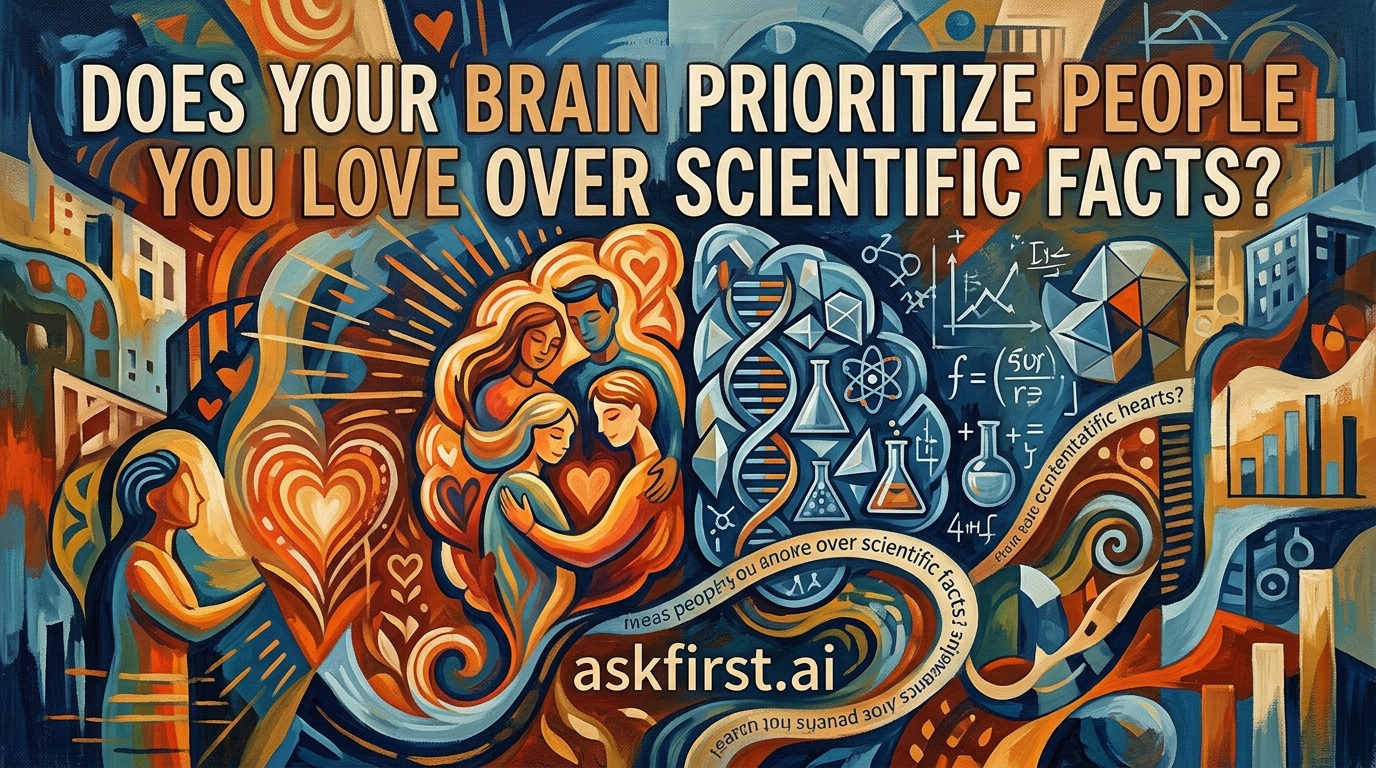
The human brain is an evolutionary masterpiece, yet it often operates through cognitive shortcuts that favor social cohesion over objective truth. When presented with the question of whether the brain prioritizes loved ones over scientific facts, the answer lies in the complex architecture of our neural pathways, specifically the competition between the prefrontal cortex—the seat of logic and analysis—and the limbic system, which governs emotional bonds and social survival. ### The Evolutionary Mandate for Social Bonds From an evolutionary perspective, human survival has never been achieved through individual prowess alone. Instead, survival was inextricably linked to the strength of social units. Being ostracized from a group meant a death sentence in ancestral environments. Consequently, the brain evolved to treat threats to social relationships with the same urgency as physical threats. When a core belief held by a loved one conflicts with a scientific fact, the amygdala may trigger a 'threat response' similar to encountering a predator. The brain prioritizes the preservation of the relationship because, in our deep evolutionary history, the maintenance of the group was the most reliable indicator of longevity. ### Neural Architecture and Cognitive Dissonance When an individual encounters information that contradicts the worldviews of their inner circle, they often experience a psychological state known as cognitive dissonance. This is the discomfort felt when holding two conflicting beliefs simultaneously. To resolve this tension, the brain often engages in motivated reasoning. Rather than objectively evaluating the scientific evidence, the brain unconsciously cherry-picks data or dismisses contradictory facts to maintain internal and social harmony. This is not necessarily an act of ignorance; it is a mechanism of self-preservation aimed at protecting one’s social standing within their 'tribe.' Research in social neuroscience suggests that when people are shown evidence that threatens their social identity or the opinions of those they trust, the areas of the brain involved in logic often show decreased activity, while areas associated with emotional processing show increased activation. ### The Role of Oxytocin and Attachment Mechanisms Neurobiology plays a significant role in this priority shift. Oxytocin, often referred to as the 'bonding hormone,' modulates our responses to social stimuli. High levels of oxytocin increase trust and empathy toward our 'in-group' while simultaneously increasing suspicion toward 'out-groups.' If a loved one is perceived as part of the primary in-group, the brain is neurochemically primed to view their perspectives as more valid or safer than dispassionate scientific data from an abstract, impersonal source. The biological reward system—releasing dopamine when we experience agreement or closeness with a partner—acts as a powerful reinforcement tool. Agreeing with a loved one produces a chemical 'reward,' whereas accepting a scientific fact that alienates that loved one produces a 'cost' in terms of lost social capital. ### Scientific Literacy vs. Emotional Loyalty It is critical to note that the prioritization of people over facts does not mean the brain is incapable of objective reasoning. Rather, it suggests that the brain is a 'situational' processor. In professional or academic contexts where social stakes are low, the brain functions quite well as a logical instrument. However, when the context shifts to interpersonal relationships, the priority is immediately reassigned to social maintenance. Studies in the field of science communication demonstrate that simply presenting people with more data often fails to change their minds if that data threatens their social identity. To effectively bridge the gap between scientific truth and personal belief, communicators often find more success by aligning facts with the values of the individual’s social circle rather than attacking their existing beliefs. ### Strategies for Cognitive Balance Developing a more balanced approach requires metacognition—the ability to 'think about our thinking.' Individuals can learn to identify when they are defaulting to an emotional, social-prioritization mode. By acknowledging that the brain is inherently designed to favor social bonds, one can create a 'buffer zone' when discussing facts. Key strategies include: * Delaying Judgment: Allowing time for the limbic system to calm down before responding to challenging information. * Seeking Perspective: Actively engaging with diverse groups to expand the definition of one's 'in-group.' * Separating Ideas from Identity: Cultivating a mindset where changing one's mind based on new data is seen as a sign of intellectual growth rather than a betrayal of one's circle. Understanding these mechanisms transforms our perception of why scientific consensus is often met with resistance. It is not an inherent hostility toward truth; it is a profound testament to the power of human connection. The brain prioritizes the people we love because, for the duration of human history, they were the very thing that ensured our existence in an unpredictable world. Ultimately, our intelligence is not just a tool for calculating variables; it is a social navigator designed to keep us connected, even if it requires a little cognitive gymnastics along the way.





Ask First can make mistakes. Check important info.
© 2026 Ask First AI, Inc.. All rights reserved.|Contact Us