The Psychology of Regret: Why Our Failures Outweigh Our Triumphs
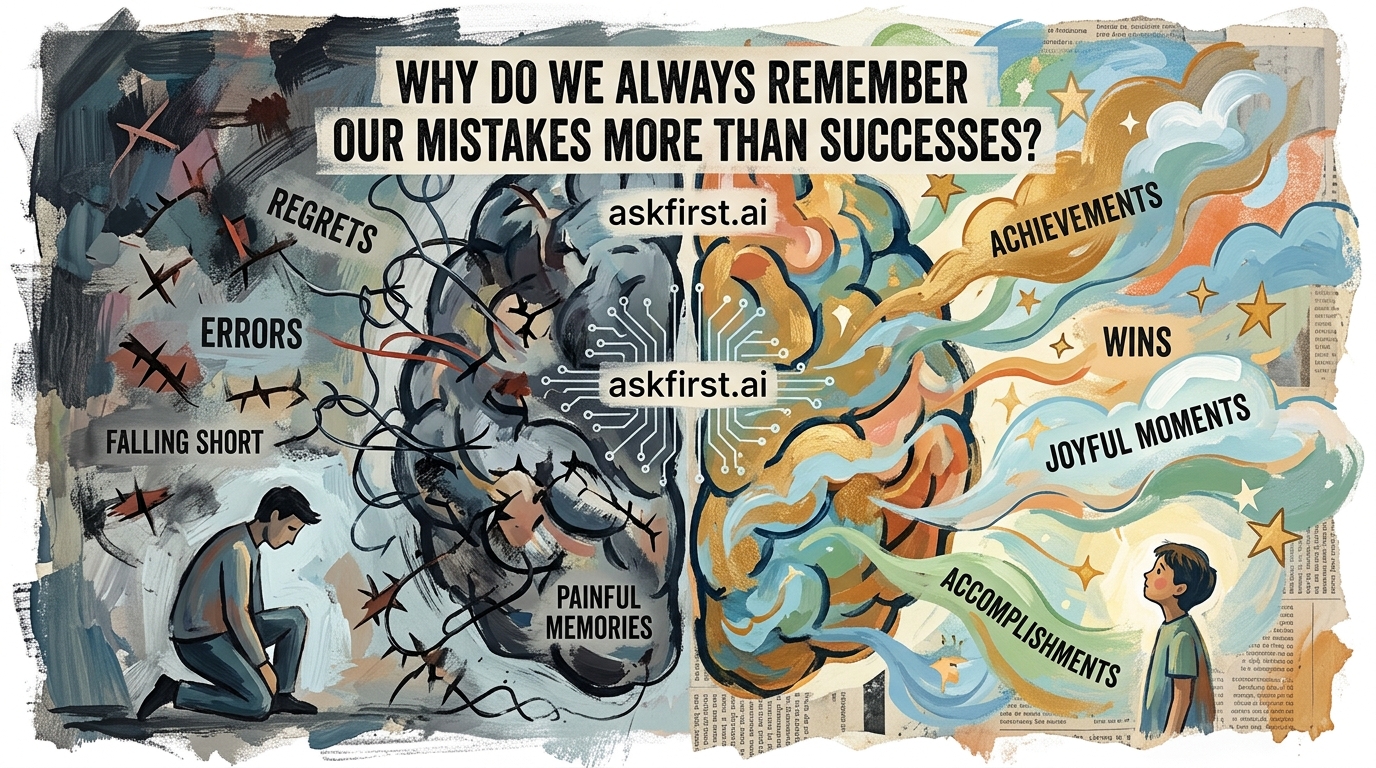
Human memory is not a neutral recording device; it is a selective, biased, and highly functional tool designed primarily for survival rather than for the objective cataloging of our life’s highlights. If you have ever found yourself lying awake at 3:00 AM, replaying a minor social blunder from five years ago while your greatest professional achievements remain conveniently tucked away in the shadows of your mind, you are experiencing a universal cognitive phenomenon. This asymmetry in memory—where mistakes and failures possess a significantly higher "emotional stickiness" than successes—is rooted in deep-seated evolutionary biology and complex psychological mechanisms.
The Evolutionary Imperative: The Negativity Bias
The most fundamental reason we prioritize mistakes is rooted in the Negativity Bias. Evolutionary psychologists, such as Dr. Roy Baumeister in his seminal paper Bad Is Stronger Than Good (published in the Review of General Psychology), argue that our ancestors who were hyper-attuned to threats and failures were significantly more likely to survive than those who focused on rewards.
In the ancestral environment, missing a meal was a minor setback, but failing to notice a predator or violating a social taboo that led to ostracization from the tribe meant certain death. Consequently, the human brain evolved to treat negative information—mistakes, insults, and dangers—as high-priority data. We are biologically hardwired to "over-learn" from our errors because, in a primal context, the cost of a mistake was absolute. Even in our modern, safer world, our amygdala remains primed to flag failures as "critical alerts," ensuring they are encoded with greater intensity and vividness than neutral or positive memories.
The Zeigarnik Effect and Cognitive Closure
Another crucial mechanism is the Zeigarnik Effect, a psychological principle named after Soviet psychologist Bluma Zeigarnik. Research conducted in the 1920s demonstrated that people remember uncompleted or interrupted tasks better than completed ones. When we succeed, we achieve a sense of "cognitive closure"—the task is done, the goal is reached, and the brain effectively "archives" the memory, moving on to the next objective.
Conversely, a mistake often represents an unresolved conflict or a disruption in our expected trajectory. Because the error remains "open" in our mental ledger, the brain keeps it active, constantly circling back to it in an attempt to find a solution or a lesson that might prevent future failure. This recursive processing cycle transforms a simple error into a persistent, high-definition memory. We aren't just remembering the mistake; we are mentally "debugging" it, which reinforces the neural pathways associated with that event.
The Role of Self-Concept and Identity
Our mistakes often clash with our desired self-image, creating a state of Cognitive Dissonance. As described by Leon Festinger in his foundational work A Theory of Cognitive Dissonance, humans have an innate drive to maintain internal consistency. When we perform well, it aligns with our positive self-view, and we accept it as "normal." However, when we err, it threatens our identity.
To resolve this conflict, we obsess over the mistake, analyzing why it happened and how it contradicted our perception of ourselves. This intense internal dialogue serves as a form of "identity protection." By ruminating on the error, we are attempting to reconcile the failure with our self-worth. In contrast, successes are often attributed to external factors (luck, help from others) or simply accepted as a baseline expectation, leading to what psychologists call the "hedonic treadmill"—where we quickly adapt to our successes and return to a neutral emotional state, rendering them less memorable over time.
Social Pain and Neurobiology
Neuroscientific studies, such as those conducted by Dr. Naomi Eisenberger at UCLA, have shown that social rejection and the shame associated with public mistakes activate the same neural pathways as physical pain. When we make a mistake in a social setting, the brain treats the incident as a physical injury. Because the brain is designed to prevent pain, it creates a "pain memory" to ensure we avoid repeating the behavior that caused the injury.
Think of a time you misspoke during a presentation or accidentally offended a friend. The visceral feeling of embarrassment is a biological alarm system. Because the brain associates that memory with the "pain" of rejection, it keeps the memory easily accessible. It is a protective mechanism, albeit one that often manifests as chronic rumination.
Conclusion: Reframing the Archive
While it is frustrating to be plagued by the ghosts of past blunders, this tendency is a testament to the brain’s relentless pursuit of improvement. We do not remember our mistakes because we are flawed or overly self-critical; we remember them because our biology prioritizes the "data of failure" as the most effective tool for long-term adaptation.
To mitigate the weight of these memories, it is helpful to recognize them for what they are: not reflections of your character, but high-priority neural "learning files." By consciously acknowledging the lesson and "closing the file," we can transition from passive rumination to active growth, allowing our successes to occupy as much mental real estate as our failures. We are, quite literally, the sum of what we have survived, and our mistakes are the most rigorous teachers we will ever encounter.