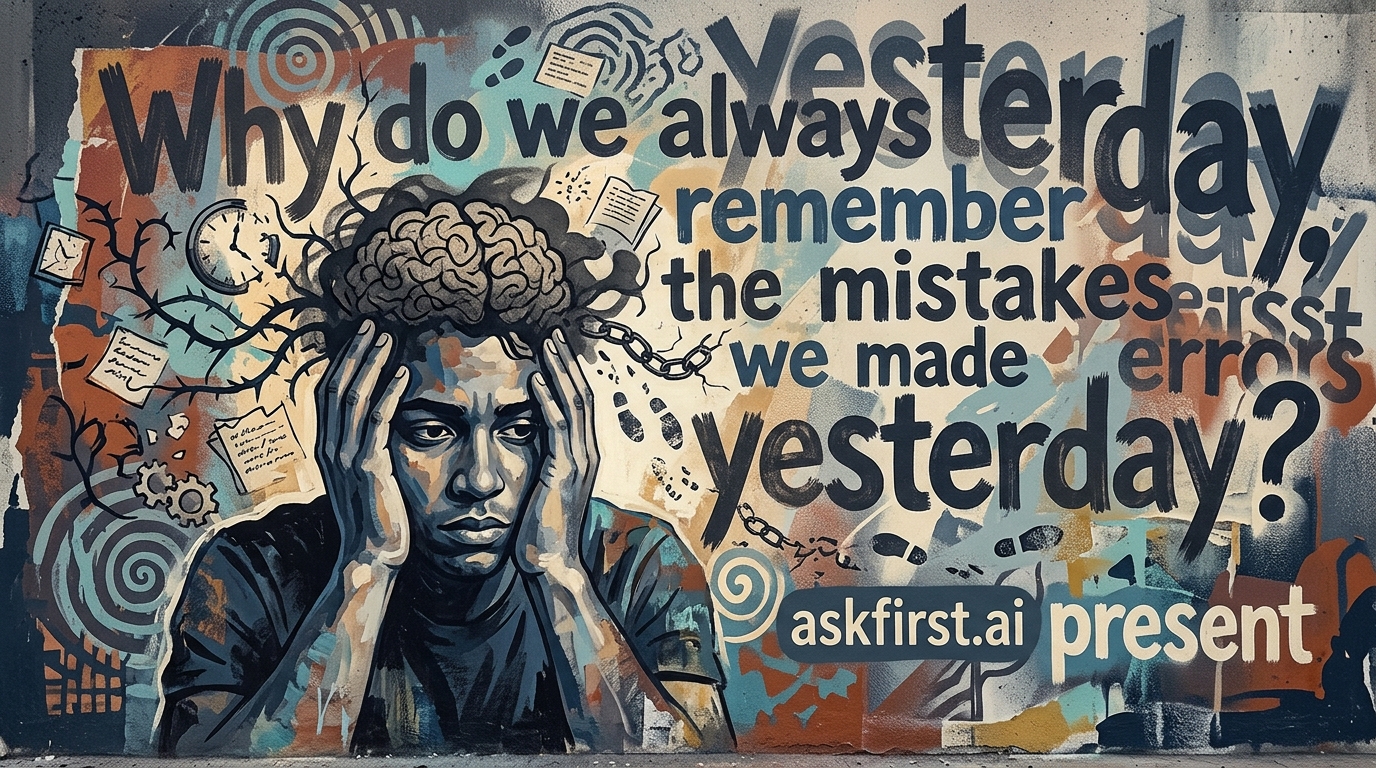
The Evolutionary Science of Ruminating on Errors
The human brain is not designed for happiness; it is designed for survival. When an individual reflects on mistakes made yesterday, they are engaging in a sophisticated neurological process often misunderstood as mere self-criticism. In reality, this is the brain's internal 'Learning Management System' working in overdrive. The tendency to focus on errors is known as the Negativity Bias, a cognitive phenomenon where negative experiences carry significantly more weight than positive ones. This is not a personal failure, but an evolutionary adaptation inherited from ancestors who needed to remember which berries were poisonous to survive the next day.
Neuroplasticity and the Error Detection Signal
The brain utilizes specialized neural circuits to monitor performance. When a mistake occurs, the Anterior Cingulate Cortex (ACC) fires an 'Error-Related Negativity' (ERN) signal. This signal acts like an alarm, alerting the brain to discrepancies between expected outcomes and actual results.
- High Alert Status: Because the brain prioritizes survival, it categorizes these 'alarm signals' as high-priority data points.
- Consolidation: During sleep, the hippocampus processes these emotional memories, 'replaying' the sequence of events to refine future decision-making paths.
- Neural Pruning: By intensely focusing on why a mistake happened, the brain strengthens the synaptic pathways associated with avoiding that specific error in the future.
The Zeigarnik Effect: Why Unfinished Business Haunts Memory
Psychology explains why certain mistakes feel 'stuck' in the conscious mind. The Zeigarnik Effect states that individuals remember uncompleted or interrupted tasks better than completed ones. A mistake often represents an 'unfinished' psychological loop—the individual has not yet reached a state of 'resolution' regarding the error. Because the outcome of the mistake felt suboptimal, the brain refuses to file it away as 'closed,' keeping it active in working memory to find a better, more successful conclusion.
Reframing the Mistake as 'Data Mining'
Rather than viewing persistent memories of yesterday’s errors as ruminative anxiety, top performers and neuroscientists suggest viewing them as high-value data sets. If the brain ignores a mistake, the probability of repeating that error increases. By consciously reviewing the mistake, the individual converts raw experience into wisdom.
To effectively utilize this biological tendency, consider the following strategies:
- Objective Analysis: Remove the emotional charge. Ask: 'What specific input led to this output?' instead of 'Why am I like this?'
- Contextual Mapping: Identify the environment where the mistake occurred. Was it during a period of low glucose or high stress?
- The 'Three-Step' Refinement: Define the error, analyze the cause, and create a binary rule to prevent recurrence.
The Role of Social Cognition
Social environments also play a massive role in why we dwell on errors. Humans are inherently social creatures, and the fear of social judgment—the 'Spotlight Effect'—causes us to overestimate how much others noticed our mistakes. The brain remembers yesterday’s social faux pas because it views social exclusion as a physical threat. In ancestral times, being ostracized from the tribe meant immediate danger. Consequently, the brain keeps those social mistakes in high definition to ensure one remains a valued member of the group.
Moving Beyond the Loop
The goal of understanding this process is not to eradicate memory, but to master it. Once the brain understands that the 'lesson' has been properly learned and archived, the urgency of the ruminative loop naturally fades. When a memory of a past mistake appears, label it as a 'system update.' Recognize that the brain is simply reviewing its internal code to optimize performance for future challenges.
By shifting the focus from the emotional pain of the mistake to the functional utility of the memory, one transitions from being a passive victim of cognitive bias to an active architect of personal development. The persistent nature of these thoughts is, at its core, a sign of a brain striving for excellence, constantly adjusting the trajectory of behavior toward a more successful, efficient version of the self.