The Cognitive Mechanics of Imaginary Dialogue
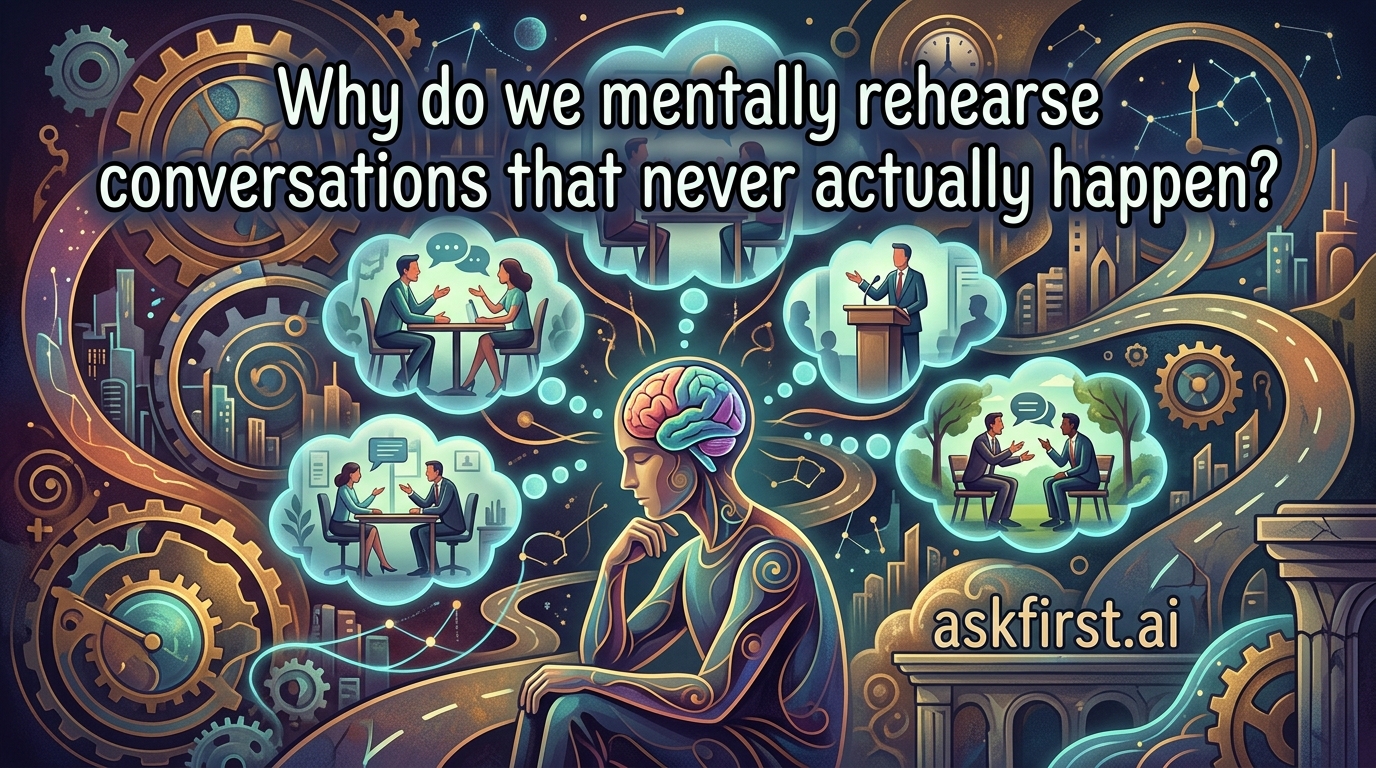
Mentally rehearsing conversations that never occur is a common psychological phenomenon known as anticipatory processing. This behavior serves as a complex cognitive strategy designed to navigate the uncertainties of social interaction. At its core, the human brain is a prediction machine. It constantly seeks to minimize surprise by simulating future scenarios, a process often referred to as 'proactive thinking.'
The Evolutionary Advantage of Simulation
From an evolutionary standpoint, the ability to play out potential social encounters offers a significant survival advantage. Humans are inherently social beings; success in human societies has historically depended on effective communication, coalition building, and the avoidance of social conflict. By running 'what-if' scenarios, the brain evaluates potential outcomes of verbal exchanges without incurring the real-world costs of a social blunder. This allows for the refinement of arguments, the preparation of emotional responses, and the mitigation of social risk. According to theories in evolutionary psychology, individuals who could anticipate and prepare for high-stakes interactions were more likely to maintain status and social cohesion.
The Role of Working Memory and Executive Function
This phenomenon relies heavily on the phonological loop, a component of working memory that handles auditory information and verbal rehearsal. When people engage in these imaginary conversations, they are utilizing executive functions to manipulate complex social variables within the prefrontal cortex. The brain creates a surrogate environment where a person can play both the roles of the self and the interlocutor. This dual-role simulation allows for the testing of diverse interaction styles and helps in predicting the emotional reactions of others, effectively creating a safe laboratory for social mastery.
Why the Mind Remains Obsessed with Unseen Scenarios
There are several psychological drivers for why these rehearsed conversations feel so compelling and why they often never materialize in reality:
- The Desire for Control: Life is inherently unpredictable. Mentally rehearsing allows individuals to impose order and predictability onto chaotic future events.
- Emotional Regulation: These rehearsals are often fueled by the need to manage anxiety. By 'living through' a potential conflict in the mind, the brain may experience a reduction in cortisol levels or provide a sense of preparedness that lowers baseline anxiety.
- Social Scripting: These conversations act as a form of cognitive training, building 'social scripts' that increase fluency and comfort during real-time communication.
The Myth of Pure Planning
While often viewed as unproductive daydreaming, this activity is actually a form of cognitive appraisal. However, it is important to note the counter-intuitive reality: these mental rehearsals often fail to mirror actual human interaction. When a person finally enters the real-world conversation, the other party rarely follows the 'script' created in the mind. This leads to what psychologists call the 'unexpected interaction gap.' Despite this, the brain persists in the habit because the act of planning provides a subjective feeling of competence, regardless of whether the specific scenario unfolds.
Managing the Cognitive Load
While normal, excessive rumination on imaginary conversations can lead to 'mental fatigue.' When these rehearsals become persistent, they can transition into a cycle of overthinking, sometimes fueling social anxiety rather than resolving it. Strategies to manage this include:
- Mindfulness Techniques: Practicing presence helps transition the brain from the 'future-oriented' simulation mode to the current reality.
- Productivity Framing: Acknowledging the mental rehearsal as a tool for planning and then explicitly 'closing' the file once the preparation is deemed sufficient.
- Reframing Uncertainty: Accepting that spontaneity is an inherent and healthy part of human interaction, rather than something that must be fully scripted.
Conclusion: The Brain as a Perpetual Architect
Ultimately, the brain's tendency to rehearse imaginary conversations is a testament to its drive to master the social landscape. It is not a sign of irrationality, but rather a reflection of the sophisticated neural architecture dedicated to social navigation. By simulating potential conversations, the mind is attempting to build a world where the outcome of every interaction is known, safe, and controlled. Even if these rehearsals never result in actual spoken words, they represent a significant investment in personal and social competence, ensuring that we are perpetually ready for the unpredictability of human connection.