The Mechanism of Sensory Adaptation
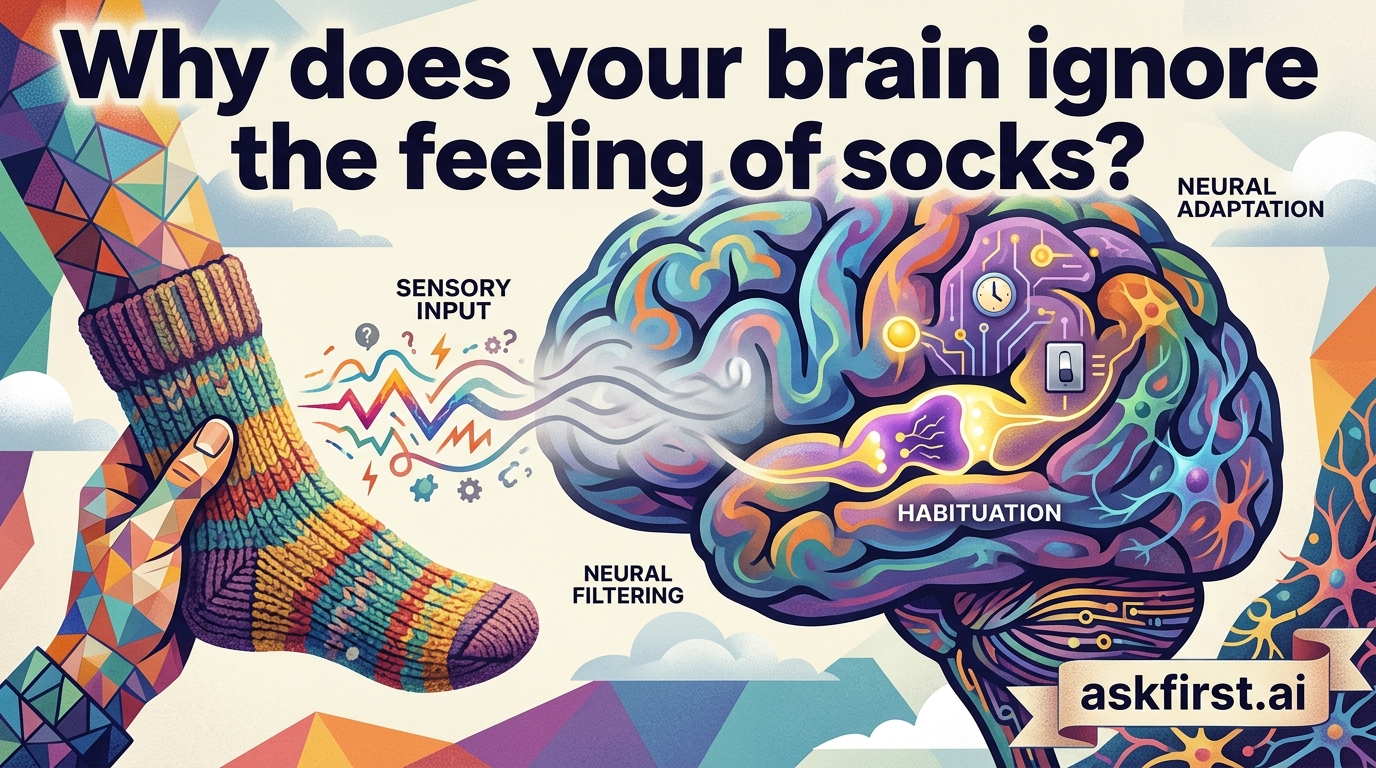
At the core of the human experience lies a sophisticated neurological process known as sensory adaptation (or neural adaptation). This phenomenon serves as the brain's primary filter, allowing humans to navigate an environment saturated with constant stimuli. When one puts on a pair of socks in the morning, the brain initially registers the tactile input—the friction against the skin, the tightness of the elastic, and the texture of the fabric. However, within minutes, this sensation fades into the background. This is not because the nerve endings in the feet have stopped firing, but because the brain has decided that the information is no longer vital to survival or immediate action.
The Biological Purpose: Why Efficiency Matters
The brain is an energy-demanding organ, consuming roughly 20 percent of the body's total energy budget. To conserve resources, it prioritizes change over constancy. If the sensory input remains unchanged—meaning the socks are not moving, tearing, or burning the skin—the brain categorizes the stimulus as 'background noise.' By dampening the signals from unchanging stimuli, the brain maintains sensitivity to new, potentially dangerous, or significant changes in the environment. This evolutionary trait ensures that if a mosquito lands on an ankle or a pebble slips into a shoe, the brain instantly shifts its focus to that new sensation, effectively 'waking up' the awareness of the feet.
The Role of Habituation
Habituation is a specific form of learning where the organism ceases to respond to a stimulus after repeated or prolonged exposure. In neuroscience, this is often explained through the fatigue of synaptic responses. When neurons are constantly stimulated by the same pressure, they eventually become less responsive. This process occurs at multiple levels of the central nervous system, from the peripheral receptors in the skin to the thalamus and finally the somatosensory cortex.
- Peripheral Receptors: Mechanoreceptors in the skin, specifically Pacinian corpuscles and Meissner's corpuscles, detect pressure and vibration. While they respond vigorously to the initial contact, their firing rate drops rapidly unless the stimulus changes.
- The Thalamus: This region acts as the brain's 'gatekeeper.' It filters incoming sensory data before it even reaches the conscious parts of the brain. If the thalamus detects that a signal is repetitive and predictable, it throttles the transmission of that signal.
- Cortical Processing: By the time the signal reaches the somatosensory cortex—where 'feeling' is actually processed—the input has been significantly smoothed out. The brain effectively creates a 'static model' of the socks, allowing conscious attention to focus on higher-order tasks.
The 'Static Filter' Hypothesis
Imagine the brain as a high-performance computer. If the computer spent 100 percent of its processing power acknowledging the constant presence of a desktop wallpaper, it would have little power left to run applications. Similarly, the brain creates a mental model of the body in space. Once the 'socked' state is confirmed to be safe and standard, the brain updates its internal map of the body. It essentially 'subtracts' the sensation of the socks from the conscious experience.
Can We Bypass This Filter?
The answer to why we suddenly 'feel' our socks again is equally fascinating. If the fabric bunches up or slides down, the change in pressure alerts the mechanoreceptors, which immediately resets the sensory filtering process. This reminds us of a concept known as Active Inference, where the brain predicts incoming sensory data. When the reality of the sensation matches the prediction (that the socks are there), the perception vanishes. When the reality deviates from the prediction (the sock slips), the prediction error triggers a burst of neural activity, forcing the sensation back into our conscious awareness.
Broader Implications of Neural Adaptation
This phenomenon is not limited to clothing. It explains why one becomes 'nose blind' to the scent of their own home, why one eventually stops hearing the hum of a refrigerator, and why glasses seem to disappear from the face. It is a fundamental testament to human adaptability. Without sensory adaptation, the human mind would be overwhelmed by the sheer volume of sensory input, leading to sensory overload and an inability to focus. By ignoring the mundane, the brain preserves its capacity for complex thought, allowing us to thrive in an unpredictable world.
In essence, the next time you realize you have forgotten you are wearing socks, consider it a victory of your neurological architecture. Your brain is functioning exactly as it should: prioritizing novelty, ensuring efficiency, and shielding your consciousness from the mundane reality of being surrounded by fabric.