The Paradox of Rational Ignoring: Understanding Cognitive Resistance
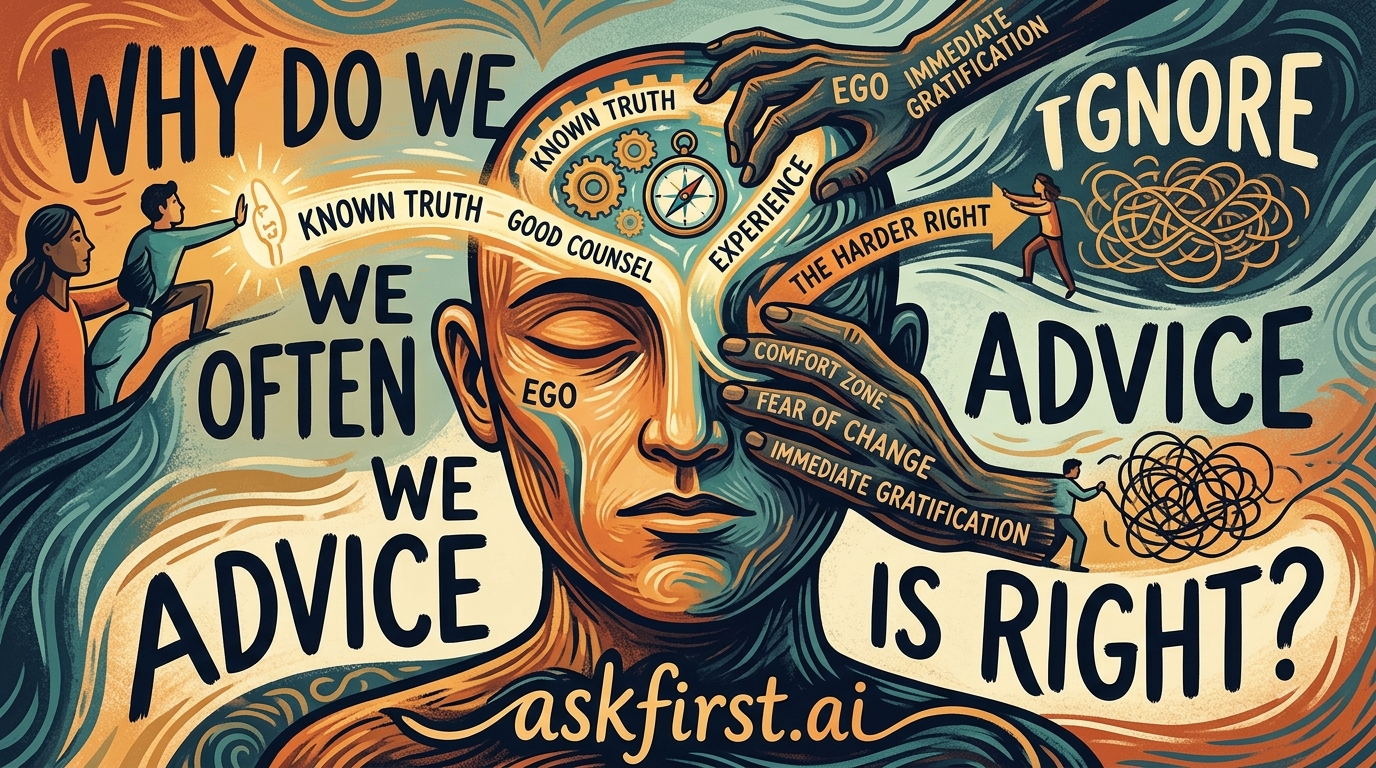
Human behavior is frequently characterized by a fascinating paradox: the possession of sound, life-improving advice paired with a stubborn inability to act upon it. This phenomenon, often termed 'advice resistance' or the 'knowing-doing gap,' stems from a complex interplay of evolutionary psychology, neurological wiring, and the pursuit of individual agency. When people ignore guidance that they intellectually acknowledge as correct, they are rarely behaving irrationally in their own minds; rather, they are navigating a dense forest of competing internal motivations and cognitive biases.
The Need for Autonomy and Psychological Reactance
A primary driver of advice rejection is the psychological phenomenon known as reactance. According to social psychologist Jack Brehm, individuals possess a deep-seated need for autonomy. When someone offers advice—even excellent advice—it can be perceived as an encroachment upon personal freedom or a subtle challenge to one's competence. If a person feels pushed into a decision, their brain instinctively pushes back to restore a sense of self-governance. Consequently, the act of rejecting the advice becomes a mechanism to affirm one's independence, even if that rejection results in a suboptimal outcome.
Cognitive Dissonance and Ego Protection
The brain is wired to maintain a consistent self-image. When an external suggestion highlights a flaw in a person's current strategy or behavior, it creates cognitive dissonance. This is a state of mental discomfort caused by holding two conflicting beliefs or facing evidence that contradicts one’s self-conception. To alleviate this distress, individuals often default to discounting the source of the advice or rationalizing why the advice, while 'generally' good, does not apply to their unique, specific circumstances. This protective mechanism allows individuals to avoid the painful process of admitting past errors or the effort required to change established habits.
The Cost of Implementation and Hyperbolic Discounting
There is often a significant disconnect between the long-term value of advice and the immediate cost of implementation. In behavioral economics, the principle of hyperbolic discounting explains that humans consistently prefer smaller, immediate rewards over larger, delayed ones. Sound advice almost always requires an upfront 'payment' in the form of effort, time, or emotional discomfort. Even if the 'correct' advice promises a massive long-term benefit, the human brain is evolutionarily predisposed to prioritize current comfort over future gain. When a person ignores advice to save money or improve health, they are not necessarily rejecting the logic; they are prioritizing their current emotional equilibrium.
Status Quo Bias and the Comfort of Routine
Human beings are habitual creatures. Status Quo Bias describes the emotional preference for the current state of affairs. Existing habits, even those recognized as detrimental, provide a sense of psychological safety. Changing these patterns requires significant cognitive energy—a process the brain constantly tries to minimize through 'heuristics' or mental shortcuts. Adopting new, 'correct' advice necessitates the abandonment of these established routines, which feels inherently risky and taxing. The brain interprets the status quo as the 'known' and, therefore, the safe environment, while change is categorized as an 'unknown' variable that could potentially be dangerous.
The Source-Message Gap
Interestingly, the delivery of the advice is often as important as the content itself. Research into persuasion indicates that we are highly sensitive to the social status and perceived empathy of the advice-giver. If the messenger is viewed as condescending or detached, the recipient is more likely to ignore the advice, regardless of its objective accuracy. This is a form of social navigation where the message is discarded to prevent a perceived social hierarchy from being imposed upon the receiver.
Practical Strategies for Overcoming Resistance
To bridge the gap between knowing and doing, one must engage in meta-cognitive reflection:
- Seek Self-Generated Solutions: Instead of asking for advice, ask for frameworks that allow you to reach your own conclusions. This preserves autonomy and minimizes reactance.
- Deconstruct the Ego: Recognize that the feeling of defensiveness is a signal, not a fact. When advice makes you uncomfortable, ask, 'What part of this am I afraid to address?'
- Incremental Change: Break down correct advice into tiny, non-threatening steps. By reducing the 'cost' of implementation, you bypass the brain's resistance to large, sudden changes.
- The Perspective Shift: Frame the advice as a tool for self-mastery rather than an instruction from an external authority. By 'owning' the change, you align it with your internal values.
Understanding that this resistance is a universal human trait is the first step toward reclaiming agency. By identifying the psychological barriers at play—whether they are rooted in the need for control, the comfort of habits, or the avoidance of discomfort—individuals can begin to transform that 'correct' advice into actionable, life-enhancing change. Growth, ultimately, is not just about knowing what to do, but about intentionally choosing to ignore the brain's internal impulse to remain static.