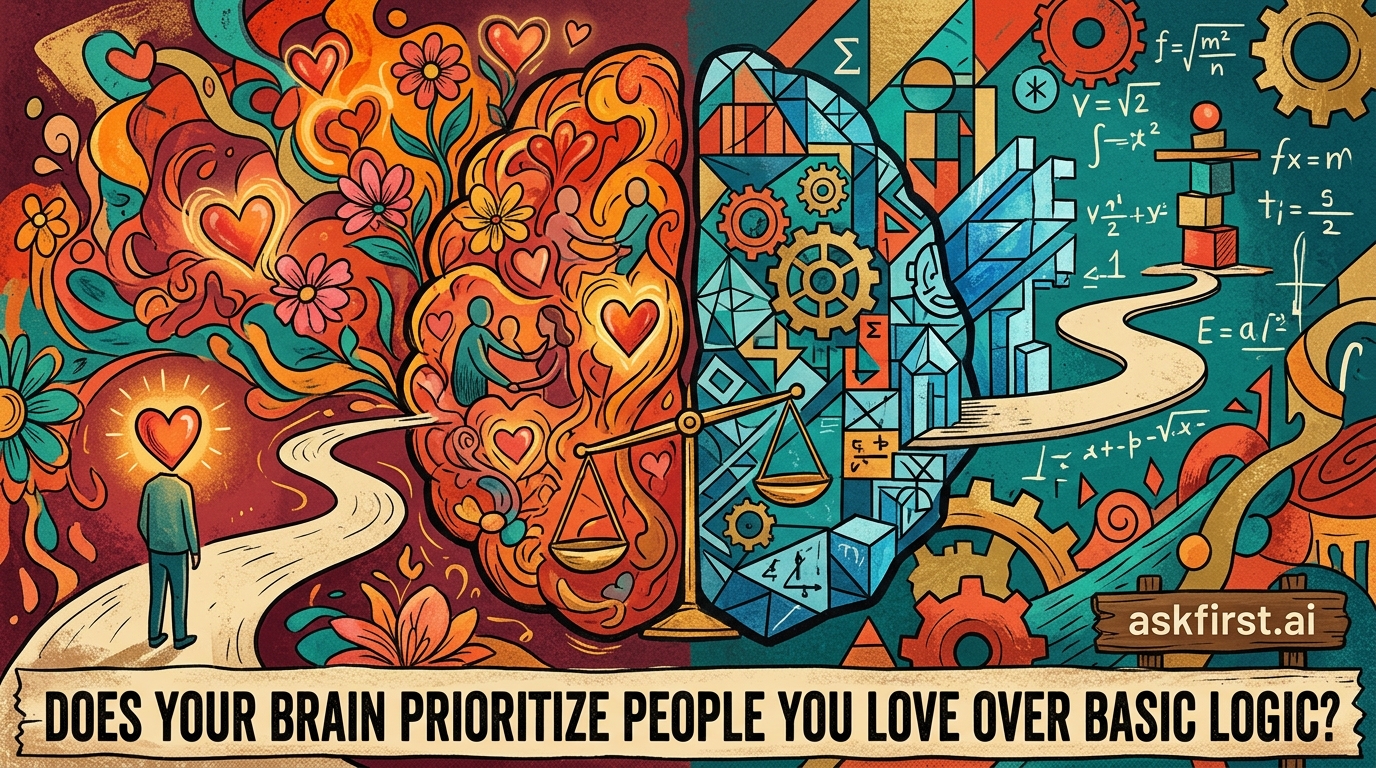
The Neurobiology of Affection and Reasoning
When faced with a decision involving a loved one, the human brain often pivots away from cold, analytical logic in favor of emotional prioritization. This phenomenon is not a failure of intelligence but a sophisticated evolutionary adaptation centered on survival, attachment, and the preservation of social bonds. Neuroscientific research, particularly regarding the ventromedial prefrontal cortex (vmPFC), suggests that our biological hardware is wired to integrate emotional valence with decision-making processes, often making love a primary filter for logic.
The Anatomy of Attachment
At the core of this prioritization is the limbic system, specifically the amygdala and the hypothalamus. When an individual interacts with a person they deeply love, the brain releases a cascade of neurochemicals such as oxytocin and dopamine. These substances create a biological feedback loop that reinforces trust and attachment. Studies on romantic and parental love have shown that these specific areas of the brain show diminished activity when evaluating loved ones critically. Essentially, the neural circuitry used to analyze risks becomes dampened, which is why "love is blind" is not just a poetic idiom but a biological reality.
The Conflict Between Logic and Love
Logic resides primarily in the dorsolateral prefrontal cortex (dlPFC), the area responsible for executive function and objective reasoning. However, when the brain processes information about a loved one, the vmPFC—a region that bridges emotional information with logical processing—tends to override the dlPFC.
- The In-Group Bias: Evolutionarily, prioritizing one’s kin or partners was essential for tribal survival. Protecting the group meant survival, even if it meant disregarding individual or objective safety.
- Reward Processing: Dopamine pathways reward the individual for behaviors that strengthen social bonds. Prioritizing logic over a loved one often triggers a sense of psychological discomfort or 'cognitive dissonance'.
Can Logic Ever Win?
While the biological urge to prioritize loved ones is powerful, the human brain is also highly neuroplastic. It is possible to cultivate what psychologists call emotional regulation and metacognition.
- Reframing Perspectives: By consciously stepping back from a situation, individuals can recruit the dlPFC, allowing for a more analytical assessment of reality.
- External Audits: Seeking objective opinions from third parties helps bypass the brain's internal emotional biases.
- Recognizing Bias: Simply being aware that the brain is hardwired to favor loved ones helps individuals pause before making life-altering decisions.
The Role of Social Cognition
Social cognition allows humans to navigate complex relationships. It involves Theory of Mind, the ability to attribute mental states to oneself and others. Because we rely on loved ones to navigate the world, the brain views these individuals as extensions of the self. Research in social psychology suggests that the 'self-other overlap'—where the neural representation of a close other becomes similar to the representation of the self—is the reason why logic becomes secondary. If you perceive your partner’s wellbeing as your own, logic dictates that you protect them as you would your own body.
Why This Remains an Evolutionary Advantage
While this mechanism can lead to errors in judgment, it is fundamentally an advantage. Without the capacity to prioritize loved ones above detached logic, social cohesion would crumble. Societies thrive on cooperation and self-sacrifice, behaviors that are often logically irrational but emotionally necessary. The brain is not 'wrong' to prioritize love; it is simply operating on an operating system designed for human connection rather than computer-like optimization.
Conclusion
Ultimately, the brain does not distinguish between 'logic' and 'love' as separate, non-overlapping functions. Instead, it embeds emotional weight into every logical conclusion. Recognizing that the brain naturally biases toward loved ones is the first step toward a healthier balance. By embracing this biological reality, one can move through life with both deep affection and a steady, objective hand, understanding that the human experience is most rich when logic and love are allowed to dance together rather than compete for dominance.