The Phenomenon of Temporal Compression
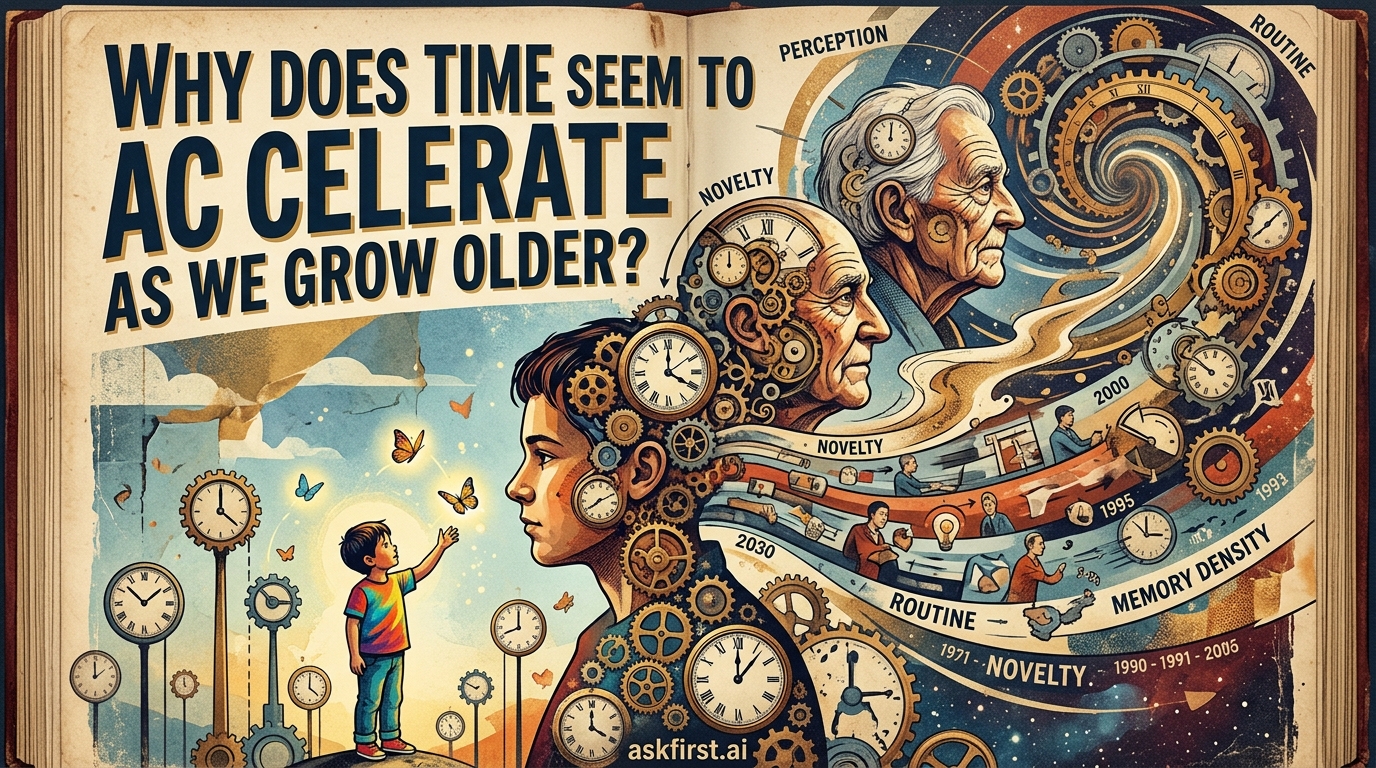
The subjective experience of time moving faster as one ages is a pervasive human observation, often referred to as the 'Holiday Paradox.' When children experience life, every event is a novel encounter. Because the brain has no pre-existing schemas for these experiences, it must record them with high resolution and significant neural resources. As an individual matures, life becomes increasingly routine. The brain, functioning as an energy-efficient biological computer, stops recording every detail of the familiar commute or the repetitive workday. Instead, it utilizes neural shortcuts, or 'chunking,' which leads to a decrease in memory density. When one looks back, there are fewer distinctive markers, making a year feel like a mere moment.
Psychological and Neurological Mechanisms
1. The Proportional Theory:
Proposed by Paul Janet in 1877, this theory suggests that our perception of time is relative to our total lifespan. For a five-year-old, a single year represents 20% of their entire existence. The magnitude of this experience creates a vast internal timeframe. Conversely, for a fifty-year-old, a year accounts for only 2% of their life, causing the brain to perceive it as a much smaller, faster interval. This mathematical relationship explains why early life feels like an endless expanse while later adulthood seems like a blur.
2. The Neural Coding Hypothesis:
As humans age, the speed at which neural images are acquired and processed slows down. Neuroscientists like Adrian Bejan argue that the physical degradation of neural pathways and the increase in the complexity of these pathways leads to a reduction in the rate at which sensory input is processed. Because the brain records 'fewer frames' per second as it ages, the perceived duration of a specific timeframe naturally feels shorter.
The Impact of Novelty and Engagement
Novelty serves as a primary driver for the expansion of temporal perception. When engaging in new activities, such as traveling to an unknown country or learning a complex skill, the brain is forced into a state of high awareness. This increased cognitive load causes the mind to 'stretch' time. To mitigate the feeling of accelerated aging, experts suggest the following strategies:
- Active Learning: Regularly acquiring new skills forces the brain out of its 'automatic' processing mode.
- Environmental Variation: Changing one’s physical or social environment prevents the brain from creating repetitive memory chunks.
- Mindful Reflection: Taking time to process daily experiences in detail helps the brain create richer, more durable memory imprints.
The Role of Dopamine and Emotional Intensity
Emotional arousal, particularly the release of dopamine, plays a significant role in how we perceive the duration of events. High-arousal states—whether characterized by excitement, joy, or intense focus—can cause the perception of time to dilate. When a person is deeply engaged in a pursuit, the brain processes information with heightened precision. In contrast, low-arousal, repetitive states result in a 'time-dilution' effect, where the brain effectively skips over the mundane, leading to the sensation that the week simply disappeared.
Practical Implications for Lifelong Fulfillment
Understanding the science behind time acceleration allows individuals to consciously reclaim their subjective sense of time. By intentionally breaking routines, individuals can force the brain to capture new, distinct memories. This strategy creates a 'psychological expansion' of the calendar year. A year spent learning to play the piano or exploring new cultures will inevitably feel longer and more 'full' than a year spent in rigid adherence to established habits.
Conclusion
Time acceleration is not an inevitable byproduct of biological aging, but rather a consequence of decreasing novelty. The human brain is a magnificent, adaptive organ that prioritizes energy efficiency; when the world becomes familiar, it goes on autopilot. By fostering a lifestyle defined by curiosity, discovery, and active engagement, one can effectively widen the bottleneck of temporal perception, ensuring that the subjective experience of time remains rich, vivid, and expansive throughout every stage of life.