The Neurobiology of Melodic Memory versus Semantic Recall
The phenomenon of retaining complex musical compositions while failing to recall factual lecture material is a testament to the specialized architectural framework of the human brain. Memory is not a singular, monolithic entity; rather, it is a highly compartmentalized process governed by distinct neural pathways, cognitive load capacities, and emotional encoding triggers. To understand this disparity, one must examine the neurological mechanisms of Implicit versus Explicit memory.
1. The Power of Emotional Encoding and the Limbic System
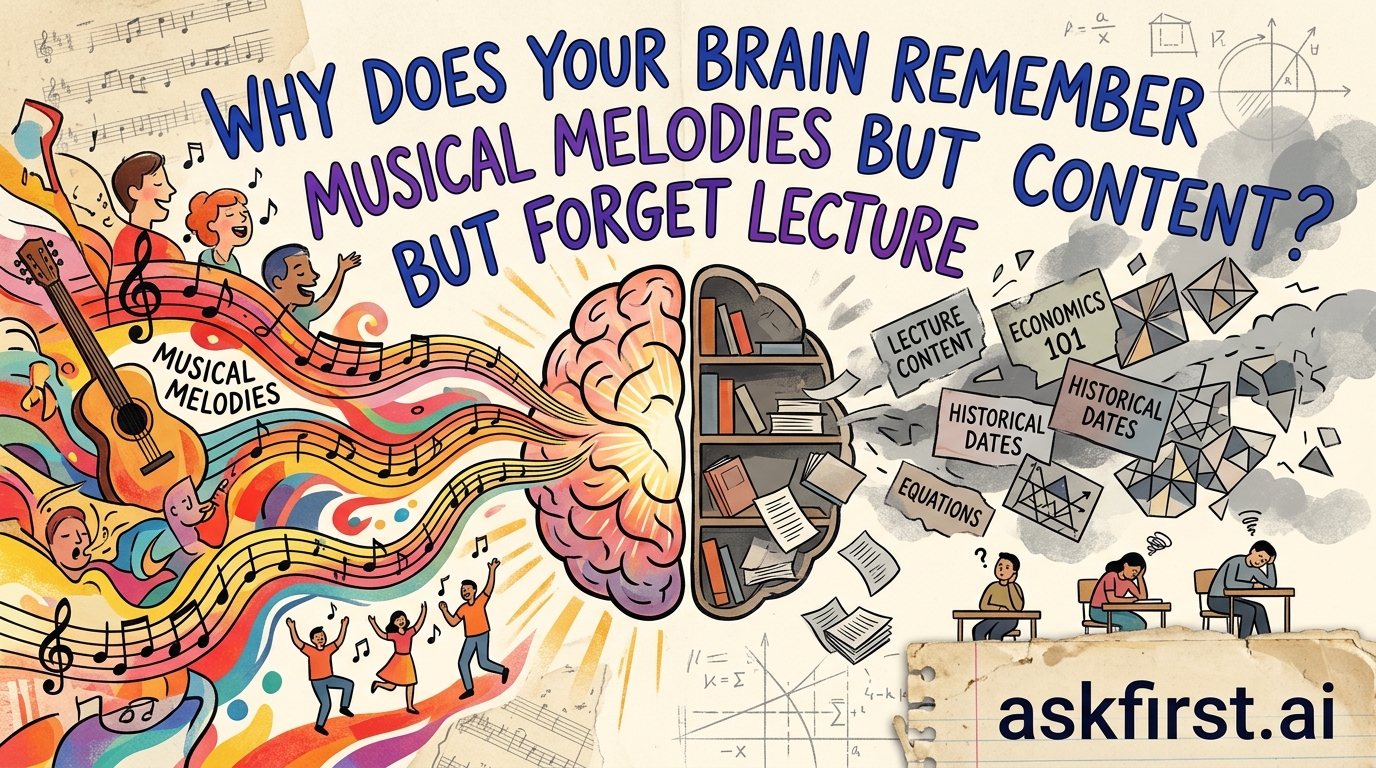
Music occupies a unique position in the brain because it stimulates the limbic system, the seat of human emotion. When a melody is processed, the amygdala and the hippocampus—structures critical for emotional regulation and memory formation—are activated simultaneously. Scientific research suggests that musical structure triggers the release of dopamine in the nucleus accumbens, a reward-based neural circuit. In contrast, standard lecture material is often processed as semantic information, which primarily engages the prefrontal cortex—the logical, analytical portion of the brain. Because lectures often lack high-arousal emotional stimuli, the brain classifies them as lower priority, leading to faster decay in storage.
2. Pattern Recognition and Rhythmic Structure
The human brain is an evolutionary pattern-recognition machine. Music is inherently hierarchical, built upon recurring structures: rhythm, meter, melody, and timbre. These patterns act as mnemonic scaffolds. When a person hears a melody, the brain performs continuous predictive processing, anticipating the next note. This engagement requires high levels of neural synchronization. Conversely, lectures are frequently linear, lacking the periodic, predictable structural cadence of music. Without these rhythmic cues to act as anchors, the semantic data becomes prone to interference from competing external information.
3. The Dual-Coding Theory
Psychologist Allan Paivio’s Dual-Coding Theory posits that memory is enhanced when information is stored in both visual/spatial and verbal formats. Music excels here: it combines sonic data (auditory) with abstract structural patterns (cognitive) and frequently associates with personal memories (episodic). A lecture, however, often relies strictly on verbal/linguistic processing. When information is delivered through only one channel, it is less resilient to forgetting. Music bridges the gap between procedural memory (the skill of understanding music) and episodic memory (the memory of when and where the music was heard).
4. Synaptic Plasticity and Expert Wiring
The brain exhibits extreme neuroplasticity when it comes to musical intelligence. Because music is a universal human trait, the auditory cortex possesses dedicated neural circuitry to process tonal intervals and harmonic sequences. Studies indicate that professional musicians show enlarged corpus callosums, enhancing communication between the left and right hemispheres. For the average listener, this 'hard-wiring' for rhythm allows the brain to store melodies as holistic chunks of information, whereas a lecture requires the painstaking integration of discrete, disjointed facts. Essentially, the brain 'compresses' musical files more efficiently than linguistic data.
5. Strategies for Better Semantic Retention
To bridge the gap between melodic recall and factual retention, one can utilize techniques that mirror the benefits of music:
- Rhythmic Chunking: Organize facts into rhyming structures or rhythmic groups to exploit the brain's pattern-matching tendencies.
- The Spacing Effect: Just as one needs to hear a song repeatedly to memorize it, factual information requires spaced repetition to move from short-term to long-term memory via synaptic consolidation.
- Emotional Contextualization: Attach subjective value or narrative drama to academic content, thereby tricking the limbic system into treating the data as emotionally significant.
Conclusion
The brain does not 'forget' lectures because it is lazy; it forgets them because they lack the multidimensional stimuli—the rhythm, the emotional reward, and the pattern-based structure—that the brain has evolved to prioritize as high-value data. By understanding the mechanical advantage of melody, learners can intentionally structure information in ways that mimic musical architecture, thereby transforming transient lecture data into lasting knowledge.