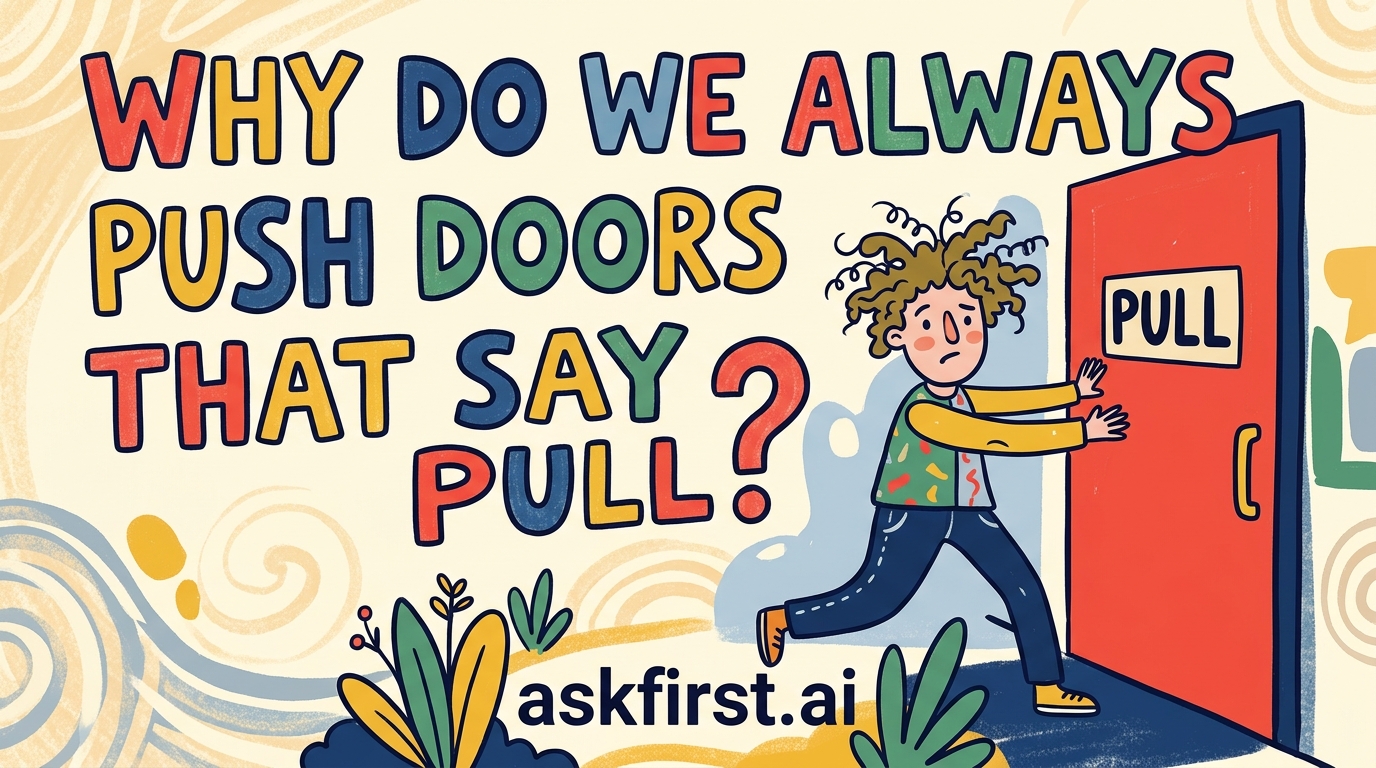
The phenomenon of pushing a door labeled 'pull' is a classic case study in human factors engineering and cognitive psychology, often referred to as a 'Norman Door.' Named after Donald Norman, the author of 'The Design of Everyday Things,' this term describes an object that creates frustration because its appearance gives the wrong cues as to how it should be operated. When a door is designed in a way that suggests the opposite action of its function, the human brain relies on instinctive heuristics rather than reading instructional text. ### The Psychology of Affordances The primary culprit is the concept of 'affordance.' An affordance is a perceived and actual property of the thing, primarily those fundamental properties that determine just how the thing could possibly be used. When a door features a flat metal plate, the brain subconsciously interprets this as an object to be pushed. Even if a 'Pull' sign is clearly displayed, the tactile experience of the flat surface overrules the linguistic instruction. The human brain processes visual cues much faster than it processes text. By the time the mind registers the word 'Pull,' the hand has already committed to the pushing motion. ### The Mismatch of Expectations In public buildings, people operate on 'mental models' of how doors function. If ninety percent of the doors encountered throughout the day open by pushing, the brain creates a default setting for door interaction. This is known as 'habituation.' When individuals encounter a door that requires pulling, the cognitive load required to deviate from that habit is significant. In a busy environment, the brain minimizes energy expenditure by relying on past experiences rather than re-evaluating the current interface. This leads to what designers call a 'slip'—an error made when someone intends to perform one action but accidentally performs another due to a failure in execution or sensory perception. ### Design Principles and Cognitive Load Excellent design should eliminate the need for signage. If a door needs a sign to tell a user how to operate it, the design is inherently flawed. A handle that can be gripped is a strong 'pull' indicator, while a flat plate is a 'push' indicator. The confusion occurs when architects prioritize aesthetics—such as uniform flush handles on both sides of a door—over functional clarity. When a door's design ignores the psychological requirements of its user, the human behavior is not 'wrong'; rather, the interface is poorly designed. According to Fitts's Law, the time required to rapidly move to a target area is a function of the distance to and the size of the target. When users are walking quickly, their focus is on the path, not the hardware. They approach the door at an angle, reach out, and hit the mechanism that is most reachable, which is often a flat plate designed for pushing. ### How to Solve the Problem To rectify these errors, designers employ 'signifiers' that are physical rather than textual. For example: * Use Contrasting Surfaces: Placing a prominent, grippable handle on the pull side and a flat, un-grippable plate on the push side removes ambiguity immediately. * Spatial Cues: Designing the door to move in one direction exclusively creates a natural rhythm in pedestrian traffic, reducing the frequency of error. * Visual Consistency: Ensuring that all doors within a building operate with similar visual indicators prevents users from having to pause and analyze every exit point. Understanding this phenomenon highlights a profound truth about modern life: our errors are rarely a failure of intelligence. Instead, they are often a failure of design to match the natural shortcuts our brains use to navigate the physical world. Next time a door pulls back when expected to push, remember that it is not a personal failure, but rather a testament to the persistent power of habit and the vital importance of intuitive industrial design.
HomeLifestyle
Read Also
Why do we find specific geometric patterns inherently soothing?
Previous Article
What's the name of the largest ocean in the world?
Next ArticleWhy do rivers sometimes flow uphill briefly?
Read Also
Which extinct species would trigger a global ecological collapse?
Read Article
Why do we find specific geometric patterns inherently soothing?
Read Article
Why do we always feel like we are forgetting something important?
Read Article
Could trees be communicating through a secret fungal internet?
Read Article
Ask First can make mistakes. Check important info.
© 2026 Ask First AI, Inc.. All rights reserved.|Contact Us