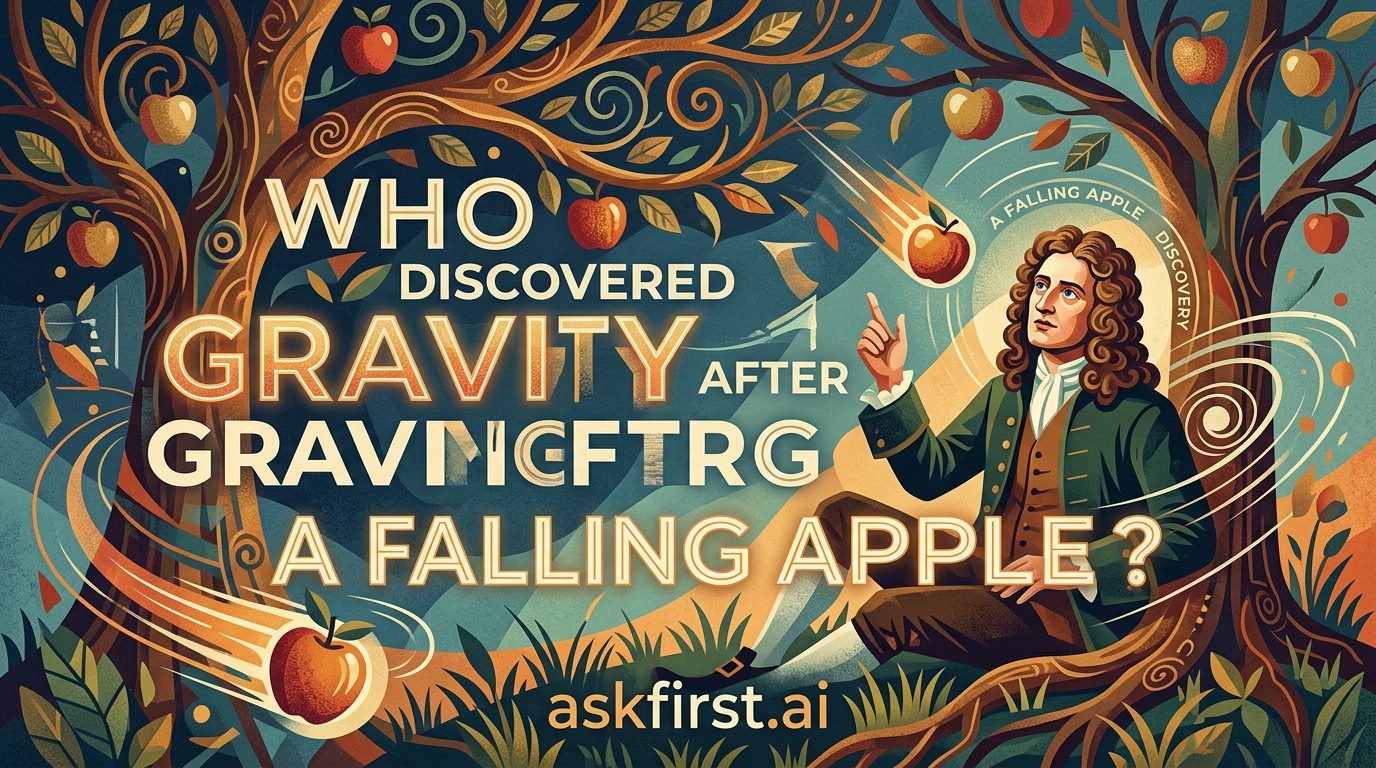
The person credited with the discovery of the law of universal gravitation after observing a falling apple is Sir Isaac Newton.
Here are a few key details regarding this historical account:
- The Legend: According to the popular story, Newton was sitting in his garden at Woolsthorpe Manor in 1666 when he saw an apple fall from a tree. This prompted him to wonder why the apple always fell straight to the ground, leading to his realization that the same force acting on the apple also governs the motion of the moon and planets.
- Historical Accuracy: While the story of the apple is widely accepted as a simplified version of events, historians believe it is largely true. Newton himself recounted this anecdote to several acquaintances in his later years, explaining that the sight of the apple sparked a train of thought about the nature of gravity.
- Scientific Contribution: This observation eventually culminated in the publication of his work, Philosophiæ Naturalis Principia Mathematica (1687), where he formulated the Law of Universal Gravitation.
It is important to note that while Newton formulated the mathematical laws of gravity, he did not "discover" gravity in the sense that people were previously unaware things fell to the ground; rather, he was the first to explain that gravity is a universal force that acts between all objects with mass.