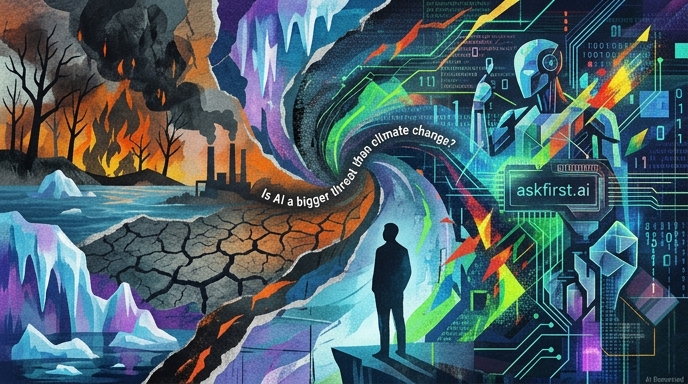
The question of whether artificial intelligence (AI) poses a greater existential threat than climate change is one of the most contentious debates of the 21st century. Both phenomena represent "wicked problems"—complex, multi-dimensional challenges that defy simple solutions—but they operate on fundamentally different timelines, mechanisms, and levels of certainty. To evaluate which is a "bigger" threat, we must dissect their respective impacts on global stability, human biology, and planetary integrity.
The Existential Profile of Climate Change
Climate change is a systemic, high-probability, and currently unfolding crisis. Its mechanism is rooted in the fundamental laws of physics and chemistry: the accumulation of greenhouse gases in the atmosphere trapping thermal energy.
- Predictability and Momentum: Unlike hypothetical risks, climate change is measured with precision. We have centuries of data, sophisticated climate modeling, and observable evidence—rising sea levels, ocean acidification, and the increasing frequency of extreme weather events. The momentum of the climate system means that even if emissions were halted today, the planet would continue to warm for decades.
- Scale of Impact: Climate change acts as a "threat multiplier." It exacerbates resource scarcity, drives mass migration, destabilizes food security, and threatens the habitability of large swaths of the equatorial region. The risk is not merely the weather; it is the potential for the collapse of global supply chains and the geopolitical conflicts that arise when states compete for dwindling arable land and potable water.
- Biological Imperative: Climate change threatens the very biosphere upon which human life depends. It is a slow-motion catastrophe that forces a fundamental reconfiguration of how human civilization organizes itself. It is a threat to the foundation of existence.
The Existential Profile of Artificial Intelligence
In contrast, the threat posed by AI is characterized by high uncertainty, rapid acceleration, and a lack of historical precedent. While climate change is a physical transformation of our environment, AI is a transformation of our cognitive and agency-based architecture.
- The Alignment Problem: The primary concern regarding AI safety is the "alignment problem"—the technical difficulty of ensuring that an autonomous, super-intelligent system pursues goals that are truly compatible with human survival. If an AI system attains a level of intelligence that surpasses human capability, its ability to manipulate systems, influence politics, or design biological or cyber-weapons becomes an existential variable.
- Speed and Opacity: AI development does not obey the slow, linear progression of planetary warming. It operates on exponential timelines. An algorithmic breakthrough could occur overnight, creating a "phase shift" in capability that leaves policymakers and safety researchers years behind. Unlike climate change, which we can observe through thermometers, the inner workings of deep neural networks are often "black boxes," making it difficult to predict when or how a system might fail or be weaponized.
- Societal Erosion: Beyond the "Terminator" scenario—which many experts consider speculative—AI poses an immediate, tangible threat to the cognitive fabric of society. The erosion of truth through hyper-realistic disinformation, the displacement of labor on a global scale, and the concentration of immense power in the hands of a few private corporations represent profound risks to democratic stability and social cohesion.
Comparative Analysis: Comparing Apples and Oranges
To determine which is "bigger," one must distinguish between certainty of impact and severity of potential outcomes.
- Certainty: Climate change is a certainty. We are already living through its early stages. AI, while transformative, remains speculative in terms of its most extreme existential risks. While we know the climate will continue to warm, we do not know if we will ever reach a state of Artificial General Intelligence (AGI) that possesses the autonomous intent to threaten humanity.
- Control and Mitigation: Climate change is a collective action problem; we know the solution (decarbonization), but we lack the political willpower. AI is an innovation problem; we possess the desire to develop it, but we lack the technical guardrails to control it. We can theoretically "engineer" our way out of climate change through carbon capture and renewable energy; it is much harder to "engineer" a way out of a rogue super-intelligence.
- The Interdependence: These two threats are not mutually exclusive. In fact, they are deeply intertwined. AI is currently being used to accelerate the discovery of new materials for batteries and to optimize energy grids, which could help solve climate change. Conversely, the energy-intensive nature of training large-scale AI models is itself a contributor to carbon emissions.
Conclusion
If we define "threat" as the probability of catastrophic harm within the next 50 years, climate change currently occupies the top position because its mechanisms are already in motion and its effects are global and unavoidable. It is a threat to our physical survival.
However, if we define "threat" by the potential for irreversible, rapid, and total systemic disruption, AI represents a higher volatility risk. While climate change might lead to a degraded, difficult future, an uncontrolled super-intelligent system could potentially lead to a future where human agency is rendered obsolete.
Ultimately, climate change is a battle against the laws of physics, while AI is a battle against the limits of our own wisdom. Both require immediate, unprecedented global coordination, but they demand it for different reasons: one to preserve the world we have, and the other to ensure the world we are building remains human-centric.