The Governance of Algorithmic Decision-Making: A Critical Analysis
The integration of autonomous systems into the fabric of human decision-making represents one of the most profound socio-technical shifts in modern history. As algorithms increasingly influence outcomes in judicial sentencing, medical diagnostics, financial lending, and geopolitical strategy, the question of whether these systems should possess decision-making authority—or merely advisory capacity—has become a central pillar of contemporary ethics and political philosophy.
The Argument for Algorithmic Utility
The primary justification for delegating decision-making to autonomous systems lies in the limitations of human cognition. Humans are notoriously susceptible to cognitive biases, fatigue, emotional interference, and the inability to process vast, multidimensional datasets simultaneously.
- Consistency and Objectivity: Algorithms, when properly calibrated, do not suffer from "decision fatigue." A judge might rule differently before and after lunch due to physiological fluctuations, whereas a consistent model would apply the same logic to identical data points.
- Scale and Complexity: In fields such as high-frequency trading or global logistics, the volume of data exceeds human cognitive capacity. Algorithms can identify patterns and correlations that are invisible to the human eye, potentially leading to more efficient resource allocation and risk mitigation.
- Predictive Power: By leveraging historical data, AI can forecast long-term outcomes with a level of statistical precision that humans cannot match, effectively acting as a safeguard against catastrophic planning errors.
The Ethical and Structural Risks
Despite these advantages, the delegation of high-stakes decisions to non-human entities introduces existential and systemic risks that demand rigorous scrutiny. The fundamental concern is not merely the accuracy of the decision, but the legitimacy and accountability of the process.
- The "Black Box" Problem: Many advanced machine learning models, particularly deep neural networks, operate in ways that are not interpretable by humans. If an AI denies a loan application or recommends a medical intervention, it is often impossible to provide a granular, human-readable justification. This lack of transparency undermines the right to due process and informed consent.
- Encoded Bias and Feedback Loops: AI systems are trained on historical data, which is often a repository of past societal prejudices. If an algorithm is trained on biased recruitment or policing data, it will not only replicate these biases but amplify them, embedding systemic discrimination into the digital infrastructure.
- The Erosion of Moral Agency: Decision-making is not merely a mathematical exercise; it is a moral one. When a machine makes a decision, there is a "responsibility gap." If an autonomous system causes harm, who is held accountable? The programmer, the user, or the dataset curator? The diffusion of responsibility threatens to weaken the ethical accountability structures that underpin our legal and social systems.
The Necessity of "Human-in-the-Loop" Frameworks
To navigate this transition safely, society must move toward a paradigm of Human-in-the-Loop (HITL) or Human-on-the-Loop (HOTL) systems. In this model, the AI serves as a high-performance analytical tool, but the final executive authority remains firmly with human experts.
- Contextual Nuance: Humans possess the capacity for moral reasoning, empathy, and an understanding of context that is currently absent in machine logic. A judge can consider the specific, unquantifiable life circumstances of a defendant, whereas an algorithm sees only variables.
- Accountability Chains: Maintaining human oversight ensures that there is always an identifiable agent responsible for the consequences of a decision. This is essential for the function of legal liability and democratic governance.
- Dynamic Error Correction: Humans have the unique ability to intervene when a system encounters a "black swan" event—a scenario outside the training distribution where the AI’s logic breaks down.
The Future of Decision Governance
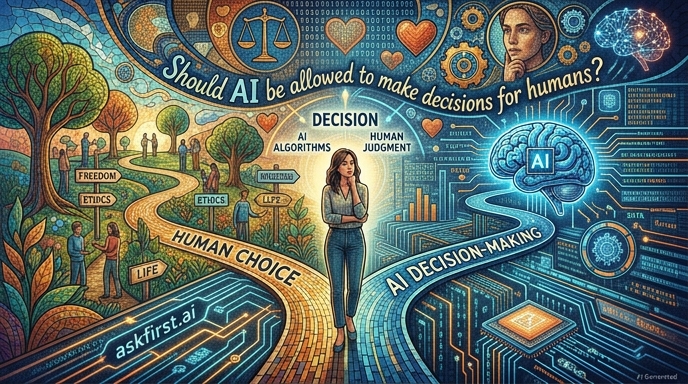
The question should not be framed as an "all-or-nothing" choice between human and machine. Instead, we should conceptualize decision-making as a collaborative architecture. The goal should be the creation of Augmented Intelligence, where the machine handles the data processing and pattern recognition, while the human provides the value-based judgment and ethical oversight.
We must also implement robust regulatory frameworks that mandate explainability (XAI), ensuring that any automated decision affecting human rights or welfare must be auditable. Furthermore, society must invest in "algorithmic literacy," ensuring that the individuals tasked with overseeing these systems understand their limitations, failure modes, and underlying biases.
In conclusion, while AI offers an unprecedented opportunity to improve the efficiency and accuracy of our decisions, it must never be granted the power to act as the final moral arbiter of human life. The preservation of human dignity, accountability, and the ability to challenge authority requires that we retain the final word in the decisions that shape our world. We must use AI to empower human judgment, not to replace it.