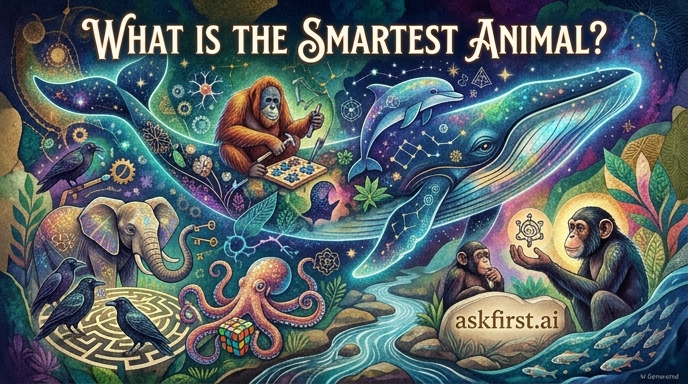
Determining the "smartest" animal is a complex endeavor that challenges the very definition of intelligence. In the scientific community, cognitive ability is rarely measured on a single linear scale. Instead, researchers categorize intelligence based on specific domains: social complexity, tool use, problem-solving, self-awareness, and linguistic capability. Because different species have evolved to solve unique environmental pressures, comparing a chimpanzee to a dolphin or an octopus is akin to comparing a mathematician to a master architect; both are brilliant, but their genius is expressed in entirely different languages.
The Great Apes: Our Cognitive Mirror
When evaluating intelligence, humans naturally gravitate toward the great apes—specifically chimpanzees, bonobos, and orangutans. These animals share a significant portion of our DNA and exhibit behaviors that are hauntingly familiar. Chimpanzees (Pan troglodytes) are widely considered among the most intelligent animals due to their sophisticated use of tools and complex social hierarchies. They have been observed modifying sticks to "fish" for termites, using stones as hammers to crack nuts, and even sharpening spears to hunt smaller primates.
Beyond physical tool use, chimpanzees demonstrate a high degree of Theory of Mind—the ability to understand that others have thoughts, intentions, and perspectives different from their own. They engage in political maneuvering within their troops, forming alliances and grooming partnerships to secure status. This social intelligence is a hallmark of high-level cognition, requiring the constant processing of group dynamics and individual reputation.
The Cetacean Intellect: Masters of the Deep
In the marine world, bottlenose dolphins and orcas (killer whales) represent the pinnacle of intelligence. Their brains are significantly larger than those of most land mammals, even when accounting for body size (a metric known as the encephalization quotient). Dolphins demonstrate self-awareness, as evidenced by their ability to recognize themselves in mirrors—a test that most animals fail.
Perhaps more impressive is their communication. Dolphins use signature whistles to identify themselves and address specific individuals, effectively using names. They operate in highly coordinated hunting groups, employing strategies that require communication, planning, and role delegation. Orcas, in particular, exhibit "cultural" transmission of knowledge; different pods have distinct hunting techniques and vocal dialects that are passed down through generations. This suggests a form of intelligence that transcends instinct, moving into the realm of learned, shared social knowledge.
The Cephalopod Enigma: Intelligence Without a Spine
The octopus represents an entirely different evolutionary path to intelligence. Unlike the mammalian brain, which is centralized, the octopus brain is distributed; two-thirds of its neurons are located in its arms. This allows each arm to "think" and react to sensory input independently while still being coordinated by the central brain.
Octopuses are masters of problem-solving. They can navigate complex mazes, unscrew jars to retrieve food, and even escape from locked tanks by squeezing through tiny gaps. Their ability to camouflage themselves—changing both color and texture in milliseconds—requires immense computational power, as they must process the visual environment and translate it into a physical manifestation on their skin. Because they are short-lived and solitary, their intelligence is focused heavily on environmental adaptation rather than social politics, proving that complex cognition can evolve without a social structure.
Avian Genius: The Corvid Revolution
For decades, birds were dismissed as "bird-brained," but research into the corvid family—which includes crows, ravens, and jays—has shattered this misconception. Corvids possess a dense concentration of neurons in the forebrain, allowing for cognitive performance that rivals that of primates.
New Caledonian crows are famous for their ability to craft tools, not just use them. They can solve multi-stage puzzles that require them to use one tool to obtain another, which is then used to reach a reward. Ravens have demonstrated the ability to plan for the future, a trait once thought to be exclusively human. They can remember human faces for years, distinguishing between "friendly" researchers and those who have previously threatened their nest. Their ability to store food and track the location of thousands of individual caches demonstrates an extraordinary spatial memory.
The Consensus: Intelligence as Adaptation
If one must crown a winner, the chimpanzee often holds the title due to the breadth of its cognitive repertoire: tool use, social complexity, and linguistic potential. However, this is largely a reflection of human bias, as we prioritize traits that resemble our own.
True biological intelligence is not about reaching the "top" of a pyramid, but about how effectively an animal navigates its specific niche. A border collie’s ability to understand hundreds of words and commands, a parrot’s capacity for abstract logic, and an elephant’s long-term memory and mourning rituals all represent high-level cognitive achievements. Intelligence is ultimately a measure of adaptability; it is the silent, ongoing process of learning, remembering, and innovating to survive in an ever-changing world. Each of these species demonstrates that the capacity for thought is not a human monopoly, but a vast, diverse spectrum of life on Earth.