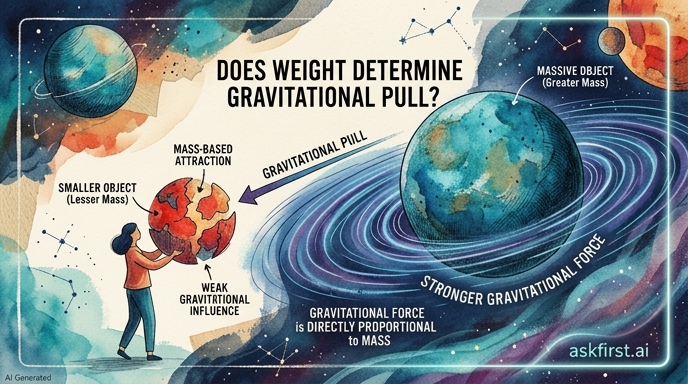
The relationship between weight, mass, and gravitational pull is one of the most frequently misunderstood concepts in classical physics. To answer the question directly: No, weight does not determine gravitational pull. In fact, the causality works in the exact opposite direction. Gravity is the force that acts upon an object to produce the property we define as weight.
Defining the Fundamental Terms
To understand why weight is a consequence rather than a cause, we must first distinguish between mass and weight, as these terms are often used interchangeably in casual conversation but represent entirely different physical realities.
- Mass: This is an intrinsic property of matter. It is a measure of an object's resistance to acceleration (inertia) and the amount of "stuff" it contains. Mass is measured in kilograms and remains constant regardless of where an object is located in the universe.
- Weight: This is a force. Specifically, it is the measurement of the gravitational pull exerted on an object’s mass by a massive body, such as a planet or a moon. Because it is a force, its value is dependent on the local gravitational field. If you were to travel from Earth to the Moon, your mass would remain identical, but your weight would decrease significantly because the Moon’s gravitational pull is weaker.
The Mechanism of Gravitational Pull
The gravitational pull exerted by an object is determined by two primary factors, as defined by Sir Isaac Newton’s Law of Universal Gravitation. The formula $F = G \frac{m_1m_2}{r^2}$ illustrates that the gravitational force ($F$) between two objects is dictated by:
- The Masses of the Objects ($m_1$ and $m_2$): Gravity is a direct result of mass. Every object that possesses mass exerts a gravitational pull on every other object. The greater the mass of the objects involved, the stronger the gravitational attraction between them.
- The Distance Between Them ($r$): Gravity follows an inverse-square law. This means that as the distance between two objects increases, the gravitational pull between them decreases exponentially.
Therefore, "weight" is merely the output of this equation when one of the objects is a planet and the other is an object on its surface. When you step on a scale, the device is not measuring your "gravitational pull" in a vacuum; it is measuring the normal force required to counteract the gravitational pull the Earth is exerting on your specific mass.
Why Weight Cannot Determine Gravity
If weight were the determinant of gravitational pull, it would imply that an object’s weight somehow "creates" the gravity it experiences. This is logically circular and physically impossible.
Consider a heavy lead ball and a light feather dropped in a vacuum. According to the Equivalence Principle, famously demonstrated by Galileo, both objects fall at the same rate of acceleration ($g \approx 9.8 m/s^2$ on Earth). Because the lead ball has more mass, it experiences a stronger gravitational force (a higher weight), but its greater inertia requires exactly that much more force to accelerate it at the same rate as the feather.
If weight determined gravity, an object’s weight would have to be an independent variable that dictates how the Earth pulls on it. Instead, the Earth’s mass and the distance of the object from the Earth’s center are the independent variables. The weight is simply the result of the Earth’s gravitational field interacting with the object’s mass.
The Role of General Relativity
While Newtonian physics provides a sufficient framework for most terrestrial engineering, Albert Einstein’s General Relativity offers a deeper insight. In this model, gravity is not merely a "force" acting between two masses, but a curvature of spacetime caused by mass and energy.
A massive object like the Sun curves the fabric of space around it. Planets orbit the Sun because they are following the straightest possible paths (geodesics) through this curved space. In this context, weight is the sensation of resisting that curvature—the feeling of being held against the surface of a planet by the geometry of the universe. Even in this advanced model, mass remains the source of the curvature, while weight remains the local experience of that curvature acting upon a body.
Practical Implications
Understanding this distinction is vital in fields ranging from aerospace engineering to medicine.
- Aerospace: When designing spacecraft, engineers must account for mass for fuel efficiency and structural integrity, while accounting for weight to calculate the thrust required to escape Earth's gravity.
- Health: In medical science, the effects of weightlessness (microgravity) on the human body demonstrate that while mass remains constant, the absence of the gravitational force that creates weight leads to muscle atrophy and bone density loss. The body requires the consistent force of weight to maintain its structural integrity.
In summary, weight is a symptom of gravity, not its cause. Gravity is a fundamental interaction dictated by mass and distance, while weight is the localized manifestation of that interaction. You do not weigh what you weigh because of your weight; you weigh what you weigh because of your mass and the gravitational field of the planet beneath your feet.