The Anatomy of Programming Competence: Beyond Individual Syntax
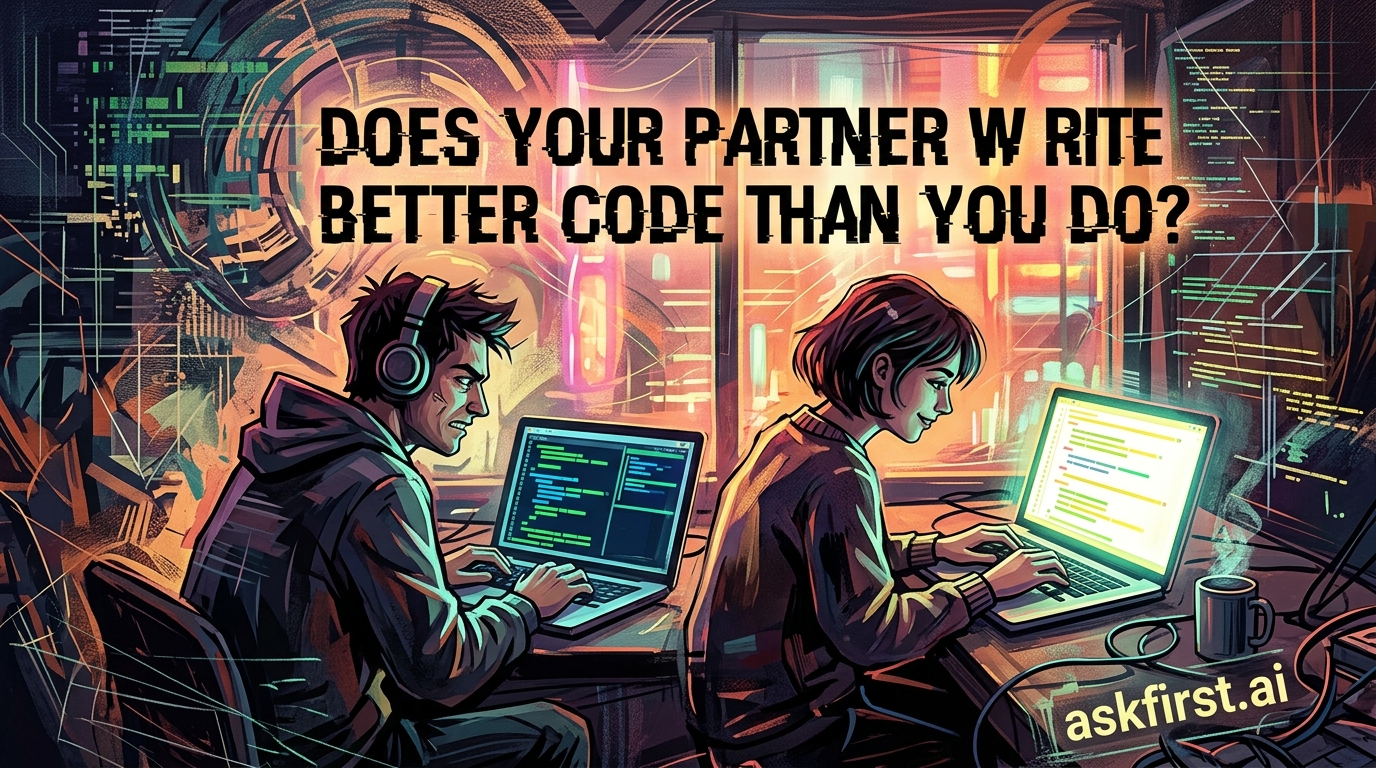
Evaluating coding proficiency within a partnership—whether professional or personal—often triggers a complex cocktail of ego, imposter syndrome, and genuine curiosity. While software development is frequently romanticized as the domain of the solitary 'lone wolf' genius, modern engineering is an inherently collaborative discipline. To determine if one partner writes 'better' code, one must first dismantle the subjective definitions of quality that plague the industry. High-quality code is not merely about execution speed; it is an amalgamation of maintainability, architectural foresight, and cognitive accessibility.
Defining the Metrics of 'Better' Code
When comparing codebases, experts prioritize several distinct KPIs (Key Performance Indicators) over simple raw output. These metrics often reveal that what appears to be 'better' is frequently just 'different' based on specific programming paradigms:
- Maintainability and Technical Debt: Does the code allow for easy modification by others? High-quality code minimizes future friction.
- Cyclomatic Complexity: Does the logic remain understandable? Overly complex nesting often signals a failure in design, regardless of how clever the implementation seems.
- Test Coverage and Reliability: Robust code includes edge-case handling. A partner who writes comprehensive unit tests is objectively providing more value than one who focuses purely on feature delivery.
- Architectural Cleanliness: Does the solution adhere to SOLID principles and design patterns that prevent system rot?
The Dunning-Kruger Effect in Peer Code Review
It is common for developers to perceive their partners as writing 'better' code due to the Dunning-Kruger effect, a cognitive bias where individuals with lower expertise overestimate their competence, while highly skilled individuals tend to underestimate their own relative ability. When observing a partner, one often sees the polished final output, whereas one is intimately aware of all the messy, iterative struggles behind one's own work. This 'curtain effect' creates an illusion of perfection that is entirely divorced from reality. Research into cognitive science suggests that we are naturally inclined to judge our internal mental processes against the external products of others, leading to an unfair skew in self-assessment.
The Collaborative Advantage: Why Competition Fails
Viewing coding as a zero-sum game is a significant psychological hurdle. Instead of asking who is 'better,' top-performing engineering teams suggest shifting the framework to Complementary Skill Sets. One partner might excel at high-level system architecture and abstraction, while the other might be a wizard at low-level optimization, memory management, or frontend UX implementation.
- The Specialist vs. Generalist: Acknowledge that different projects require different archetypes. A frontend specialist might seem 'worse' at database sharding but 'better' at accessibility standards.
- Knowledge Transfer: The most effective partnerships utilize code reviews not as a critique of identity, but as a mechanism for collective intelligence. By viewing every review as a collaborative knowledge share, the 'better' developer becomes a catalyst for the other's growth, effectively raising the floor of the entire household or team.
The 'Clean Code' Fallacy: Is Readability Subjective?
Legendary computer scientist Donald Knuth famously stated that 'programs are meant to be read by humans and only incidentally for computers to execute.' If one partner prioritizes clever, concise one-liners while the other prioritizes verbose, explicit naming conventions, the former may feel more sophisticated, but the latter is often more 'professional' in a team environment. Mastery in coding involves knowing when to prioritize performance over readability, and vice versa. True senior-level proficiency is marked by the ability to balance these tradeoffs with a focus on long-term project longevity.
Fostering a Culture of Growth
If the goal is to improve collective skill, rather than simply identifying a winner, partners should adopt these structural habits:
- Pair Programming Sessions: Dedicate time to solve complex bugs together. This exposes the subconscious logic behind each person's approach.
- The 'Why' Interview: When a partner writes a piece of code that seems superior, avoid asking 'how'—ask 'why.' Understanding the motivation reveals the architectural intent.
- Language Switching: Occasionally try to work in the other's preferred language or framework. The struggle of navigating a foreign syntax is a powerful equalizer that builds empathy for the challenges faced by your partner.
Ultimately, coding is a craft defined by constant evolution. The landscape of programming languages, libraries, and design patterns shifts every few years. The developer who writes 'better' code today may be the one who embraces curiosity and learning tomorrow. Do not treat coding skill as a static trait; treat it as a dynamic, shared journey. When you stop worrying about who is better, you gain the freedom to become the best version of your collective technical self.