The Neuro-Cognitive Architecture of Nighttime Debugging
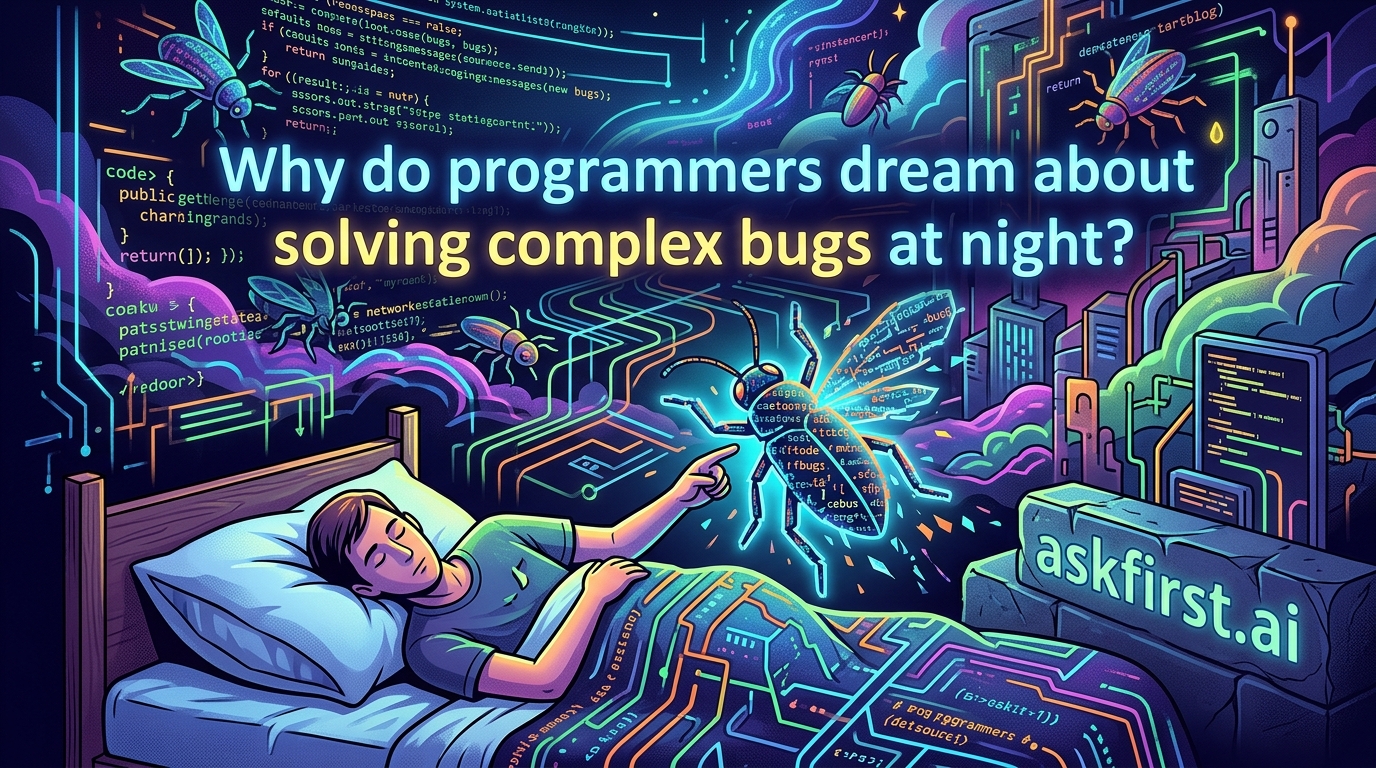
It is a widely reported phenomenon among software engineers that the most intractable programming problems often find their solutions in the dream state or immediately upon waking. This occurrence, frequently referred to as the 'shower effect' or 'nocturnal debugging,' is rooted in the intersection of cognitive neuroscience and the specific demands of symbolic logic. When the human brain encounters a complex algorithmic bug, it engages in what cognitive scientists call 'active search' within the workspace of the prefrontal cortex. However, this workspace is limited by conscious cognitive load. During sleep, specifically the REM (Rapid Eye Movement) phase, the brain facilitates a process of associative memory consolidation that ignores the rigid boundaries established by logical constraints.
The Science of Associative Memory during Sleep
During deep sleep, the brain performs a rigorous 'housekeeping' task. It scans recent neural activity patterns and identifies clusters of related information. For programmers, these clusters contain syntax rules, logic gates, and the specific variables associated with a failing build. Unlike the linear, step-by-step reasoning process required during active coding, the sleeping brain explores 'fuzzy' logic. By relaxing the strict filters that discard 'irrelevant' data, the dreaming mind creates novel pathways between disparate concepts. This is how a programmer might realize in a dream that a race condition exists in a background thread, precisely because the sleeping brain is capable of mapping out the entire system architecture without the distraction of immediate syntax errors or compiler feedback.
Why the Subconscious Excel at Debugging
- Reduction of Interference: During the day, constant sensory input and the pressure of immediate deadlines create noise. In the dream state, the brain filters out external environmental distractions, allowing the neural networks responsible for logic and spatial modeling to operate at higher efficiency.
- Metaphorical Mapping: Complex software architectures are essentially abstractions. The brain is evolutionary hard-wired to process spatial and metaphorical information efficiently. A bug—which is essentially a structural flaw in abstract logic—is often 'visualized' by the brain as a geometric or physical problem. Dreams translate abstract code into tangible shapes or narratives, making the invisible visible.
- Pattern Recognition Amplification: Pattern matching is the cornerstone of human intelligence. Programmers possess highly specialized pattern recognition skills. When the brain is detached from task-oriented performance, it enters a state of 'diffuse mode' thinking, which is far superior to 'focused mode' for identifying long-range patterns that connect a symptom in one module to a root cause in another.
Theoretical Foundations: The Zeigarnik Effect
Psychologically, the preoccupation with unsolved bugs is linked to the Zeigarnik Effect, which dictates that humans remember uncompleted or interrupted tasks better than completed ones. A bug represents an 'open loop' in the brain's cognitive cache. This state of tension is uncomfortable, keeping the problem active in the peripheral awareness of the mind even when the programmer is not at the keyboard. The brain creates a drive to close these loops, resulting in hyper-focus during the dream cycle.
Practical Strategies for Harnessing Nocturnal Insight
To leverage this biological quirk for technical mastery, programmers often utilize a few common heuristics:
- The Pre-Sleep Load: Reviewing the problematic code or architectural diagram immediately before bed primes the neural pathways.
- The Pen-and-Paper Protocol: Keeping a notebook by the bed is essential. Because dream memory decays rapidly, capturing the 'Aha!' moment within seconds of waking prevents the loss of complex technical connections that might seem obvious at 3:00 AM but evaporate by 8:00 AM.
- Constraint Deliberation: Instead of seeking a solution, simply spend ten minutes visualizing the desired state of the system, not the code itself, to prime the brain for structural problem-solving rather than rote debugging.
Summary of the Phenomenon
Ultimately, dreaming about code is not a sign of exhaustion, but an indicator of high-level cognitive integration. The brain, functioning as a massive biological parallel processor, continues to iterate through the logical state space of the program long after the physical hardware has been powered down. As artificial intelligence advances and neural-computer interfacing research grows, the study of how programmers effectively outsource complex computation to their subconscious will remain a vital field of interest. Mastering the ability to influence this nocturnal 'background process' can be a competitive advantage for any professional engineer working within the complex landscape of modern distributed systems.