The Aesthetic Architecture of Syntax
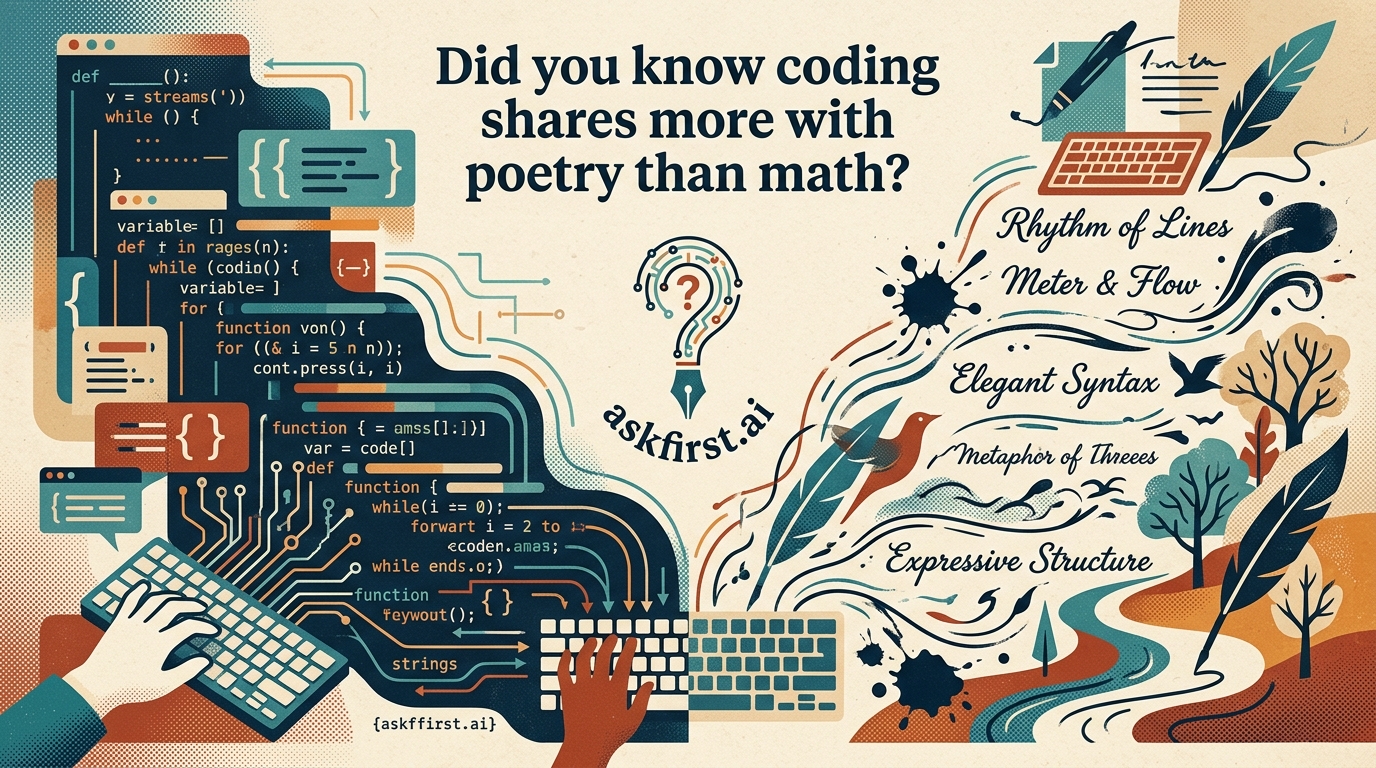
While the common perception of computer programming remains firmly rooted in the realm of cold logic, rigid mathematics, and binary certainty, a deeper examination reveals a striking alignment with the art of poetry. Both disciplines are fundamentally concerned with the economy of expression, the power of structure, and the pursuit of elegance within constrained systems. Coding, like poetry, is a linguistic act—a deliberate arrangement of symbols intended to convey meaning, perform functions, and evoke specific outcomes within a virtual ecosystem.
Economy of Language: The Power of Constraints
In both coding and poetry, the most profound impact often arises from extreme brevity. A haiku captures vast emotional truths in seventeen syllables; a recursive function or a clever algorithm can solve an intractable problem in mere lines of code. This is the art of optimization. When a developer refactors code, they are essentially practicing a form of poetic editing—stripping away redundant variables, smoothing out flow, and ensuring that every single character serves a purpose. Just as a poet chooses a specific word for its resonance, a programmer selects a specific syntax for its performance, readability, and maintainability. This pursuit of minimalism is the hallmark of craftsmanship in both fields.
The Architecture of Metaphor and Abstraction
Programming languages are constructed on top of metaphors. We speak of "stacks," "trees," "heaps," and "clouds." These are not literal physical objects but conceptual frameworks that allow developers to model reality. Poetry functions similarly by using imagery to bridge the gap between the abstract and the tangible. In coding, high-level languages like Python or Ruby act as layers of abstraction that shield the user from the "grime" of assembly language, much like how a metaphor abstracts a complex emotion into a relatable image. The programmer builds a mental world, organizes it through logic, and gives it life through execution—a process mirroring the creative genesis of a long-form poem.
Rhythm, Flow, and Syntax
Good code, like good poetry, possesses a discernible rhythm. Readability is not merely a "nice to have" feature; it is essential for the longevity of a software project. Code that is poorly structured, tangled, or arrhythmic is difficult to maintain and prone to failure, much like a poem that stumbles over its own meter. Modern software development emphasizes 'clean code' movements, which prioritize aesthetics, symmetry, and logical flow. When developers read code, they look for harmony—a sense that the pieces fit together without friction. This intuitive feeling of 'rightness' is identical to the aesthetic satisfaction one derives from a well-structured stanza.
The Creative Act of Problem Solving
Critics often argue that math is discovery, while poetry is creation. Coding straddles this fence. While an algorithm may be discovered, the implementation is entirely a creative choice. Two developers given the exact same requirement will often produce wildly different solutions. This variation in 'voice' is the hallmark of the human element in technical work. Just as two poets can interpret the same sunrise in two entirely different ways, two engineers can interpret the same functional requirement through unique stylistic lenses—prioritizing different trade-offs, naming conventions, and structural motifs.
Building Worlds with Words
Ultimately, coding is the act of bringing thought into existence through syntax. When a program runs, it transforms static text into dynamic action. It changes the state of the machine, manipulates memory, and communicates with other systems. This is the definition of performative language. Like a poem that changes the reader’s perception of the world, code changes the machine's behavior within its environment. Both are transformative acts. By viewing programming as a creative, poetic endeavor, the field moves away from the clinical 'engineer-as-mechanic' stereotype and toward the reality of the 'software-architect-as-artist.' This perspective encourages developers to pursue beauty in their logic, empathy in their interfaces, and intentionality in their design, ensuring that technology remains as much a cultural artifact as it is a utility.