Building a robust, functional, and intelligent chatbox in the modern digital landscape requires a multidisciplinary approach that bridges user experience (UX) design, backend engineering, and natural language processing (NLP). Whether you are building a simple rule-based bot for customer service or an advanced generative AI assistant, the architectural principles remain remarkably consistent.
1. Defining the Purpose and Architecture
Before writing a single line of code, you must define the "intent" of your chatbox. Is it a transactional bot (booking flights, checking balances) or a conversational bot (customer support, entertainment)?
For transactional bots, you should look into Finite State Machines (FSM). As described by Martin Fowler in his seminal work Patterns of Enterprise Application Architecture, state machines allow you to explicitly define the "flow" of a conversation, ensuring the user doesn't get lost in infinite loops. Conversely, for conversational bots, you will likely integrate a Large Language Model (LLM) via APIs like OpenAI’s GPT-4 or Anthropic’s Claude, utilizing a Retrieval-Augmented Generation (RAG) architecture to provide the bot with proprietary knowledge.
2. The Tech Stack: Choosing Your Foundation
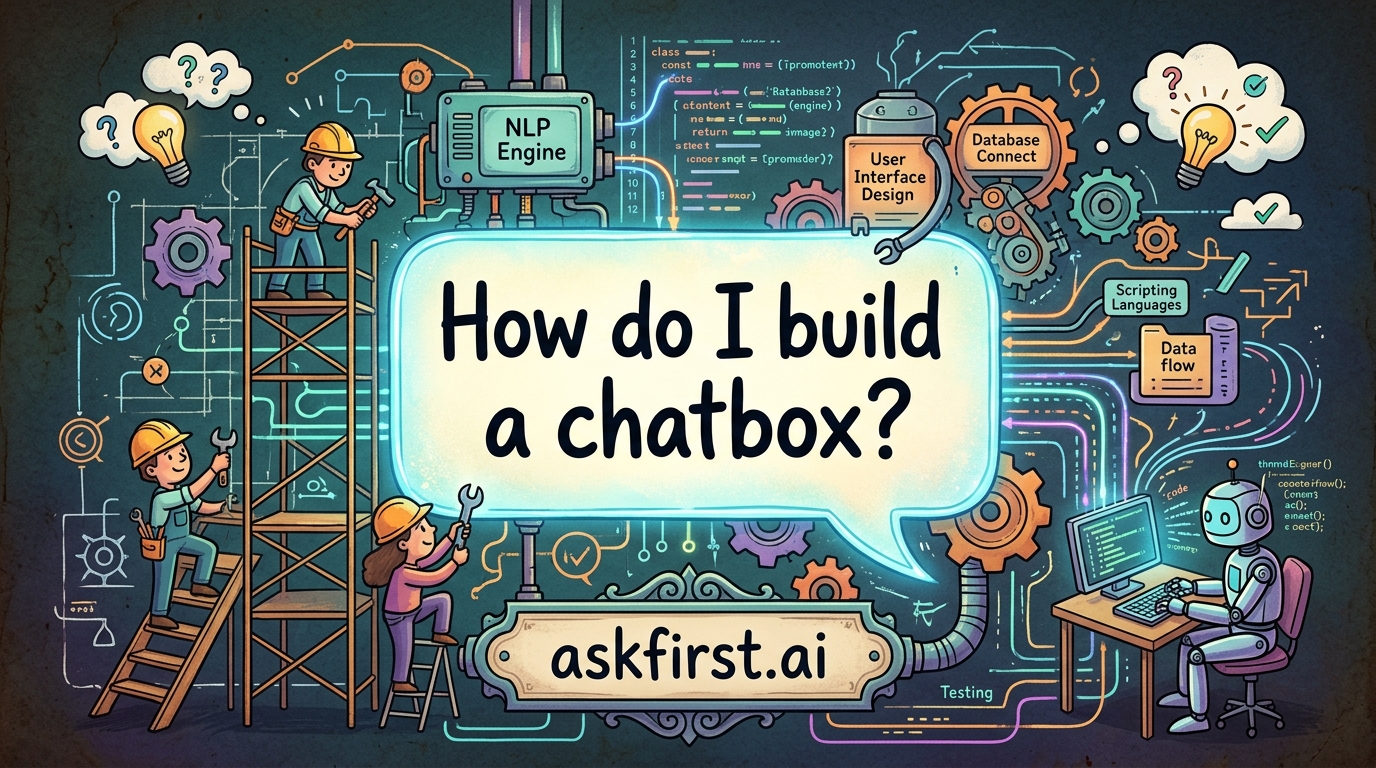
A professional-grade chatbox consists of three distinct layers:
- The Frontend (Client Side): This is the interface the user interacts with. React.js or Vue.js are industry standards here. You should utilize WebSockets (Socket.io) for real-time, low-latency communication. Avoid standard HTTP requests for chat, as they are too slow for an interactive experience.
- The Backend (Server Side): Node.js or Python (FastAPI/Django) are the preferred choices. If you are handling high concurrency, Go (Golang) is often cited for its superior performance in managing thousands of simultaneous WebSocket connections.
- The Brain (NLP/LLM): If you are building a custom NLP engine rather than using an API, you would rely on libraries like Hugging Face’s Transformers or spaCy. Matthew Honnibal, the creator of spaCy, emphasizes in his documentation that industrial-strength NLP requires a pipeline that handles tokenization, entity recognition, and dependency parsing before the data even touches the "logic" layer.
3. Engineering the Data Flow
The data flow of a chatbox typically follows a standard sequence:
- Input Capture: The user sends a message, which is sanitized to prevent Cross-Site Scripting (XSS) attacks.
- Intent Classification: The system determines what the user wants. Tools like Rasa (an open-source framework for conversational AI) use a combination of machine learning classifiers to map user inputs to specific "intents."
- Context Management: This is the most critical step. Your server must store the "session state" (usually in a fast key-value store like Redis). Without this, the chatbox will have no memory of the previous message, rendering it useless.
- Response Generation: The logic layer queries a database or an LLM to formulate a response, which is then pushed back to the client.
4. Implementing RAG for Domain Expertise
If you want your chatbox to answer questions about your specific business data, you cannot rely solely on the pre-trained knowledge of an LLM. You must implement a Vector Database (such as Pinecone, Milvus, or Weaviate).
In the book Vector Databases for Machine Learning by Arun M. and colleagues, the authors explain that by converting your documents into "embeddings" (numerical representations of meaning) and storing them in a vector database, you can perform a "semantic search" whenever a user asks a question. The system finds the relevant paragraph in your documents, sends that context to the LLM, and instructs it: "Using only the provided context, answer the user's question." This effectively eliminates "hallucinations" and ensures factual accuracy.
5. Security, Privacy, and Ethical Guardrails
Building a chatbox is not just about functionality; it is about safety. You must implement strict input validation to prevent "prompt injection" attacks, where users try to trick the bot into ignoring its instructions. Furthermore, ensure you are compliant with GDPR or CCPA regulations. Never log PII (Personally Identifiable Information) in your chat logs unless you have encrypted it at the database level.
Always include a "Human-in-the-Loop" (HITL) mechanism. If the bot's confidence score falls below a certain threshold (e.g., 70%), the system should automatically trigger a handover to a live human agent via a dashboard.
Conclusion
Building a chatbox is an iterative process that begins with clear logic, relies on high-performance infrastructure, and evolves through data-driven optimization. By leveraging modern frameworks like Rasa for intent handling and vector databases for knowledge retrieval, you can build a system that is not only responsive but also genuinely helpful. Start by prototyping a simple state-machine-based bot to understand the flow, then gradually integrate more complex AI capabilities as your requirements grow. Success in this field requires constant monitoring of your conversation logs to identify where users are dropping off, ensuring your bot is always evolving to meet the actual needs of your audience.