The Fundamental Dichotomy: Hardware vs. Software in Computing
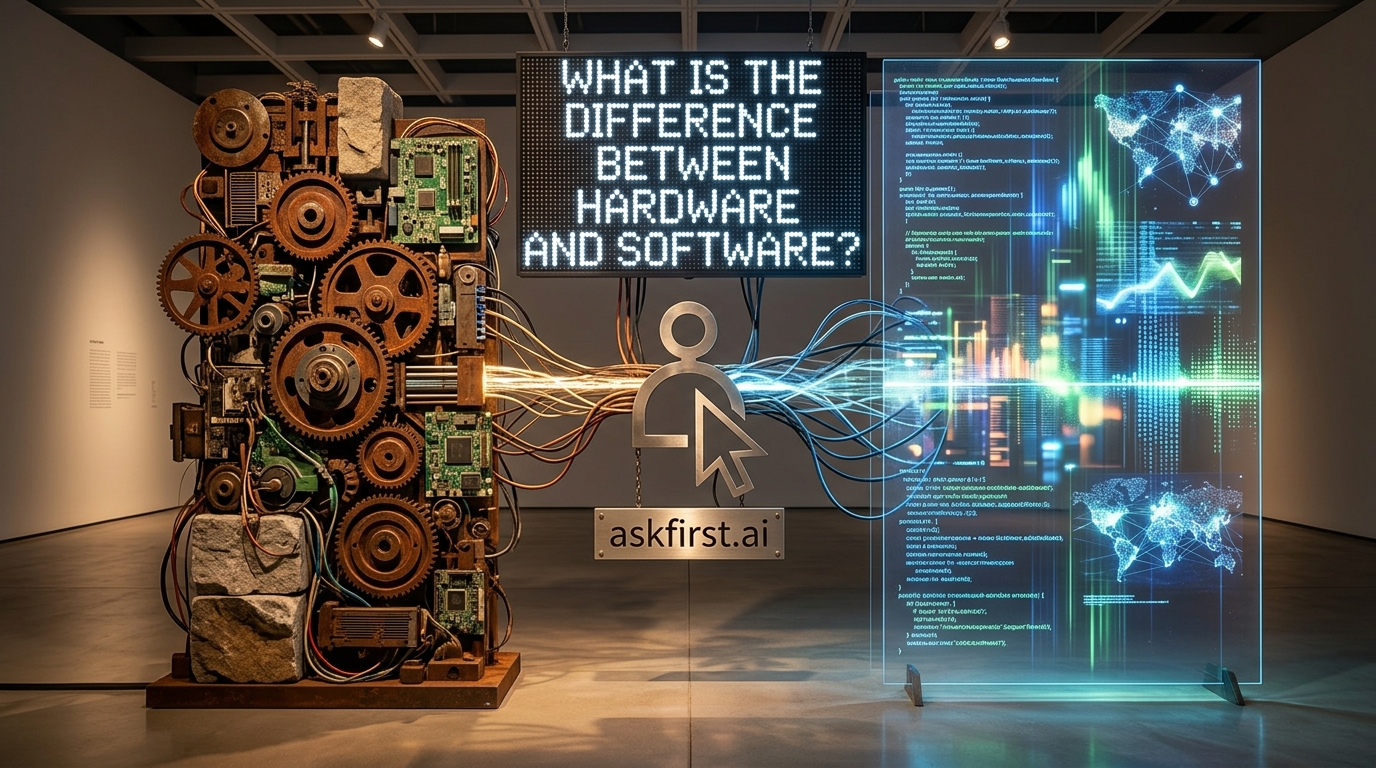
In the realm of computer science and information technology, the distinction between hardware and software is the foundational pillar upon which all digital systems are built. To understand modern technology, one must perceive these two entities not as separate silos, but as a symbiotic relationship where one provides the physical stage and the other provides the script for the performance. In technical terms, hardware represents the tangible, electronic machinery, while software represents the intangible, logical instructions that dictate what that machinery should accomplish.
Understanding Hardware: The Tangible Infrastructure
Hardware refers to the physical components of a computer system—the parts you can touch, see, and hold. It is the "body" of the machine. Without hardware, software would have no medium through which to exist or execute its functions. Hardware is engineered using conductive materials, semiconductors, and mechanical parts designed to process electricity and manipulate data.
Key Components of Hardware:
- Central Processing Unit (CPU): Often referred to as the "brain" of the computer. It executes instructions by performing basic arithmetic, logical, control, and input/output (I/O) operations. As noted by Charles Petzold in his seminal work Code: The Hidden Language of Computer Hardware and Software, the CPU is essentially a complex collection of logic gates that process binary signals.
- Memory (RAM): Random Access Memory acts as the short-term workspace for the computer. It stores data that the CPU needs to access quickly. Unlike a hard drive, RAM is volatile, meaning it loses its information when power is cut.
- Storage Devices: These include Hard Disk Drives (HDD) and Solid State Drives (SSD). These components provide long-term, non-volatile storage for files, applications, and operating systems.
- Peripherals: These are external devices that expand the functionality of the computer, such as keyboards, mice, monitors, and printers.
The evolution of hardware is famously tracked by Moore’s Law, an observation made by Gordon Moore, co-founder of Intel. He posited that the number of transistors on a microchip doubles approximately every two years, which explains why our hardware has become exponentially more powerful and smaller over the decades.
Understanding Software: The Intangible Logic
Software is the collection of data and instructions that tells the hardware how to work. It is the "mind" of the machine. Software is intangible; it exists as code—a sequence of binary digits (1s and 0s) that the hardware translates into specific actions. If you were to look at a computer screen, you are interacting with the end product of software.
Categories of Software:
- System Software: This is the foundation that manages the hardware. The most prominent example is the Operating System (OS), such as Microsoft Windows, macOS, or Linux. The OS acts as an intermediary, managing memory, processes, and hardware communication. According to Andrew S. Tanenbaum in his authoritative textbook Modern Operating Systems, the OS exists to provide an abstraction layer so that programmers do not need to understand the underlying physical circuitry to write applications.
- Application Software: These are the programs designed for end-users to perform specific tasks. Examples include web browsers (Chrome, Firefox), word processors (Microsoft Word), and creative suites (Adobe Photoshop).
- Firmware: A specialized type of software that is permanently programmed into hardware devices (like the BIOS on a motherboard). It provides the low-level control for the device's specific hardware.
Software is created through a rigorous process of programming, using languages such as Python, C++, or Java. These languages are then compiled or interpreted into machine code that the hardware can understand.
The Symbiotic Relationship: How They Interact
The most effective way to conceptualize the difference is through an analogy: think of a musical instrument. The hardware is the piano—the wood, the strings, and the keys. The software is the sheet music—the instructions that dictate which keys to press and in what rhythm. Without the piano, the music has no voice; without the sheet music, the piano remains silent.
A practical example of this interaction occurs when you type a letter on your keyboard.
- Hardware Input: The keyboard sends an electrical signal to the computer.
- Software Processing: The operating system intercepts this signal, identifies which character was pressed, and sends it to the word processor application.
- Software Execution: The word processor instructs the graphics card (hardware) to render the shape of the character on the monitor (hardware).
This constant cycle of signals moving between physical components and logical instructions occurs millions of times per second.
Conclusion
The distinction between hardware and software is not merely academic; it is the defining characteristic of the digital age. Hardware provides the physical constraints and capabilities, while software provides the limitless flexibility of logic and function. As we look toward the future—with advancements in quantum computing and artificial intelligence—this boundary continues to blur. Technologies like "Software-Defined Networking" (SDN) or "Field-Programmable Gate Arrays" (FPGAs) allow for hardware behavior to be modified by software in real-time, suggesting that the divide is becoming more fluid. However, at their core, hardware remains the vessel, and software remains the intelligence that navigates it. Understanding this relationship is essential for anyone seeking to master the complexities of modern engineering and digital communication.