The Ancient Threads of Computation
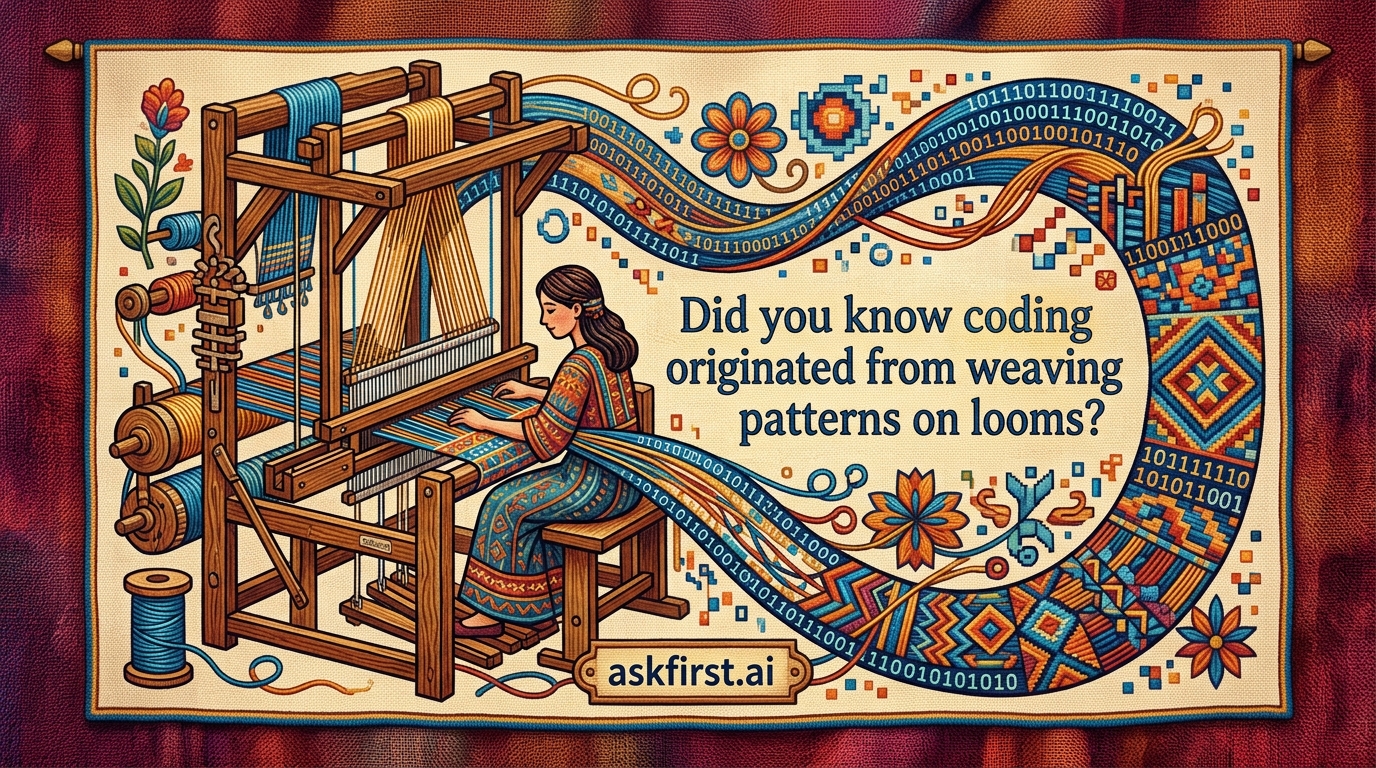
It is a common misconception that the roots of modern computing lie solely in the vacuum tubes of the mid-20th century or the complex mathematics of the Enlightenment. In reality, the foundation of binary logic—the language that powers every smartphone, supercomputer, and server on Earth today—was physically manifested centuries ago on a loom. The story of coding begins not with electricity, but with the intricate artistry of textile production.
The Jacquard Revolution
In 1804, Joseph Marie Jacquard, a French weaver and merchant, revolutionized the textile industry by creating the Jacquard loom. This invention utilized a system of punched cards to automate the process of weaving complex patterns into fabric. Before this innovation, weaving intricate designs was an arduous, manual task requiring high skill and endless patience. Jacquard’s genius was in recognizing that a pattern could be decomposed into a series of binary decisions: hole or no hole, thread up or thread down.
- The Binary Foundation: The presence of a hole in a card signified an 'on' state (the hook engages the thread), while the absence of a hole represented an 'off' state. This is the precise predecessor to the zero-and-one architecture of modern digital logic.
- The Programmable Logic: For the first time, an industrial machine could be 'programmed' to create different outputs simply by swapping a stack of cards. The hardware (the loom) remained constant, while the software (the card sequence) dictated the functional output.
Ada Lovelace and the Analytical Engine
When Charles Babbage conceptualized his Analytical Engine, he sought a way to input instructions that could handle complex mathematical calculations. Ada Lovelace, often recognized as the world's first computer programmer, immediately grasped the significance of the Jacquard mechanism. She saw that the loom's punch card system could store not just patterns for silk, but symbols for abstract operations. In her famous notes, she articulated that the Engine might act upon other things besides number—that it could manipulate music, graphics, or logical rules if mapped correctly. She essentially foresaw the transition from 'calculating machines' to 'computing engines' by treating the punch cards as a form of stored program memory.
The Direct Lineage to Modern Hardware
This connection is not just historical trivia; it is a direct genealogical line. When Herman Hollerith developed the tabulating machine for the 1890 U.S. Census, he utilized punch cards inspired by the Jacquard system. This technology eventually led to the formation of the Tabulating Machine Company, which later merged to become International Business Machines, or IBM.
Throughout the early 20th century, punch cards remained the primary medium for data entry and programming. Scientists and engineers in the 1940s and 50s would spend days crafting programs on card stacks, where a single misplaced hole could derail an entire calculation. This physical manifestation of logic is why modern programmers still refer to 'threads' in multi-threaded programming—a linguistic homage to the loom's original mechanical operations.
Lessons for the Future
The history of the loom teaches us that innovation is often the synthesis of existing fields. Computing was born from the marriage of mechanical engineering and textile craft. By viewing coding as a successor to weaving, we gain a deeper appreciation for the nature of software: it is the art of weaving complex, logical structures out of thin, intangible threads of data.
- Abstraction is Timeless: The jump from a physical punch card to an intangible line of code is simply a jump in efficiency, not in theory.
- Patterns Drive Complexity: The same principles used to create a brocade fabric are used to create the operating systems that drive autonomous vehicles and cloud-based artificial intelligence.
Today, we no longer use wooden punch cards, but the spirit of the loom lives on in every line of code written. When you write a function, you are essentially defining the weave of a digital fabric, creating patterns of logic that dictate the behavior of the world around us. This historical context provides a bridge between the physical and the virtual, reminding us that every technological leap rests upon the shoulders of those who first dared to map the infinite possibilities of a simple binary state.