The Loom: The Original Computational Engine
The history of computing is frequently misremembered as a strictly twentieth-century endeavor sparked by the digital revolution. However, the conceptual foundation of modern programming rests firmly upon the mechanical loom. At its core, the intersection of textile design and binary logic represents one of the most profound leaps in human technological history.
The Jacquard Loom Revolution
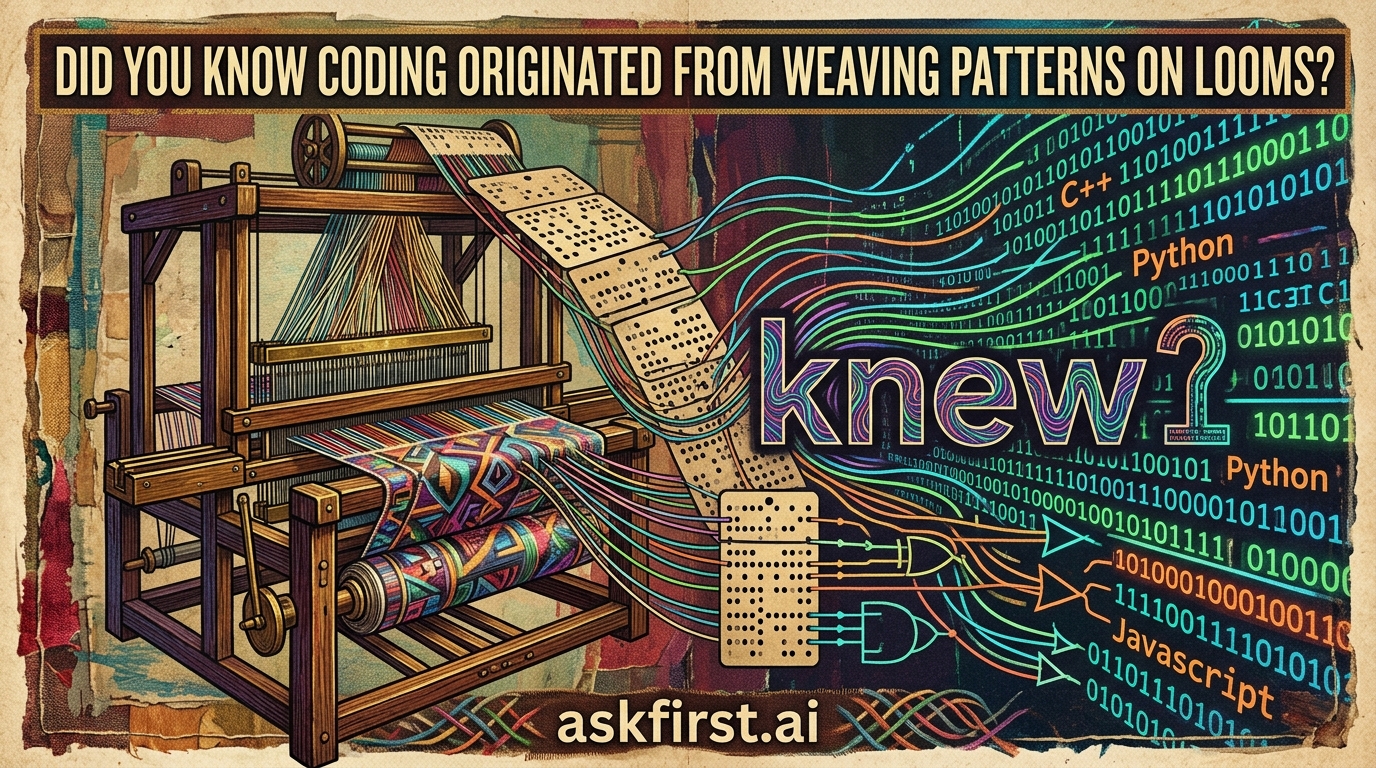
In the early nineteenth century, Joseph Marie Jacquard revolutionized the weaving industry by introducing a system of interchangeable punched cards to control the pattern of the weave. Prior to this innovation, intricate textile designs required laborious manual manipulation by skilled artisans. Jacquard realized that the instructions for complex patterns could be encoded onto cards. The presence or absence of a hole represented a binary choice—the literal ancestor of the 0s and 1s that power modern devices today.
- Input Mechanism: Holes in the cardboard cards served as the input.
- Processing: The mechanical apparatus of the loom read these cards to determine which warp threads were raised.
- Output: The result was a precisely woven, intricate design.
Ada Lovelace and the Analytical Engine
When Charles Babbage conceptualized his Analytical Engine, it was Ada Lovelace, a brilliant mathematician, who grasped the broader implications of this technology. Studying the mechanical advancements of the era, including Jacquard's punch-card systems, Lovelace articulated the potential for a machine to manipulate symbols rather than just numbers. She essentially authored the first algorithm intended to be executed by a machine. Her work serves as the intellectual bridge between the mechanical loom and the software-driven world of today.
Binary Logic and Textile Patterns
Modern coding relies on the abstraction of state. In a loom, the physical state is either 'up' or 'down' for each thread. In computer architecture, the state is 'high' voltage or 'low' voltage. The fundamental truth remains constant: if you can encode a series of binary decisions, you can automate a sequence of complex tasks. The loom proved that a machine could store memory and execute commands stored externally on physical media. This realization shifted the role of the operator from a laborer to a designer of instructions.
Why This Matters Today
Understanding the connection between weaving and software provides a deeper perspective on how technology evolves. Every high-level programming language today is essentially a complex, multi-layered weave of logic. When developers write code, they are creating a sequence of instructions that, like the punched cards of the Jacquard loom, dictate a specific outcome based on predefined binary inputs.
- Modularity: Just as loom cards could be rearranged to create new patterns without rebuilding the loom, software modules allow for the creation of new features without altering the hardware foundation.
- Scalability: The ability to store instructions externally enabled the mass production of complex goods, a precursor to the software scalability we experience in global digital systems.
- Automation: The transition from manual weaving to mechanical automation mirrors the modern shift toward automated testing, continuous integration, and artificial intelligence.
The Enduring Legacy of Algorithmic Weaving
While the materials have shifted from silk and wool to silicon and light, the principle of symbolic instruction remains identical. The 'threads' of modern code are the logical threads that construct our digital reality. When looking at a computer screen, it is helpful to visualize the background process as a virtual loom, weaving data into the information, graphics, and services we utilize every day.
By viewing programming as a creative, iterative process of 'weaving' logic, one gains a greater appreciation for the craftsmanship inherent in software engineering. The transition from industrial mechanics to digital architecture is not a replacement of logic, but a refinement of it. The legacy of the looms lives on in every smartphone, server, and embedded processor that drives the modern human experience. We have not abandoned the loom; we have simply made it invisible, faster, and infinitely more capable, yet the fundamental rhythm of 'input, process, output' remains as vital today as it was in the workshops of the early 1800s.