Understanding Genetic Compatibility: Navigating AS and AS Marriages
In the realm of hematological genetics, the sickle cell trait remains one of the most significant topics for reproductive health counseling, particularly in regions where the prevalence of the hemoglobin S gene is high. When two individuals with the AS genotype—meaning they are both carriers of the sickle cell trait—consider marriage and family planning, the question of whether they can have children without the SS genotype (Sickle Cell Anemia) is paramount. The answer is rooted in Mendelian inheritance patterns, which dictate the probabilities of genetic transmission for every pregnancy.
The Mechanics of Mendelian Inheritance
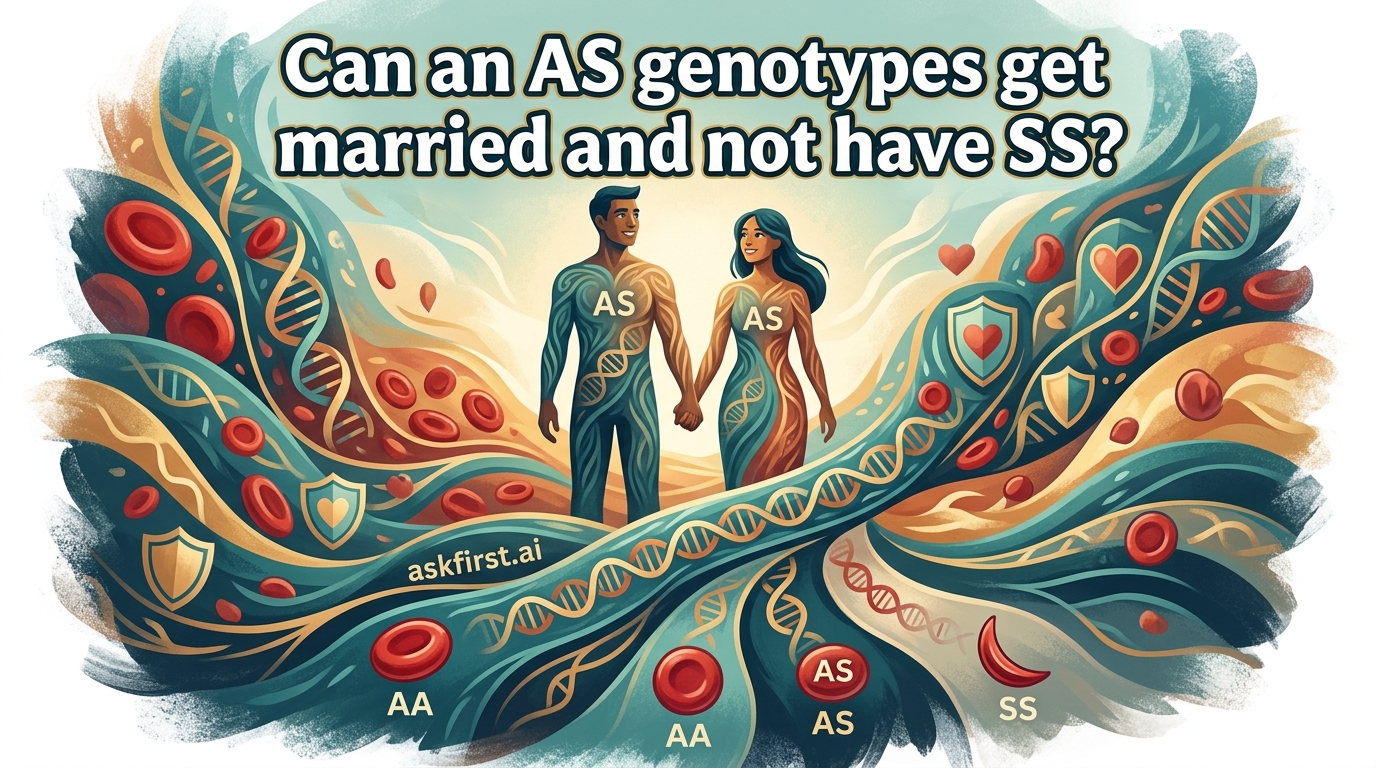
To understand the risk, one must first look at the biology of the AS genotype. An individual with AS genotype possesses one normal hemoglobin gene (A) and one sickle hemoglobin gene (S). When two such individuals conceive, each parent contributes one allele to the child. According to the laws of inheritance first formalized by Gregor Mendel in his mid-19th-century experiments with pea plants—later expanded upon in texts like Principles of Genetics by Snustad and Simmons—the potential combinations for the offspring are as follows:
- AA (Normal): The child inherits the 'A' gene from both parents. This occurs with a 25% probability.
- AS (Carrier): The child inherits one 'A' gene and one 'S' gene. This occurs with a 50% probability.
- SS (Sickle Cell Anemia): The child inherits the 'S' gene from both parents. This occurs with a 25% probability.
Therefore, while it is mathematically possible to have a child who does not have the SS genotype (the probability of an AA or AS child is 75%), it is never a guarantee. Every single pregnancy carries a 1-in-4 chance of resulting in a child with sickle cell disease. This is a critical distinction: the probability is calculated per conception, not as a cumulative average across four children.
Addressing the Possibility of Avoiding SS
Can an AS couple have children and avoid SS? Yes, but not through natural, unassisted conception alone. Because of the 25% risk per pregnancy, modern reproductive medicine offers several pathways for couples who wish to ensure their children do not inherit the homozygous SS condition.
- Preimplantation Genetic Testing (PGT-M): This is the most definitive method. Through in vitro fertilization (IVF), embryos are created in a laboratory setting. Once the embryos reach the blastocyst stage, a biopsy is performed to test for the presence of the S gene. Only embryos identified as AA or AS are selected for implantation into the uterus. As noted in the Journal of Assisted Reproduction and Genetics, this technology has revolutionized the ability of carrier couples to have healthy biological children.
- Prenatal Diagnosis (CVS or Amniocentesis): Some couples choose natural conception followed by diagnostic testing during pregnancy. Chorionic Villus Sampling (CVS) is typically performed between 10 and 13 weeks of gestation, while amniocentesis is performed after 15 weeks. These procedures allow parents to know the genotype of the fetus. If the fetus is diagnosed with SS, the parents must then face difficult decisions regarding the continuation of the pregnancy, which involves complex ethical, cultural, and personal considerations.
- Gamete Donation: Another path involves the use of donor eggs or donor sperm from individuals who are confirmed AA. This eliminates the possibility of the child inheriting the S gene from the donor side, effectively removing the 25% risk of SS.
The Societal and Clinical Perspective
It is important to emphasize that having the AS genotype does not preclude marriage or parenthood. However, informed decision-making is essential. In many countries, particularly across sub-Saharan Africa and within the African diaspora, public health initiatives focus heavily on "genotype screening before marriage." Organizations such as the Sickle Cell Disease Association of America (SCDAA) provide extensive resources for couples navigating these choices.
Counseling is vital because the impact of sickle cell disease is profound. According to clinical data published in Hematology/Oncology Clinics of North America, individuals with SS genotype face chronic pain crises, increased susceptibility to infections, and potential organ damage over their lifespan. Understanding these risks allows couples to approach family planning with eyes wide open, utilizing genetic counseling to explore their options rather than relying on chance.
Conclusion
To answer the core question: Yes, it is possible for AS couples to have children without the SS genotype, but it is never a certainty through natural conception. The 25% risk of SS is a biological reality that remains constant with every pregnancy. While the majority of outcomes (75%) will result in children who are either AA or AS, the possibility of an SS outcome necessitates careful planning. Whether choosing to accept the statistical risk, utilizing PGT-M through IVF, or opting for alternative family-building methods, the path forward for AS couples is one that requires access to professional genetic counseling and a deep understanding of their reproductive choices. By leveraging the intersection of genetics and modern medical technology, couples can make empowered decisions that prioritize the health and well-being of their future family.