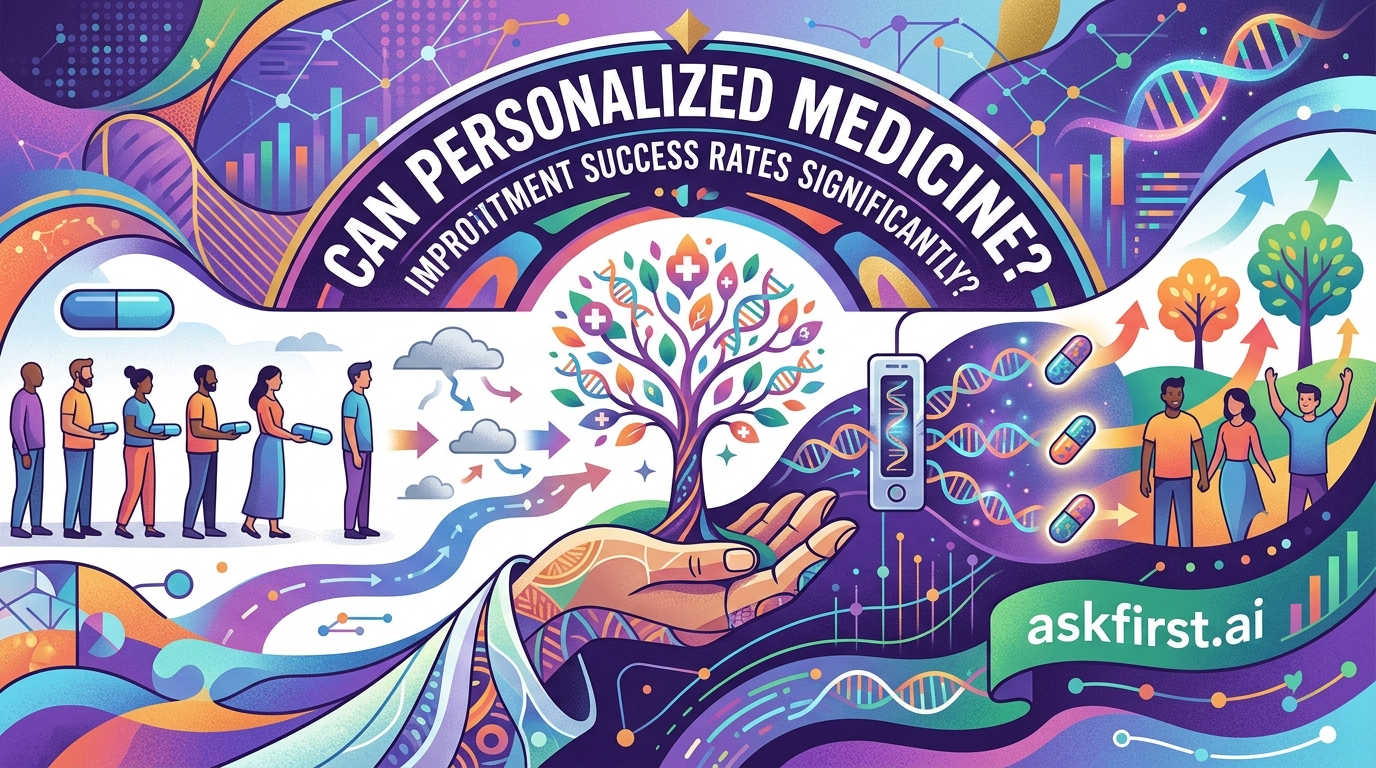
The Paradigm Shift: Can Personalized Medicine Significantly Improve Treatment Success?
Personalized medicine, often referred to as precision medicine, represents a fundamental shift in the delivery of healthcare. Rather than the traditional "one-size-fits-all" approach—where treatments are designed for the average patient—personalized medicine tailors medical decisions, practices, and products to the individual characteristics of each patient. By leveraging advances in genomics, proteomics, and data analytics, clinicians can now predict which treatments will be effective for specific individuals, thereby significantly increasing success rates, reducing adverse effects, and optimizing healthcare resources.
The Genomic Foundation of Precision
The cornerstone of personalized medicine is the ability to map and understand an individual’s genetic makeup. As noted by Dr. Francis Collins, former director of the National Institutes of Health (NIH) and a key leader of the Human Genome Project, the realization that genetic variations contribute to how individuals respond to disease and medication has transformed clinical oncology.
For instance, in the treatment of non-small cell lung cancer (NSCLC), clinicians now routinely test for mutations in the EGFR gene or ALK rearrangements. Before the advent of precision diagnostics, patients were treated with broad-spectrum chemotherapy, which often resulted in low response rates and high toxicity. Today, targeted therapies like Osimertinib specifically inhibit the mutated proteins driving the cancer, leading to significantly higher progression-free survival rates. This transition from empirical prescribing to biomarker-driven therapy is the primary engine behind improved success rates.
Pharmacogenomics: Reducing Adverse Drug Reactions
A critical component of personalized medicine is pharmacogenomics—the study of how genes affect a person’s response to drugs. The FDA has identified hundreds of medications that carry pharmacogenomic labeling, providing guidance on how genetic variations (such as those in the CYP450 enzyme system) influence drug metabolism.
Consider the common blood thinner Warfarin. Historically, determining the correct dosage was a dangerous trial-and-error process, often leading to hemorrhage or stroke. By testing for variants in the VKORC1 and CYP2C9 genes, physicians can now calculate a dose that minimizes the risk of bleeding while maintaining therapeutic efficacy. According to research published in the Journal of the American Medical Association (JAMA), integrating genetic data into dosing protocols significantly reduces the incidence of adverse drug events, which remain a leading cause of hospitalization worldwide.
Data Integration and Artificial Intelligence
The complexity of personalized medicine necessitates the integration of massive datasets. Modern clinical decision support systems (CDSS) now aggregate electronic health records (EHRs), imaging data, and genomic profiles to provide actionable insights at the point of care.
In the book The Digital Doctor: Hope, Hype, and Harm at the Dawn of Medicine’s Computer Age by Dr. Robert Wachter, the author explores how data-driven workflows are beginning to harmonize disparate pieces of patient information. When a physician can view a patient’s "molecular signature" alongside their historical health data, the probability of selecting an ineffective treatment drops drastically. This is particularly evident in rare disease diagnosis, where the "diagnostic odyssey"—a process that previously took years—is now being shortened to weeks through rapid whole-genome sequencing (WGS).
Overcoming Challenges to Widespread Implementation
Despite the clear benefits, personalized medicine faces significant hurdles. The first is cost. While the price of sequencing a genome has plummeted from millions of dollars in 2003 to under $600 today, the infrastructure required to interpret this data remains expensive. Furthermore, there is a persistent "data gap" in medical research. As highlighted in the All of Us Research Program, many genomic databases are skewed toward populations of European descent, which risks creating a disparity in healthcare outcomes for underrepresented ethnic groups.
Moreover, the regulatory environment is struggling to keep pace. Approval processes for "companion diagnostics"—tests used to determine if a patient is a candidate for a specific drug—are complex and require rigorous validation. As argued by Dr. Siddhartha Mukherjee in his seminal work The Emperor of All Maladies: A Biography of Cancer, the challenge lies in moving from scientific discovery to routine clinical utility without sacrificing patient safety or equity.
Conclusion: The Future of Clinical Outcomes
Personalized medicine is not merely a futuristic concept; it is an active, evolving standard of care that is already demonstrably improving treatment success rates in oncology, cardiology, and pharmacology. By shifting the focus from the disease to the patient, medicine has moved into an era where "guesswork" is being replaced by biological certainty.
While issues regarding data privacy, equitable access, and the high cost of specialized therapies remain, the trajectory is clear. As our understanding of the human genome deepens and our computational power grows, the ability to tailor interventions will likely become the default, rather than the exception. The result is a healthcare system that is not only more efficient but fundamentally more effective, offering patients the right treatment at the right time, thereby maximizing the chances of recovery and minimizing the burden of ineffective care.