The Dual-Edged Sword: The Impact of Social Media on Academic Performance
In the contemporary educational landscape, social media platforms have evolved from mere recreational spaces into complex digital ecosystems that fundamentally alter how students acquire, process, and share information. While the traditional image of the scholar was one of solitary study in a library, the modern student is perpetually connected to a global network of peers and resources. This shift presents a dichotomy: social media acts as both a profound catalyst for collaborative learning and a persistent source of cognitive fragmentation. Understanding this influence requires a nuanced examination of behavioral psychology, digital pedagogy, and the evolution of social capital in academic settings.
The Architecture of Collaborative Learning
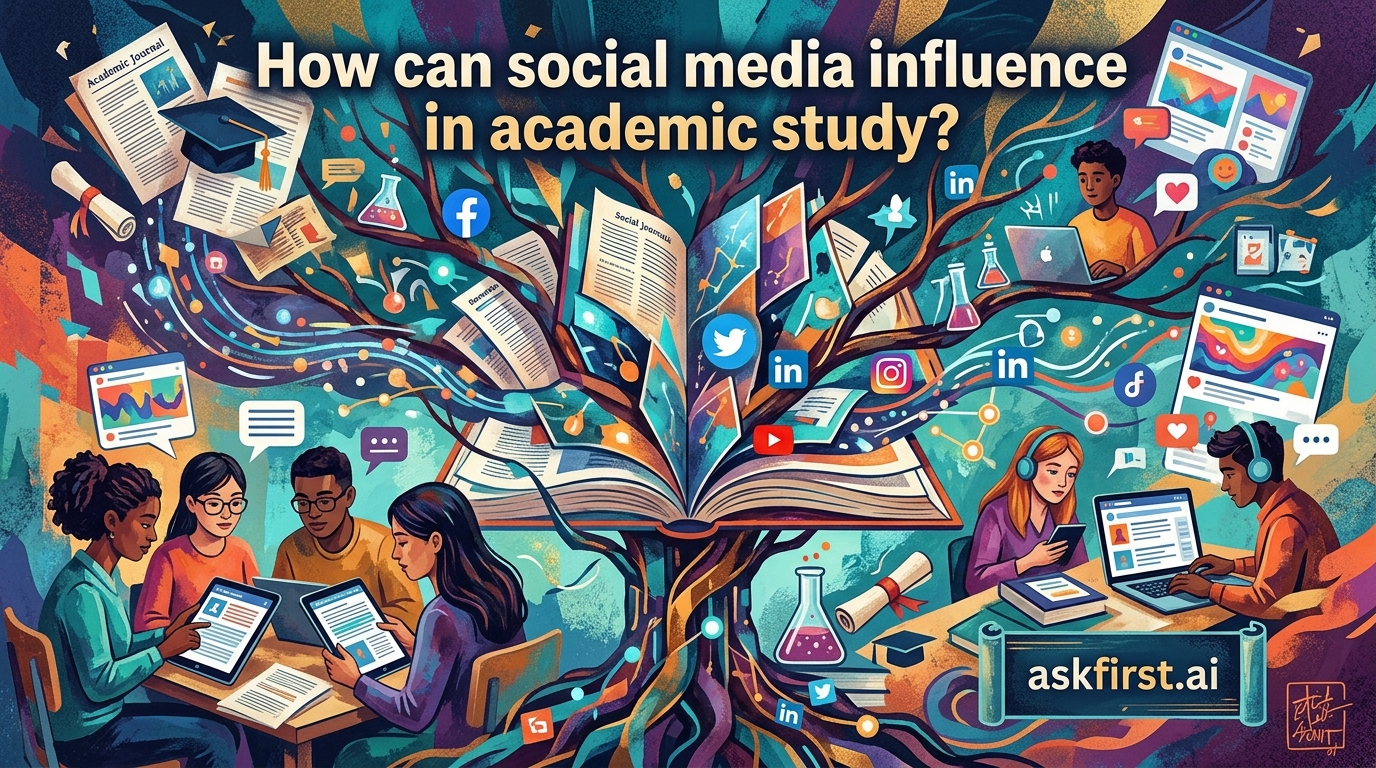
One of the most significant positive influences of social media on academic study is the democratization of information and the facilitation of peer-to-peer learning. Platforms such as Discord, Slack, and even specialized Facebook groups have become modern-day "study halls" where students transcend geographic boundaries to solve complex problems.
In his seminal work, Digital Habitats: Stewarding Technology for Communities (2009), Etienne Wenger, Nancy White, and John D. Smith argue that learning is a social process that thrives in communities of practice. Social media allows for the instantaneous formation of these communities. For example, a student struggling with a complex calculus proof can post a question to a specialized subreddit like r/learnmath and receive explanations from experts or peers across the globe within minutes. This rapid feedback loop is a radical departure from the traditional classroom model, where students were historically limited to office hours or the availability of a tutor.
Furthermore, social media platforms serve as repositories for "crowd-sourced" knowledge. Students often use Twitter (now X) or LinkedIn to follow leading academics, industry practitioners, and research journals. This allows learners to stay abreast of current trends and empirical findings that have not yet made it into standardized textbooks, effectively bridging the gap between theoretical study and real-world application.
Cognitive Fragmentation and the Attention Economy
Conversely, the pervasive nature of social media introduces significant challenges regarding cognitive load and attention management. The architecture of these platforms is designed to exploit the human brain’s reward system through intermittent reinforcement—the same mechanism that drives gambling addiction.
Dr. Cal Newport, a professor of computer science at Georgetown University, elaborates on this danger in his influential book, Deep Work: Rules for Focused Success in a Distracted World (2016). Newport posits that the ability to perform "deep work"—distraction-free concentration that pushes one's cognitive capabilities to the limit—is becoming increasingly rare. Social media acts as the primary antagonist to this state. When a student attempts to write a research paper while receiving intermittent notifications from Instagram or WhatsApp, they suffer from "attention residue." As Newport notes, even a brief shift in attention to a notification leaves a "residue" of thought that lingers on the distracting task, effectively lowering the quality of intellectual output and increasing the time required to complete cognitive tasks.
The constant need for digital validation, often quantified through "likes" and "shares," can also manifest as a form of academic anxiety. When students compare their own progress or grades against the curated, often idealized academic successes of others on social media, it can lead to burnout and a distorted perception of the learning process, which is inherently incremental and often fraught with failure.
Digital Literacy and the Curation of Information
The influence of social media on academic study is also heavily dependent on the user's level of digital literacy. Because social media platforms are largely algorithmic, they tend to create "echo chambers" that can reinforce confirmation bias. In an academic context, this is dangerous; it encourages students to seek out information that aligns with their pre-existing hypotheses rather than engaging with rigorous, peer-reviewed evidence.
To mitigate this, students must cultivate critical curation skills. Renowned educational theorist Henry Jenkins, in his book Confronting the Challenges of Participatory Culture (2009), emphasizes that the new media landscape requires a set of "new media literacies." These include the ability to judge the reliability of sources, the capacity to synthesize information from diverse digital perspectives, and the discernment to distinguish between high-quality scholarship and digital noise. Students who master these skills are far better equipped to use social media as a research tool rather than a distraction.
Strategic Integration: A Path Forward
To harness the benefits of social media while minimizing its detrimental effects, students must transition from passive consumption to intentional, strategic engagement. This involves:
- Boundary Setting: Implementing "time-blocking" techniques where social media is strictly prohibited during deep work periods.
- Curated Feeds: Actively unfollowing accounts that provide low-value content and following accounts that provide academic, professional, or intellectual enrichment.
- Active Participation: Moving beyond lurking and engaging in meaningful discussions or creating content that summarizes learning, which reinforces memory retention through the "Feynman Technique" of teaching others.
In conclusion, social media is neither inherently good nor bad for academic study; it is a powerful instrument that reflects the intentions of its user. While it offers unprecedented access to global collaboration and real-time knowledge, it simultaneously threatens the deep, singular focus necessary for profound intellectual growth. The modern scholar’s challenge is to master the digital environment, ensuring that technology serves as a scaffold for learning rather than a barrier to excellence. By cultivating disciplined digital habits and prioritizing deep work, students can successfully navigate the complexities of our hyper-connected age.