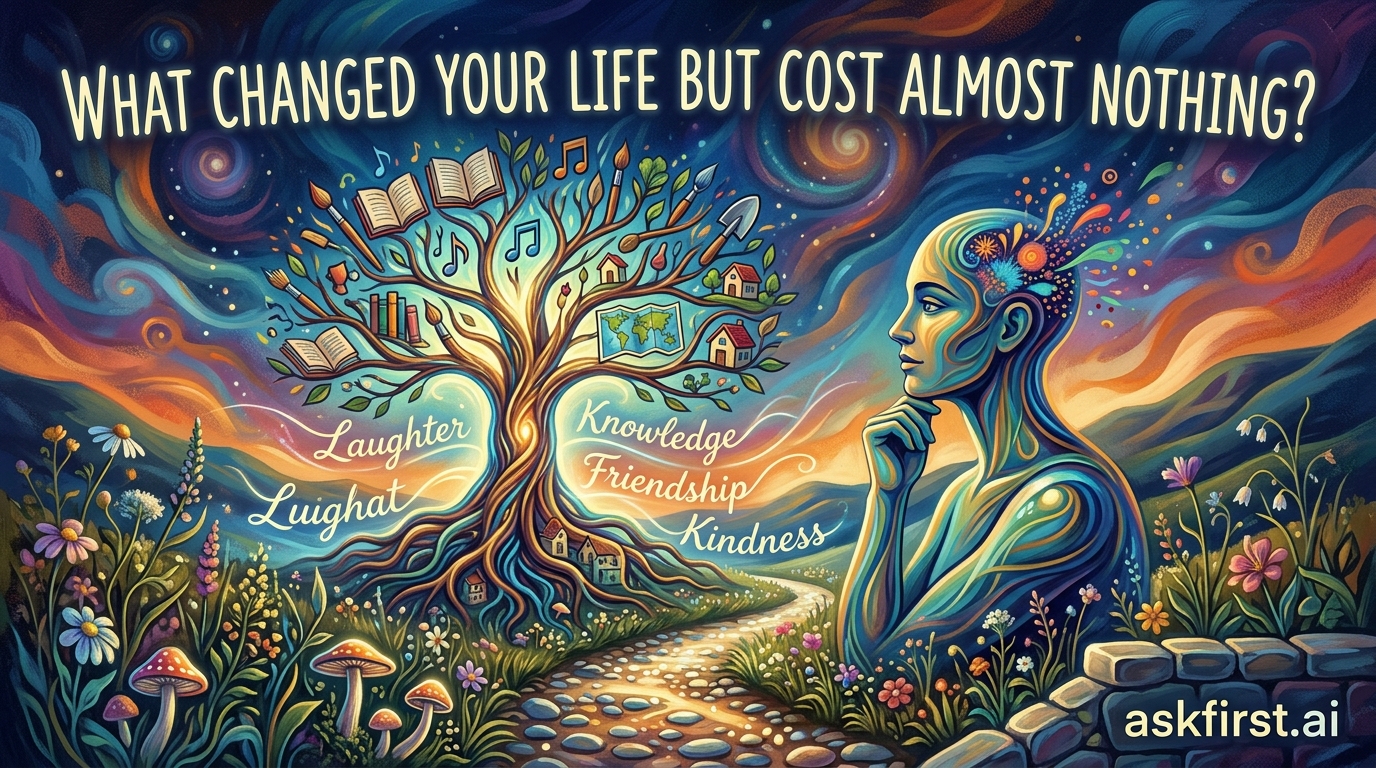
The pursuit of a transformative life experience is often mistakenly associated with high financial costs—expensive retreats, luxury travel, or cutting-edge technology. However, the most profound shifts in human cognition, physical health, and emotional stability are frequently rooted in practices that are entirely free of charge. The realization that time, attention, and discipline are the true currencies of self-actualization is a turning point for any individual. Below, I explore the life-altering power of three low-cost practices: the systematic practice of Stoic journaling, the implementation of deep-work intervals, and the adoption of the "beginner’s mind" through public library utilization.
The Stoic Practice of Reflective Journaling
Marcus Aurelius, the Roman Emperor whose private notes were never intended for publication, left us Meditations, a foundational text of Stoicism. What changed my life—and the lives of countless practitioners—was adopting his practice of the "evening review." This costs nothing more than a notebook and a pen, yet it functions as a high-fidelity diagnostic tool for the soul.
By setting aside ten minutes each evening to answer three specific questions—What did I do well? What did I do poorly? What must I do differently tomorrow?—one moves from a reactive state of existence to a proactive one. According to Ryan Holiday in The Obstacle Is the Way, the discipline of documenting one's reactions to daily stressors allows a person to detach from emotional volatility. When you write down your frustrations, you externalize them, turning a subjective crisis into an objective data point. This practice effectively bridges the gap between impulsive behavior and rational decision-making, providing a clarity that no therapist or expensive seminar can replicate.
Deep Work: The Architecture of Cognitive Mastery
In our modern attention economy, the ability to focus without distraction has become a rare and valuable commodity. Cal Newport, in his seminal work Deep Work: Rules for Focused Success in a Distracted World, argues that the capacity to perform deep work is the "superpower" of the 21st century. Implementing this costs zero dollars; it requires only the decision to disconnect.
The methodology is simple but grueling: isolate yourself for 90 to 120 minutes of uninterrupted, cognitively demanding work. During these blocks, you must eliminate all notifications, email tabs, and social media access. I have found that replacing the "shallow work" of constant connectivity with these deep, focused sessions shifts the brain’s neuroplasticity. Over months, your ability to synthesize complex information increases exponentially. The transformation is profound: you stop being a consumer of digital noise and become a producer of high-value output. This change doesn't happen at a desk bought at a high-end furniture store; it happens in the quiet, disciplined space of your own mind.
The Library as a Universal University
We live in an age where the sum of human knowledge is accessible for free, yet we often overlook the most potent resource: the public library system. Engaging with the library is not merely about borrowing books; it is about adopting the Shoshin or "beginner’s mind," a concept deeply rooted in Zen Buddhism and popularized in Western culture by Shunryu Suzuki in Zen Mind, Beginner's Mind.
By visiting a local branch and selecting a subject completely outside my professional expertise—such as macroeconomics, classical botany, or structural engineering—I forced my brain to build new neural pathways. The library acts as a equalizer, granting the same access to the works of Plato, Adam Smith, or Marie Curie to the pauper as to the prince. Reading one book per week on a subject you know nothing about will change your life faster than any expensive certification course. It builds intellectual humility and provides a breadth of context that informs every decision you make in your professional and personal life. As the writer Jorge Luis Borges famously envisioned, the library is a metaphor for the universe itself; by learning to navigate it, you learn to navigate reality.
Conclusion: The Economy of Transformation
The items that fundamentally alter the trajectory of a human life—clarity, focus, and knowledge—are rarely found behind a paywall. The Stoic journal turns chaos into order; deep work turns distraction into mastery; and the public library turns ignorance into wisdom. These practices require no capital investment, yet they yield the highest possible dividends: a life of intentionality, intellectual rigor, and emotional resilience.
To change your life, you do not need to spend money. You need to spend yourself—your focus, your honesty, and your time. By choosing to cultivate these internal resources, you move away from the superficiality of modern consumption and toward the profound stability of self-mastery. The most expensive thing you can possibly invest is your attention, and when you invest it wisely in these low-cost, high-leverage habits, the return on investment is infinite.