The Architecture of Resistance: Why Discipline Remains Elusive
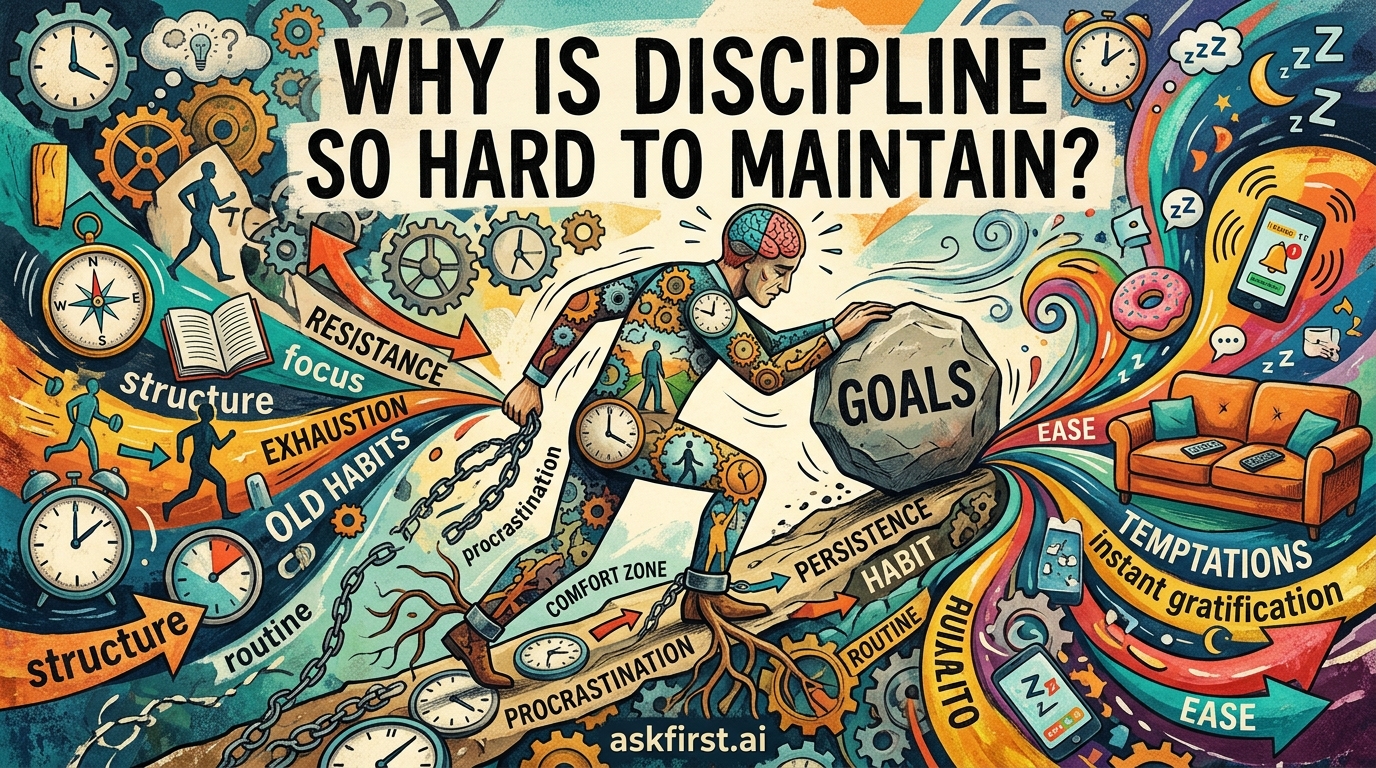
Discipline is frequently misunderstood as a simple matter of "willpower" or a static personality trait. In reality, maintaining discipline is a complex biological and psychological struggle against the human brain’s fundamental design. We are evolutionary creatures wired for immediate gratification, energy conservation, and pattern recognition, all of which often stand in direct opposition to the sustained, long-term focus required for modern disciplined living.
The Biological Imperative: Energy Conservation and the Brain
At the core of our difficulty with discipline is the brain’s mandate to conserve metabolic energy. As noted by neuroscientist Dr. Robert Sapolsky in his seminal work Behave: The Biology of Humans at Our Best and Worst (Penguin Press, 2017), the prefrontal cortex—the area of the brain responsible for executive function, impulse control, and long-term planning—is the most energy-expensive part of the human brain.
When we attempt to maintain discipline, we are essentially demanding that the prefrontal cortex remain in a state of high activity. The brain, seeking homeostasis, naturally resists this drain. It prefers the "low-road" of habitual, automatic behavior (the basal ganglia) over the "high-road" of conscious, effortful decision-making. Consequently, when you feel "tired" of being disciplined, you are often experiencing the literal metabolic fatigue of your executive brain systems.
The Dopamine Trap: Immediate Gratification vs. Delayed Reward
Modern society is engineered to hijack the brain’s reward systems. In The Molecule of More by Daniel Z. Lieberman and Michael E. Long (BenBella Books, 2018), the authors explain that the brain is driven by "dopamine circuits" that value the anticipation of a reward over the reward itself.
Discipline requires us to suppress the urge for immediate dopamine hits—such as checking social media, consuming sugar, or procrastinating—in favor of abstract, future-oriented goals. Because the brain struggles to visualize a reward that is months or years away with the same intensity as a sensory reward available right now, discipline feels like a constant uphill battle. We are fighting a biological system that evolved to prioritize "calories and safety now" over "success later."
The Myth of Willpower as an Infinite Resource
For decades, psychology operated under the theory of "ego depletion," popularized by Roy Baumeister in his research on self-control. While the nuance of this theory has evolved, the core premise remains relevant: discipline acts like a muscle that fatigues over the course of a day.
In Willpower: Rediscovering the Greatest Human Strength (Penguin Books, 2011), Baumeister and John Tierney highlight that our capacity for self-regulation is finite. Decisions, even small ones like choosing what to eat for lunch or answering emails, consume "decision fatigue" capital. By the time evening arrives, our internal reservoir for discipline is often drained, making us susceptible to impulsive behaviors. If you attempt to maintain strict discipline without accounting for this daily cycle of fatigue, you will inevitably hit a wall.
Environmental Design: The Invisible Architect
We often blame ourselves for a lack of discipline when the real culprit is our environment. Human beings are profoundly reactive to environmental cues. In Atomic Habits (Avery, 2018), James Clear argues that discipline is often less about internal fortitude and more about "choice architecture."
If your environment is cluttered with triggers—such as a smartphone on your desk or snacks in your pantry—you are forcing your brain to engage in a constant, subconscious battle of suppression. This "suppression" requires the very willpower you are trying to conserve. People who appear highly disciplined are often not exercising more willpower; they have simply curated environments that require less of it. They have replaced the need for "discipline" with the comfort of "habit."
The Psychological Barrier: Identity and Fear
Finally, discipline is often hard to maintain because it necessitates change, and change triggers the brain’s fear response. As explored in The War of Art by Steven Pressfield (Black Irish Entertainment, 2002), there is a force called "Resistance" that rises to meet any attempt to transform oneself.
Resistance is not just laziness; it is a psychological defense mechanism. When you commit to a disciplined path (e.g., writing a book, training for a marathon, or changing your career), you are essentially killing a version of yourself that is comfortable and familiar. The anxiety associated with this transition often manifests as a sudden, inexplicable loss of motivation. We avoid discipline because we are unconsciously afraid of the consequences of succeeding.
Conclusion
Discipline is difficult because it is an act of rebellion against our evolutionary programming. It requires us to override our brain's natural tendency toward energy conservation, our susceptibility to short-term dopamine rewards, and our fear of the unknown.
To master discipline, one must stop viewing it as a test of character and start viewing it as a system of management. By minimizing the number of decisions you make, designing environments that remove friction, and acknowledging the metabolic costs of focus, you can bridge the gap between who you are and who you intend to be. Discipline is not about being "stronger" than your impulses; it is about being smarter than your biology.