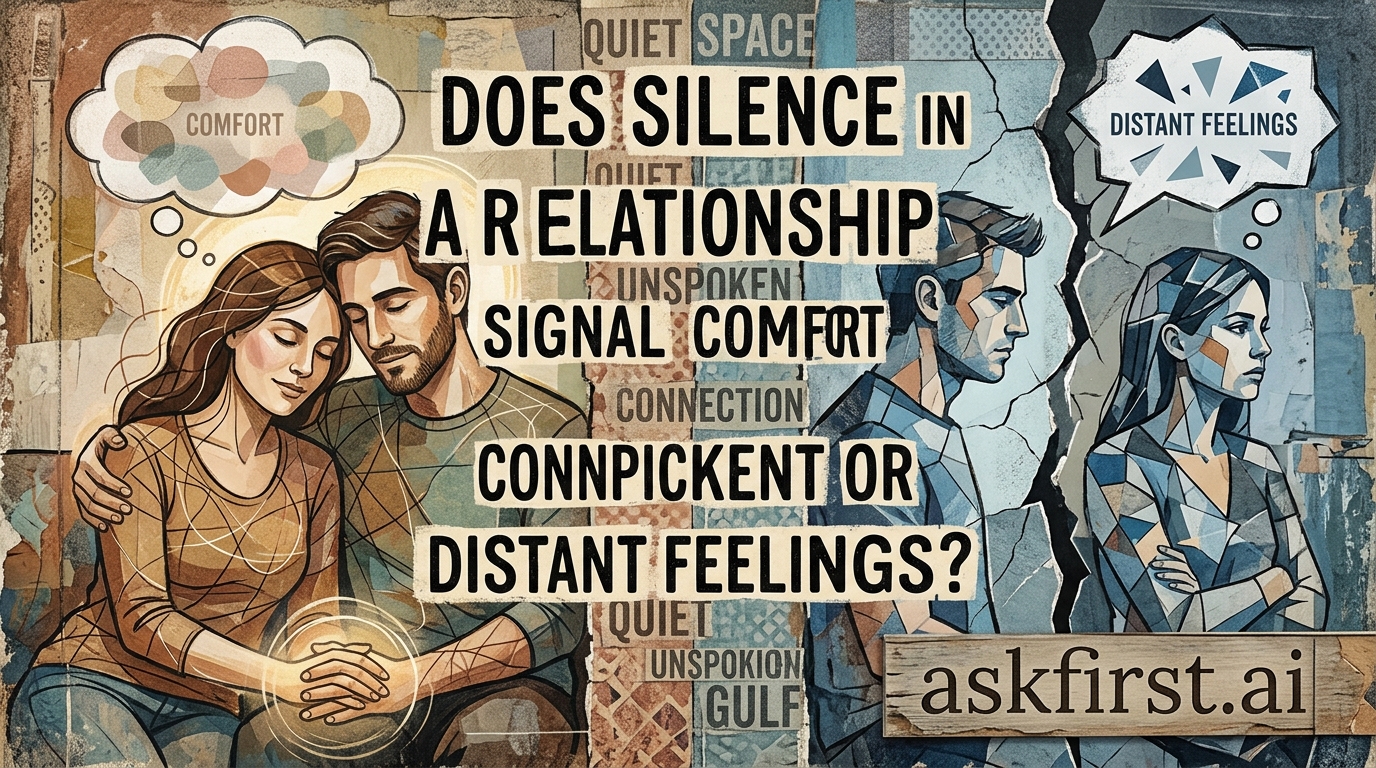
The Paradox of Quiet: Decoding Relational Silence
Silence within a romantic partnership is one of the most complex phenomena in human psychology. It occupies a liminal space where it can either signify the pinnacle of emotional security or the cold onset of disintegration. To understand whether silence is a bridge or a wall, one must look beneath the surface of the quiet to identify the underlying physiological and psychological cues.
The Anatomy of Comfortable Silence
Comfortable silence, often referred to as 'companionable silence,' is a hallmark of high-attachment security. According to attachment theory, when two individuals are securely attached, they do not feel a constant, frantic need to stimulate one another verbally to validate the relationship's existence.
- Low Physiological Arousal: In a state of comfortable silence, partners exhibit low heart rates and relaxed muscle tension. The nervous system feels safe, signaling that the 'threat' of abandonment is absent.
- Shared Flow States: This silence often occurs during parallel activities—reading side-by-side, cooking, or hiking. This is a form of non-verbal bonding where the presence of the other is perceived as a warm, protective envelope.
- The Absence of Defensiveness: There is no 'scanning' of the other person for signs of irritation. The silence is not a mask for suppressed grievances but an expression of profound mutual acceptance.
The Anatomy of Distant Silence
Conversely, distant or 'stonewalling' silence is fundamentally different. It is a protective, defensive mechanism. As observed in the research of Dr. John Gottman, chronic stonewalling—the act of withdrawing from an interaction while remaining physically present—is a leading predictor of relationship decay.
- High Physiological Arousal: During distant silence, one or both partners are often experiencing 'flooding,' where the nervous system is overwhelmed by conflict or resentment. The silence is a strategic withdrawal to prevent an emotional explosion.
- Active Avoidance: This silence feels heavy, pressurized, and brittle. It is often characterized by avoidant body language: lack of eye contact, tight jaw, or moving to a different room to maintain physical distance.
- The Echo of Unspoken Conflict: Unlike companionable silence, this form of quiet is filled with 'internal noise.' The partners are ruminating on grievances, rehearsing arguments, or feeling a sense of alienation from the other’s emotional world.
Distinguishing the Two: The 'Three-Second Test'
If one is unsure which silence is present, social psychologists suggest looking for the presence of 'bids for connection.'
- The Responsive Bid: If a partner breaks the silence to point out something minor—like a bird outside the window or a song on the radio—does the other respond with genuine interest or dismissive annoyance? In comfortable silence, the bid is received with ease. In distant silence, the bid is either ignored or treated as an intrusion.
- The Physiological Scan: During a quiet moment, notice the body. Does the chest feel open and soft, or does the gut feel tight? The body often detects emotional withdrawal long before the conscious mind acknowledges it.
- Contextual Awareness: Has there been an unresolved argument recently? Silence immediately following a conflict is almost never 'comfortable'; it is usually a manifestation of emotional processing or distancing.
Cultivating Healthy Silence
It is entirely possible to foster a relationship where silence acts as a sanctuary rather than a source of anxiety.
- Transparency About Needs: If one partner needs silence to decompress, communicating this effectively prevents the other from misinterpreting it as coldness. A simple, 'I am feeling a bit drained and need some quiet time to recharge, but I love being near you,' transforms a potentially worrying silence into an act of self-care.
- Rituals of Connection: When silence is balanced by intentional moments of high-quality conversation, the relationship remains resilient. Silence should be a period of rest between active engagements, not the entire duration of the relationship.
- Mindful Presence: Learning to be present without the need to 'do' or 'say' helps foster a deeper appreciation for the partner's intrinsic value, separate from their utility as a conversational partner.
Conclusion
Ultimately, silence is a mirror reflecting the current health of the emotional bond. When the foundation is strong, silence is a peaceful retreat. When the foundation is fractured, silence becomes a dangerous, insulating barrier. By becoming attuned to the physiological and behavioral markers of each, couples can move from fearing the silence to utilizing it as a tool for deeper, unspoken intimacy.