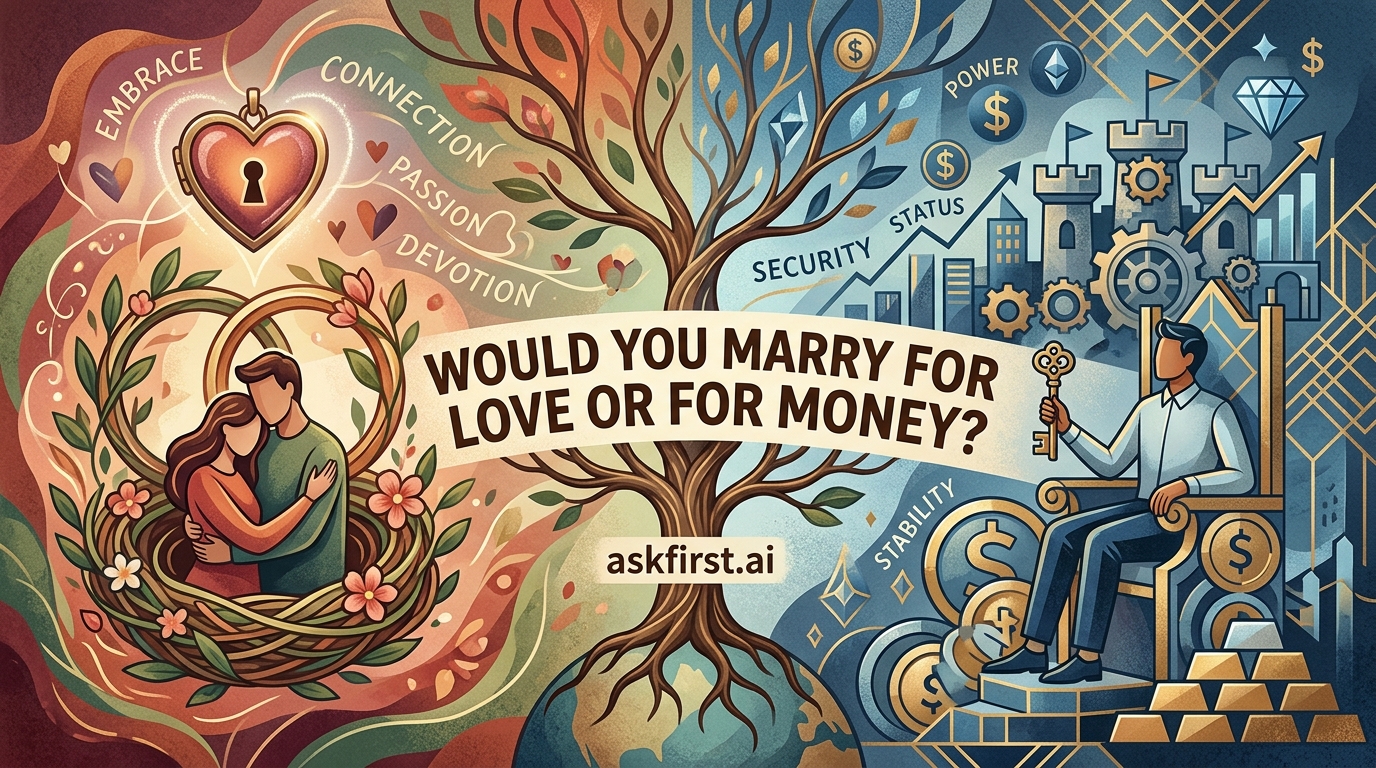
The question of whether to marry for love or for money is perhaps one of the oldest and most contentious debates in the history of human sociology and philosophy. Throughout the ages, poets, economists, and psychologists have weighed in on this dilemma, offering competing frameworks for how one should approach the most significant partnership of their life. To understand this choice, we must look beyond the binary framing and examine the socioeconomic, psychological, and historical underpinnings of marriage as an institution.
The Historical Evolution of Marriage
For most of human history, marriage was rarely about romantic love. As historian Stephanie Coontz outlines in her seminal work, Marriage, a History: From Obedience to Intimacy, or How Love Conquered Marriage, the institution was historically a mechanism for consolidating wealth, forging political alliances, and ensuring the survival of the lineage. In agrarian and aristocratic societies, marrying for "love" was often viewed as a dangerous, volatile, and impractical endeavor. It was only with the rise of the Enlightenment and the Industrial Revolution that the romantic ideal—the notion that one should marry only for deep emotional affection—became the cultural norm.
When we ask if one should marry for love or money, we are essentially navigating the tension between the modern romantic ideal and the ancient reality of resource management.
The Case for Financial Security: The Pragmatic Perspective
Those who argue for the importance of financial stability in marriage are often labeled "cynical," but from a sociological standpoint, they are often simply being realistic. Financial stress is consistently cited by researchers, including those at the Gottman Institute, as one of the leading predictors of divorce. When a couple enters a union without a stable foundation, the pressures of debt, housing insecurity, and daily survival can erode the emotional intimacy that love was supposed to protect.
In The Psychology of Money, Morgan Housel explores how our relationship with wealth defines our decision-making. Marriage is, at its core, a financial merger. If one marries purely for love while ignoring the fiscal reality of their partner, they may find that the "love" is eventually suffocated by the resentment and anxiety that accompanies financial instability. In this view, marrying for money is not necessarily an act of greed, but an act of seeking a "safety net" that allows for a more peaceful, low-conflict domestic life.
The Case for Love: The Psychological Imperative
Conversely, the psychological cost of marrying for money—without genuine affection or compatibility—is profound. Psychologists like Erich Fromm, in his classic book The Art of Loving, argue that love is not a passive feeling but an active, disciplined practice. Fromm posits that a marriage based solely on material gain is a form of "symbiotic union," where the individuals lose their autonomy and become merely appendages of a socioeconomic arrangement.
Without the emotional anchor of love, a marriage often lacks the resilience to weather the inevitable crises of life. When one marries for money, they are effectively entering a contract that is conditional on the stability of that wealth. If the money disappears or the lifestyle loses its luster, the entire rationale for the union evaporates. Love, by contrast, provides an intrinsic motivation to support one another through periods of poverty, illness, and tragedy. It acts as a buffer against the external pressures of a volatile world.
The Synthesis: The Modern "Strategic" Partnership
In the contemporary era, the most successful unions often reject the binary choice entirely. Many modern sociologists suggest that the healthiest approach is to prioritize "shared values and financial alignment" alongside emotional compatibility. This is not about choosing between love and money, but rather acknowledging that a marriage requires both to be sustainable.
Consider the concept of "conscious partnership." This involves vetting a potential spouse not just for how they make you feel, but for how they manage resources, how they view ambition, and whether their long-term life goals align with your own. If you marry someone you love but who is fundamentally irresponsible with money, you are setting yourself up for heartbreak. Conversely, if you marry someone wealthy but devoid of emotional connection, you are setting yourself up for profound loneliness.
Conclusion: The Holistic Choice
Ultimately, the decision to marry is a personal one, but it is one that should be informed by a clear-eyed understanding of what a marriage requires to last. If we look to the wisdom of philosophers like Alain de Botton, particularly in his essay On Love, we realize that we are often looking for the wrong things in a partner. We often prioritize either the "romantic" or the "utilitarian," failing to see that a successful marriage is a collaborative project.
To marry for love is to invest in the emotional longevity of the union; to marry for financial security is to invest in its structural stability. The wisest course of action is to seek a partner who inspires your love while simultaneously sharing your fiscal values. By doing so, you ensure that your partnership is not merely a fleeting emotion or a cold business transaction, but a robust, enduring foundation for a life well-lived. Balance, in this as in all things, remains the key to enduring happiness.