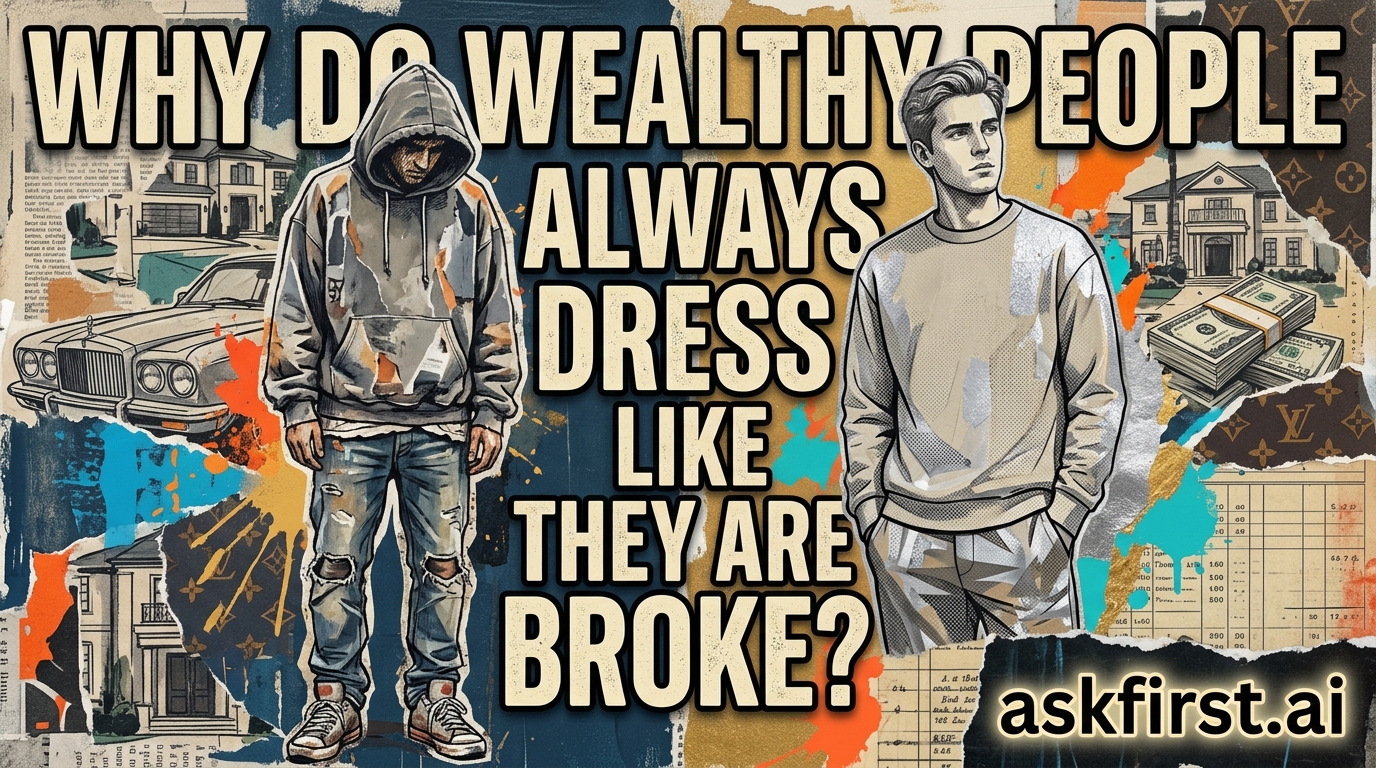
The Psychology of Stealth Wealth
In the modern era, the visual language of affluence has undergone a profound transformation. Rather than displaying overt markers of success—such as ostentatious logos, flashy jewelry, or expensive designer labels—many of the world's most affluent individuals have adopted an aesthetic commonly referred to as 'Stealth Wealth' or 'Quiet Luxury.' This phenomenon involves dressing in minimalist, high-quality, yet seemingly unassuming garments that mimic the appearance of a more modest socioeconomic status. Understanding why this trend persists requires an analysis of human psychology, social signaling, and the shifting dynamics of power.
The Signaling Theory and Social Distinction
Sociologist Pierre Bourdieu once noted that social classes define themselves not just through economic capital, but through 'cultural capital.' For the ultra-wealthy, the desire to distinguish oneself from the 'nouveau riche' is paramount. When luxury branding becomes accessible to the mass market through entry-level goods, the value of that signal diminishes. Wealthy individuals, therefore, pivot toward a new, more exclusive code. By wearing an unbranded, plain gray cashmere sweater that costs thousands of dollars, they signal their status to a highly specific in-group—those who possess the 'cultural code' to recognize the quality of the fabric and the precision of the tailoring—while appearing entirely 'broke' or nondescript to the general public.
The Comfort and Pragmatism Factor
Beyond status games, there is a fundamental psychological shift toward pragmatism. Many high-net-worth individuals have spent years navigating high-stakes environments where efficiency is the primary metric of success. Wearing simple, high-quality, 'uniform-like' clothing minimizes 'decision fatigue.' This concept, popularized by figures such as Steve Jobs and Mark Zuckerberg, suggests that by removing the need to curate a different outfit every day, one saves mental bandwidth for more critical professional or creative pursuits. When one has the financial security to not need to impress others, clothing becomes a functional tool for comfort rather than a costume for social climbing.
Psychological Security and Anonymity
There is also a profound desire for anonymity that accompanies extreme wealth. For individuals whose lives are constantly under scrutiny, the ability to blend into a crowd is a form of psychological liberation. Overt displays of wealth invite unwanted attention, solicitation, and potential security risks. Dressing in a way that suggests a middle-class or working-class background allows the wealthy to traverse the world with a sense of freedom. It is an exercise in 'social camouflage,' permitting them to observe society without being the focal point of its biases or expectations.
The 'Authenticity' Premium
In contemporary culture, there is a growing valorization of authenticity and 'realness.' The modern affluent individual often aspires to a brand of cool that feels unforced. Overt luxury can be perceived as desperate or try-hard, whereas a understated, 'broke-looking' aesthetic suggests that the person is confident enough in their position that they do not need to advertise it. It is the ultimate display of power: the power to ignore the societal expectation to perform wealth. This is often referred to as the 'Veblen Good' inversion, where the rarity lies not in the object itself, but in the indifference toward the object's public perceived value.
Summary of Key Drivers
- Internal Recognition: Signaling to one's own peer group through subtle quality markers rather than loud labels.
- Cognitive Load Reduction: Using a minimalist wardrobe to save mental energy.
- Security and Freedom: Maintaining personal safety through intentional lack of ostentation.
- Cultural Distinction: Avoiding the 'mass-marketed' look of traditional designer fashion.
The Future of 'Broke' Dressing
As the divide between high-end fashion and streetwear continues to blur, this trend of intentional understatement will likely endure. It represents a shift from material accumulation to material curation. The wealthy are not dressing like they are broke; they are dressing in a way that prioritizes their own internal values over the external gaze of society. By choosing pieces that are timeless, durable, and understated, they are investing in a personal aesthetic that transcends fleeting trends, ensuring that their style remains relevant and dignified regardless of the changing tides of global fashion. Ultimately, the choice to dress 'simply' is not a lack of taste, but the highest form of self-assured expression.