Understanding the distinction between "make" and "made" is fundamental to mastering English grammar and syntax. At its core, the difference is one of temporal orientation: "make" is the base form of the verb (present tense), while "made" is the past tense and past participle form. While this may seem straightforward, the nuances of their usage, collocations, and idiomatic implications are vast and require a structured approach to fully grasp.
The Grammatical Foundation: Present vs. Past
The verb "to make" is an irregular verb, which means it does not follow the standard "-ed" pattern for forming the past tense. Instead, it undergoes a vowel shift.
"Make" (Present Tense):
Used to describe actions that are habitual, currently occurring, or general truths. It implies the act of creating, constructing, or forcing something into existence.
Example: "I make a pot of coffee every morning at 7:00 AM." In this context, the action is routine and ongoing.
"Made" (Past Tense/Past Participle):
Used to describe actions that have already been completed. It signifies that the creation or construction occurred at a specific point in the past or has been finalized.
Example: "She made a profound impact on the industry during her tenure." Here, the action is viewed as a finished historical event.
The Etymology and Conceptual Evolution
The verb "make" finds its roots in the Old English word macian, meaning "to construct, do, or produce." As noted by linguist David Crystal in The Cambridge Encyclopedia of the English Language, the evolution of the verb has shifted from purely physical construction to a highly abstract causative verb.
When we use "made," we are often invoking the sense of "creation from components." Whether it is a physical object (a table) or an abstract construct (a decision), the term "made" suggests a transformation. In "The Elements of Style" by William Strunk Jr. and E.B. White, the authors emphasize the importance of using strong verbs; "make" and "made" are often criticized by editors for being "weak" verbs when a more descriptive alternative (like "crafted," "forged," or "assembled") exists. However, their utility remains unmatched for general communication.
Causative Usage: Making Things Happen
A critical distinction lies in how these words function in causative structures. The pattern is typically Make/Made + Object + Verb (bare infinitive).
- Present: "The loud music makes me feel anxious." (The effect is present and ongoing.)
- Past: "The loud music made me leave the party." (The effect occurred in the past, leading to a specific result.)
This construction is common in professional and casual settings alike. Notice that the verb following the object does not take "to" (e.g., "made me leave," not "made me to leave"). This is a common stumbling block for learners, as identified by Michael Swan in his seminal work, Practical English Usage.
Idiomatic Expressions and Collocations
The choice between "make" and "made" is often dictated by the idiomatic expression being used. English is replete with set phrases that do not allow for tense flexibility if the meaning changes.
- "Make a difference": This is a present-tense idiomatic phrase. To describe a past effect, you must shift to "made a difference."
- Example: "We want to make a difference in our community; last year, we made a difference by funding the library."
- "Made in [Location]": This is a specific past participle usage denoting the origin of manufacture. You would never say "Make in China" for a product label, as the manufacturing process is complete. This is discussed in depth in "English Grammar in Use" by Raymond Murphy, which highlights how the past participle functions as an adjective in this context.
The Creative Process: A Comparison of Intent
If you are writing a manual or a recipe, the distinction is usually chronological. "Make the dough" is an instruction for the future/present, while "The dough was made by hand" is a retrospective report.
Consider the difference in impact:
- "I make my own rules." This suggests a philosophy of life—a persistent, present-day stance.
- "I made my own rules." This suggests a historical accomplishment—a realization of autonomy that occurred in the past.
Conclusion
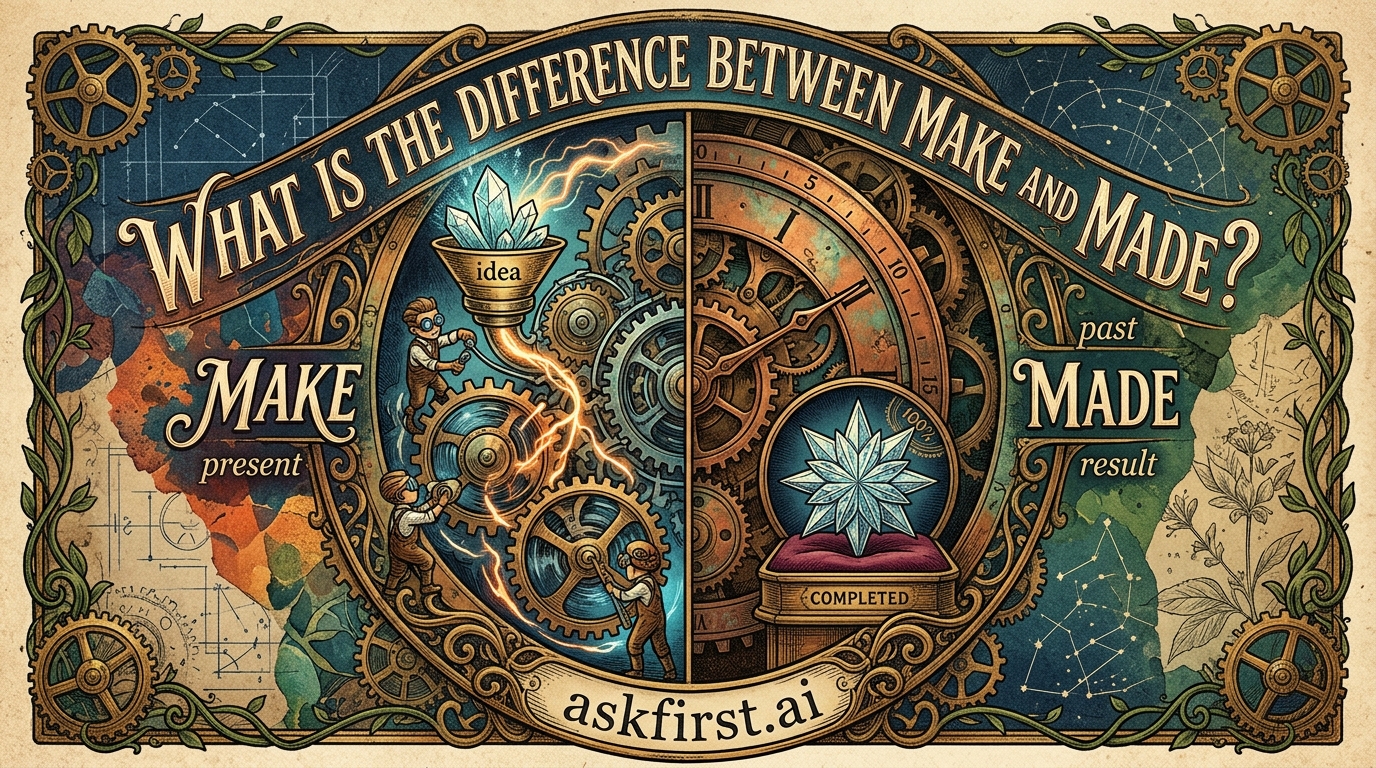
The difference between "make" and "made" is defined by the timeline of the action. "Make" is the engine of the present—the act of creation in real-time, the habit, or the general rule. "Made" is the record of the past—the completed object, the finalized decision, or the historical event.
By understanding the grammatical rules laid out by scholars like Swan and the stylistic guidance of Strunk and White, one can navigate these terms with confidence. Whether you are constructing a sentence about your daily routine or reflecting on a past achievement, the shift from "make" to "made" is the shift from potentiality to reality. Mastery of this simple transition is essential for clear, professional, and precise English communication.