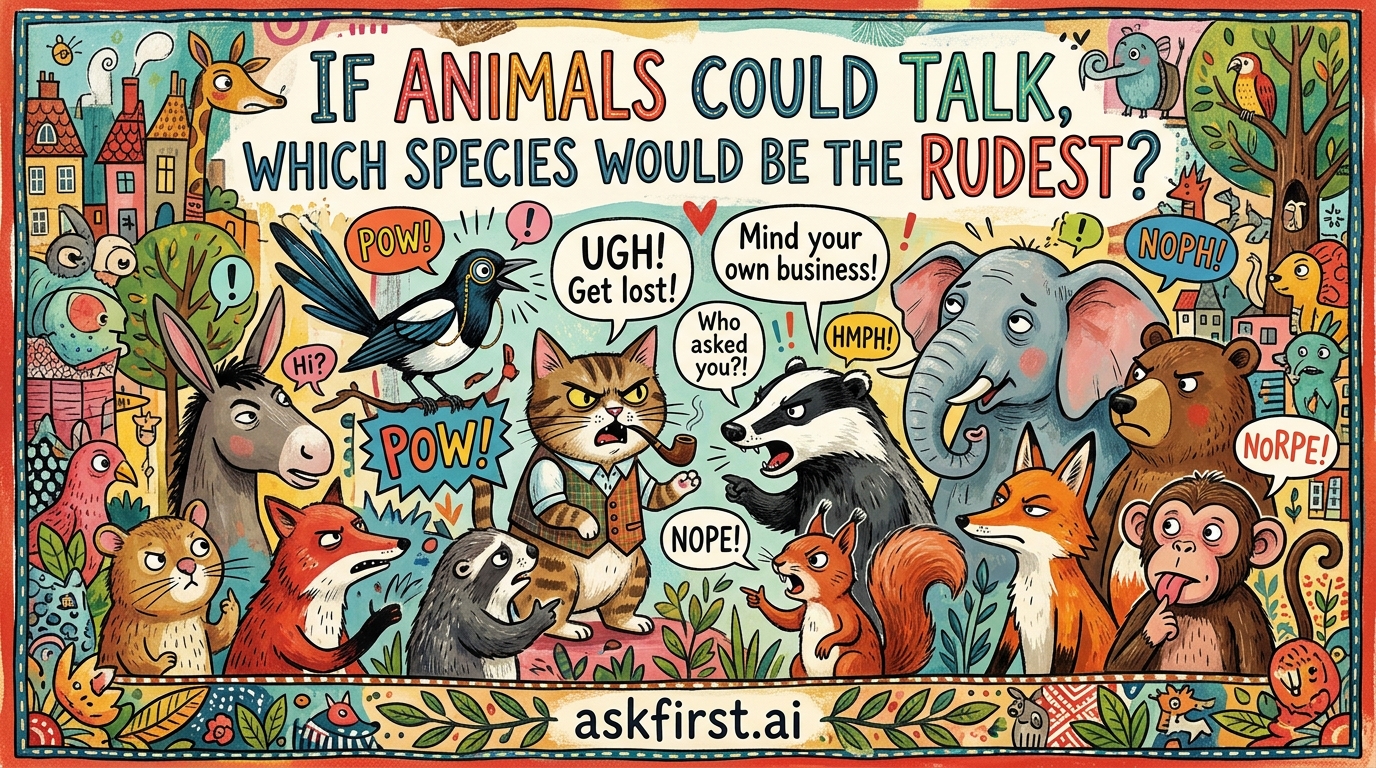
The hypothetical scenario of animal communication is a subject that has fascinated biologists, linguists, and philosophers for centuries. While we often anthropomorphize animals as gentle, noble, or misunderstood, a biological perspective suggests that if the barrier of language were removed, the "rudeness" of a species would likely be a direct reflection of its evolutionary survival strategy. In the animal kingdom, behaviors that we perceive as rude—interruption, territorial aggression, theft, or social dominance—are often essential survival mechanisms.
The Case for the Seagull: The Opportunistic Bully
If one were to crown a champion of rudeness, the Seagull (Laridae family) would be the undisputed frontrunner. Anyone who has visited a coastal boardwalk knows the experience: a sandwich stolen directly from one's hand, accompanied by a piercing, mocking shriek.
In The Beak of the Finch by Jonathan Weiner, the author details how species like the gull have evolved to exploit human-dominated environments. If gulls could talk, their communication would likely lack the nuance of social etiquette. Their entire existence is predicated on brazen opportunism. A gull wouldn't ask for a piece of your lunch; it would likely demand it with a level of entitlement that would make a human aristocrat blush. Their "language" would be a series of crude, high-decibel commands designed to intimidate, distract, and dominate. Because gulls operate in highly competitive, resource-scarce environments, they have no incentive to be polite. Their rudeness is a highly efficient tool for caloric acquisition.
The Territorial Tyranny of the House Cat
While dogs are often characterized by their eagerness to please, domestic cats (Felis catus) occupy a different psychological space. As noted by John Bradshaw in his seminal book Cat Sense: How the New Feline Science Makes You a Better Cat Owner, cats have not been domesticated in the same way dogs have; they have essentially domesticated themselves to live alongside us while retaining their predatory instincts.
If cats could talk, they would likely be the masters of the "backhanded compliment" or the cold, dismissive silence. A cat’s rudeness would be intellectual and aloof. They are solitary hunters who do not rely on the complex social hierarchies of pack animals to survive. Consequently, they would likely view human attempts at conversation as tedious or beneath them. Imagine a cat interrupting a deep conversation to point out your perceived flaws or simply walking away while you are mid-sentence. That level of dismissiveness is not born of malice, but of a fundamental lack of concern for the social contract—a trait we humans define as the height of rudeness.
The Brutal Honesty of the Honey Badger
The Honey Badger (Mellivora capensis) is renowned for its sheer lack of fear, a trait famously documented in the research of Dr. Hans Kruuk in his studies on African carnivores. The honey badger does not care about your social standing, your feelings, or your personal space.
If a honey badger could talk, it would be the embodiment of "brutal honesty." It would likely be the creature that tells you exactly why your job is meaningless or why your physical appearance is suboptimal, simply because it possesses the confidence of a creature that can fight off a lion. Their rudeness would be aggressive and confrontational. They are wired for conflict, and their verbal discourse would likely consist of constant challenges to authority. In a human social setting, the honey badger would be the person who starts a fight at a dinner party for no reason other than to prove they are the most dangerous person in the room.
Why Rudeness is a Human Construct
It is vital to recognize that "rudeness" is a human social construct designed to regulate group behavior and minimize friction. Animals exist in a state of "radical honesty." When a chimpanzee—our closest genetic relative, as described by Frans de Waal in Our Inner Ape—displays aggression, it is a clear, unambiguous communication of power.
If these animals could talk, they would not be "rude" in the way we understand the term; they would simply be efficient. We perceive an animal as rude when it violates our social expectations. However, in the wild, the concept of "waiting your turn" or "using polite language" is a luxury that would likely lead to starvation or predation. The species that would seem the rudest to us—the gull, the cat, and the honey badger—are simply the species whose survival strategies are the most antithetical to the polite, cooperative, and indirect communication style that defines human society.
Conclusion
If the animal kingdom suddenly gained the power of speech, our perception of the natural world would likely shift from one of romanticized wonder to one of jarring, ego-shattering confrontation. We would find that the creatures we admire for their beauty or ferocity are, by our standards, incredibly selfish and blunt. The seagull would be the neighborhood thief, the cat would be the condescending intellectual, and the honey badger would be the social pariah who refuses to follow any rules. Ultimately, their "rudeness" would be a stark reminder that the social niceties we cherish are not universal truths, but rather fragile inventions meant to keep our own species from devolving into the very chaos that defines the rest of the wild.