The Psychology of Minimalist Wardrobes
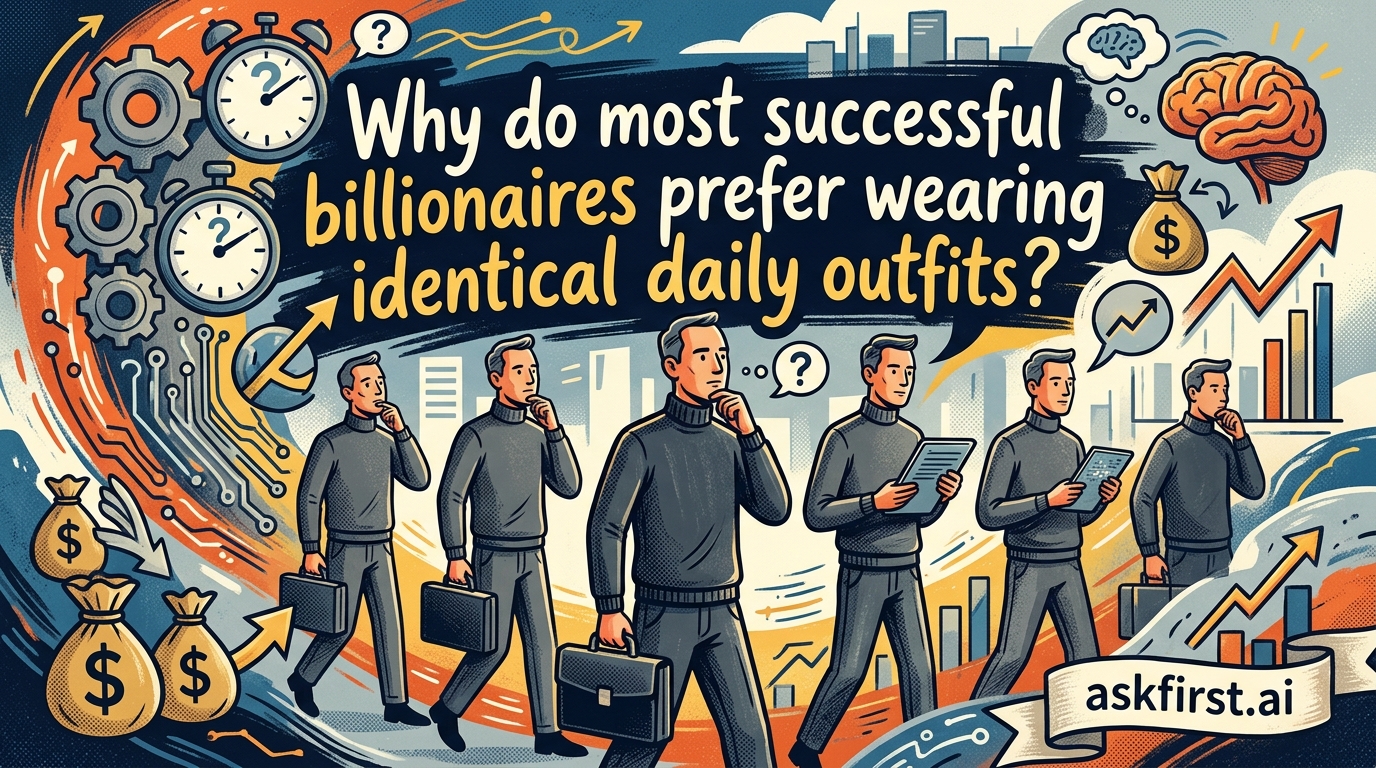
The phenomenon of billionaire icons—such as the late Steve Jobs, Mark Zuckerberg, or Christopher Nolan—consistently wearing identical or highly uniform daily outfits is not a matter of a lack of fashion sense. Rather, it is a deliberate, highly calculated strategy rooted in Decision Fatigue and Cognitive Efficiency. By removing the trivial choice of what to wear every morning, high-performers preserve their mental bandwidth for the complex, high-stakes decisions that define their professional success.
1. Combating Decision Fatigue
Decision fatigue is a psychological construct suggesting that the quality of decisions deteriorates after a long session of decision-making. Every choice made throughout the day, from selecting breakfast to prioritizing emails, consumes a portion of our cognitive energy. By eliminating the 'wardrobe variable,' these individuals ensure that their 'decision budget' remains fully stocked for critical matters, such as product architecture, resource allocation, or strategic vision. When you are responsible for multi-billion dollar ecosystems, the marginal utility of choosing between a blue shirt and a green shirt is essentially zero.
2. The Concept of Visual Uniformity
Uniformity acts as a form of Personal Branding. A signature look—such as Steve Jobs’ black turtleneck and jeans or Zuckerberg’s grey t-shirt—creates an instant, recognizable identity. This serves several psychological functions:
- Memorability: A consistent visual aesthetic makes the individual instantly recognizable, which is vital for building a global brand identity.
- Reduced Social Complexity: By removing the social signaling usually associated with fashion trends, these leaders redirect focus toward their work rather than their exterior presentation.
- Efficiency and Predictability: Knowing exactly what to put on each day removes the need for physical space and management, streamlining the morning routine into a high-performance ritual.
3. Focus on 'Essentialism'
Essentialism is the disciplined pursuit of less. For many billionaires, the goal is to filter out the noise and focus on what truly matters. In an environment saturated with infinite choices—thanks to modern fast fashion and social pressure—adopting a 'uniform' is a form of defiance. It signals that the individual has outgrown the need for social validation through status-signaling garments. This shift allows for a laser-like focus on long-term goals. As research in consumer psychology indicates, limiting choices can lead to greater levels of happiness and satisfaction, as it removes the 'paradox of choice'—a state where having too many options causes anxiety and dissatisfaction.
4. Maximizing Cognitive Bandwidth
Consider the sheer volume of information a CEO processes daily. If an individual saves five to ten minutes every morning by not deciding on an outfit, those minutes add up to significant hours over a year. More importantly, it is not about time; it is about energy management. Brainpower is a finite resource. Elite athletes, chess grandmasters, and top-tier executives all practice energy management to ensure their cognitive performance remains at its peak during critical periods. The uniform is essentially a mental shortcut that clears the desk for deeper cognitive processing.
5. Practicality and Sustainability
Beyond psychology, there is a pragmatic argument for identical wardrobes. High-quality items purchased in bulk are easier to manage and maintain. This lifestyle approach is often adopted by those who view their lives through the lens of productivity systems. If an item functions perfectly, is comfortable, and presents a neutral aesthetic, there is no logical reason to replace or diversify it. This mindset creates a sustainable loop: the individual stops chasing seasonal trends, saves money (or invests it), and reduces the psychological friction of keeping up with ever-changing fashion standards.
Conclusion: The Ultimate Performance Hack
In essence, the choice of identical daily attire is a masterclass in lifestyle engineering. By outsourcing trivial decisions to a pre-defined system, successful billionaires gain total control over their mental environment. While the world remains distracted by the 'paradox of choice,' those who opt for a 'monotone' wardrobe are quietly optimizing their lives for maximum impact. It is a reminder that excellence is rarely found in the complexity of one’s clothes, but in the clarity of one’s mind. Embracing such minimalism, even for the average person, can serve as a catalyst for greater focus and reduced stress in a chaotic, choice-heavy world.