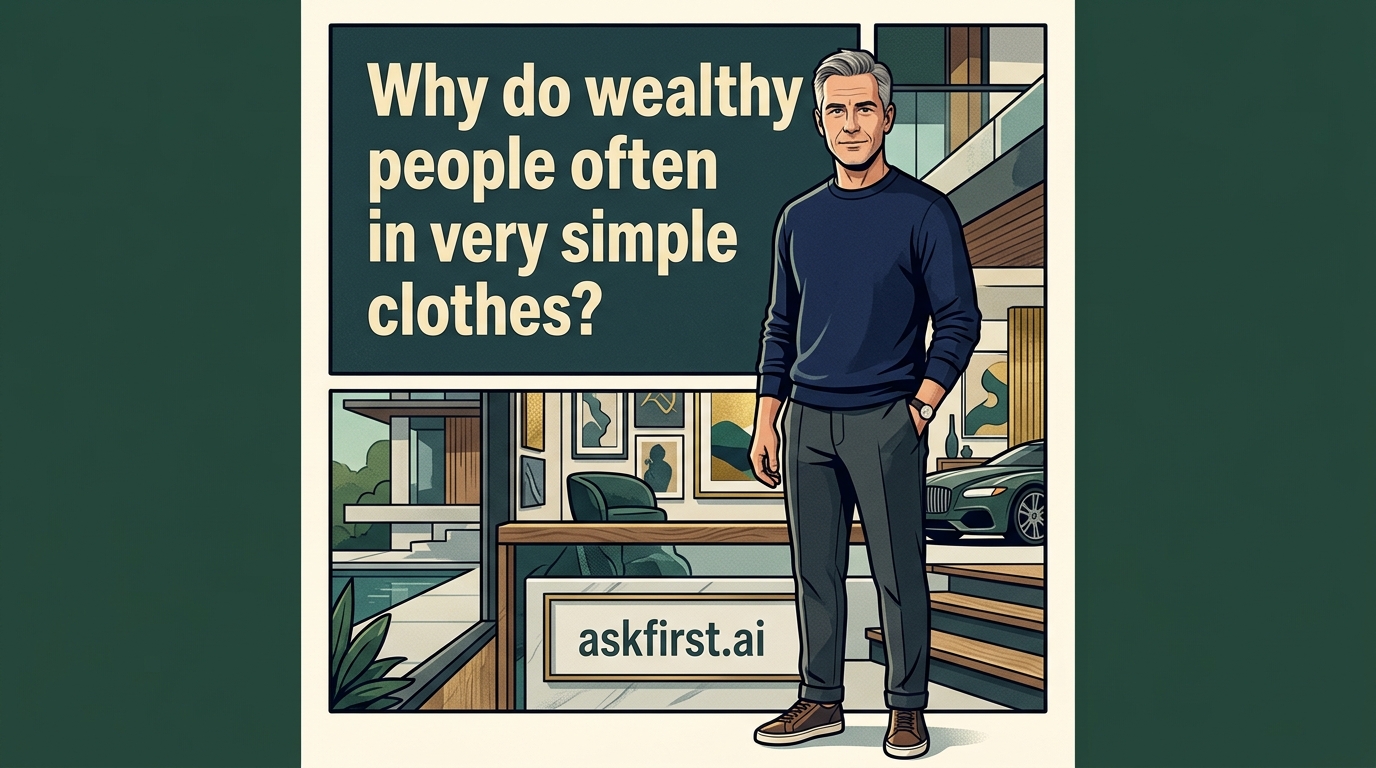
The Psychology of Minimalist Wealth: Beyond the Brand
It is a striking paradox observed by social scientists and fashion historians alike: as net worth climbs into the multi-million and billionaire tiers, the flamboyant displays of designer logos and ostentatious jewelry often vanish, replaced by plain gray T-shirts, simple dark denim, or monochromatic hoodies. This phenomenon is not merely a stylistic choice; it is a profound behavioral strategy grounded in cognitive efficiency, signaling theory, and the preservation of personal autonomy.
1. Cognitive Load and Decision Fatigue
One of the most compelling explanations for the 'billionaire uniform' is the concept of decision fatigue. High-level executives, visionary founders, and ultra-wealthy individuals are required to make hundreds of high-stakes decisions every day. From capital allocation to strategic pivots, the mental energy expended on professional matters is immense. By adopting a uniform, these individuals minimize 'decision churn'—the cumulative exhaustion caused by trivial daily choices. As noted in psychological studies regarding willpower, the brain has a finite capacity for executive function; by automating the choice of clothing, wealthy individuals reserve their cognitive resources for high-value decision-making.
2. The Theory of 'Quiet Luxury' and Signaling
In the realm of sociology, status signaling is a complex language. Traditional conspicuous consumption, often termed 'Old Money' versus 'New Money' markers, suggests that those who feel the need to broadcast their wealth via logos are often striving for validation. Conversely, the truly wealthy often engage in what is known as 'inconspicuous consumption.' They favor high-quality fabrics, impeccable tailoring, and subtle branding—elements that are recognizable only to their peers. This acts as an exclusionary social signal: the 'in-crowd' understands the value of a $500 cashmere sweater that looks identical to a $20 version, while the rest of the world remains unaware. It is a discreet form of tribal identification.
3. Intellectual Authenticity and 'The Creative Genius' Archetype
There is a deeply ingrained cultural narrative that equates simplicity with intellectual depth. The archetypal 'genius' is often depicted as someone too preoccupied with grand ideas to care about their appearance. By dressing in simple, unbranded clothing, high-net-worth individuals align themselves with the image of a creator rather than a consumer. This aesthetic reinforces the perception that their value lies in their output, their inventions, or their leadership, rather than in their social performance. It communicates that their internal world is significantly more vibrant and complex than their external presentation.
4. The Shield Against Social Pretense
Wealth attracts attention, and often, that attention comes with expectations of generosity, investment, or social favors. Dressing in a way that minimizes one’s socio-economic footprint allows wealthy individuals to navigate society with a greater degree of anonymity. This is particularly relevant in social settings where they wish to be evaluated as people rather than as bank accounts. By avoiding the 'wealthy' aesthetic, they lower the guard of those around them, enabling more authentic interactions and preventing the immediate emergence of sycophants who are drawn to signs of affluence.
5. Prioritization of Functionality Over Form
When an individual has reached the apex of their industry, the utilitarian aspect of clothing takes precedence. Wealthy individuals, particularly in technology and venture capital, prioritize high-performance materials. They often opt for clothing that is durable, comfortable, and versatile enough to transition from a boardroom meeting to a late-night coding session or an international flight. The focus shifts from 'how does this look' to 'how does this serve my lifestyle?' This transition reflects a confidence that does not require external validation to feel secure.
Summary of Principles
- Efficiency: Eliminating micro-decisions frees mental bandwidth.
- Exclusivity: Quiet luxury signals status to an elite cohort.
- Authenticity: Prioritizing output over appearance mirrors the archetype of the innovator.
- Utility: A focus on high-performance materials serves the demands of a high-pressure lifestyle.
Ultimately, the shift toward simplicity is an expression of complete psychological control. It represents a state of existence where the individual is no longer governed by the expectations of the masses or the desire for peer approval. It is the ultimate luxury: the freedom to be entirely comfortable, entirely functional, and entirely oneself in a world that is obsessed with appearances.