The Illusion of Simplicity: Navigating the Complexity of the Mundane
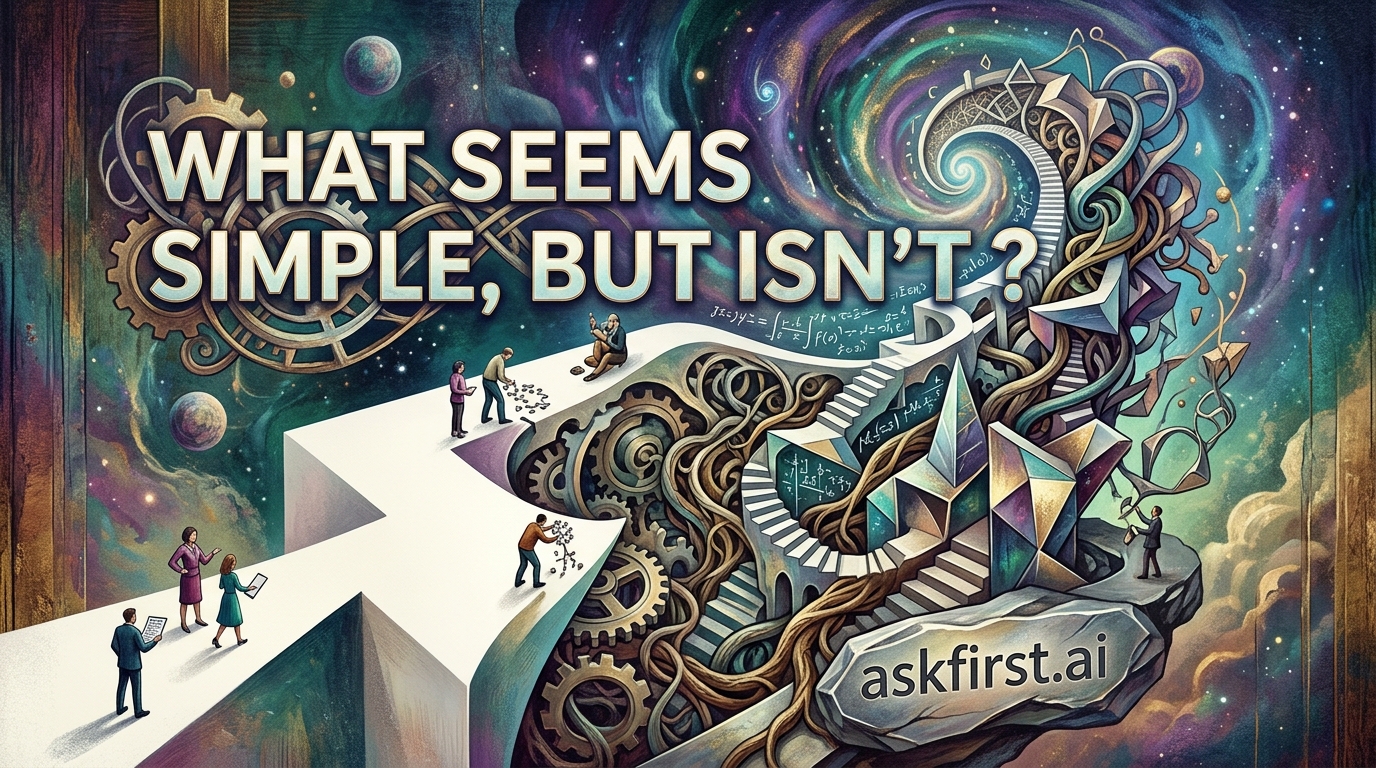
In our modern, high-speed world, we are often seduced by the appearance of simplicity. We look at a perfectly brewed cup of coffee, the act of walking across a room, or the phrasing of a simple sentence, and we assume these are rudimentary tasks. However, as we peel back the layers, we discover that what appears simple is often a fragile veneer covering profound biological, physical, or systemic complexity. This phenomenon is known in systems theory as "the illusion of transparency"—the tendency to assume that because we understand the outcome, we understand the process.
1. The Physics of Human Locomotion
To the average observer, walking is the quintessence of simplicity. We put one foot in front of the other, and we arrive at our destination. Yet, as Dr. Steven Vogel explores in his seminal work Prime Mover: A Natural History of Muscle, locomotion is a masterpiece of mechanical engineering.
When you take a step, your body is essentially performing a series of controlled falls. Your brain must calculate the center of mass, adjust for micro-variations in terrain, and signal hundreds of muscles to fire in a precise, millisecond-synchronized sequence. If you were to program a robot to mimic human walking—as seen in the ongoing research at the Boston Dynamics labs—you would quickly realize that maintaining dynamic balance on two legs is one of the most difficult challenges in robotics. The "simple" act of walking requires the integration of the vestibular system (inner ear), proprioception (the sense of where your limbs are in space), and complex neural feedback loops that operate entirely outside of conscious awareness.
2. The Linguistics of a "Simple" Conversation
We often dismiss conversation as a trivial social exchange. However, linguistics expert Noam Chomsky, particularly in his foundational text Syntactic Structures, argues that language is an incredibly complex generative system.
Consider the sentence: "The cat that the dog chased ran away." To decode this, your brain must perform a hierarchical parsing of syntax, identify recursive structures, and retrieve semantic meaning from long-term memory, all within a fraction of a second. Furthermore, social communication involves what psychologists call "Theory of Mind"—the ability to attribute mental states to others. You are not just processing words; you are simultaneously decoding subtext, tone, cultural norms, and the listener's expectations. What feels like a casual chat is, in reality, a high-stakes computational feat that involves the Broca’s and Wernicke’s areas of the brain working in tandem with the prefrontal cortex.
3. The Economics of a Cup of Coffee
If you walk into a cafe and order a black coffee, you are participating in a global economic chain that is anything but simple. This is a concept famously illustrated by Leonard Read in his classic essay I, Pencil.
To bring that coffee to your cup, the process involves:
- Agronomy: Cultivating high-altitude Arabica beans, which requires specific soil pH levels and climate regulation.
- Logistics: The global shipping infrastructure that moves raw beans from regions like Ethiopia or Colombia to your local roaster.
- Chemistry: The thermodynamics of roasting, where the Maillard reaction must be perfectly controlled to achieve the desired flavor profile.
- Extraction: The physics of brewing, where water temperature, pressure, and grind size must align to pull the correct oils and acids from the bean.
No single person on earth knows how to make a cup of coffee from scratch—from mining the iron to build the roasting machine to harvesting the beans. The "simplicity" of your morning caffeine fix is actually a testament to the staggering efficiency of global cooperation and complex, decentralized supply chains.
4. The Biological Complexity of Sleep
We close our eyes, we drift off, and we wake up refreshed. To the sleeper, this is a passive, simple state of rest. However, neuroscientists like Matthew Walker, author of Why We Sleep, describe sleep as an incredibly active state of neurobiological maintenance.
During the night, your brain cycles through Non-REM and REM stages, effectively "cleaning" the neural pathways of metabolic waste via the glymphatic system. It consolidates memory, regulates emotional centers, and recalibrates hormonal production. If you were to stop this "simple" process, the results would be catastrophic within days. Sleep is not the absence of activity; it is the most complex biological repair cycle the human body undergoes.
Conclusion
The danger in viewing the world through the lens of simplicity is that it breeds a lack of appreciation for the intricate systems that sustain us. Whether it is the mechanical miracle of our own skeletons, the linguistic depth of a casual greeting, the global web of trade that feeds us, or the nightly restoration of our minds, the world is fundamentally complex. By recognizing this, we move from a state of passive consumption to one of active observation. The next time you find yourself thinking that something is "just simple," take a moment to look deeper. You will almost certainly find a universe of complexity hidden in plain sight.