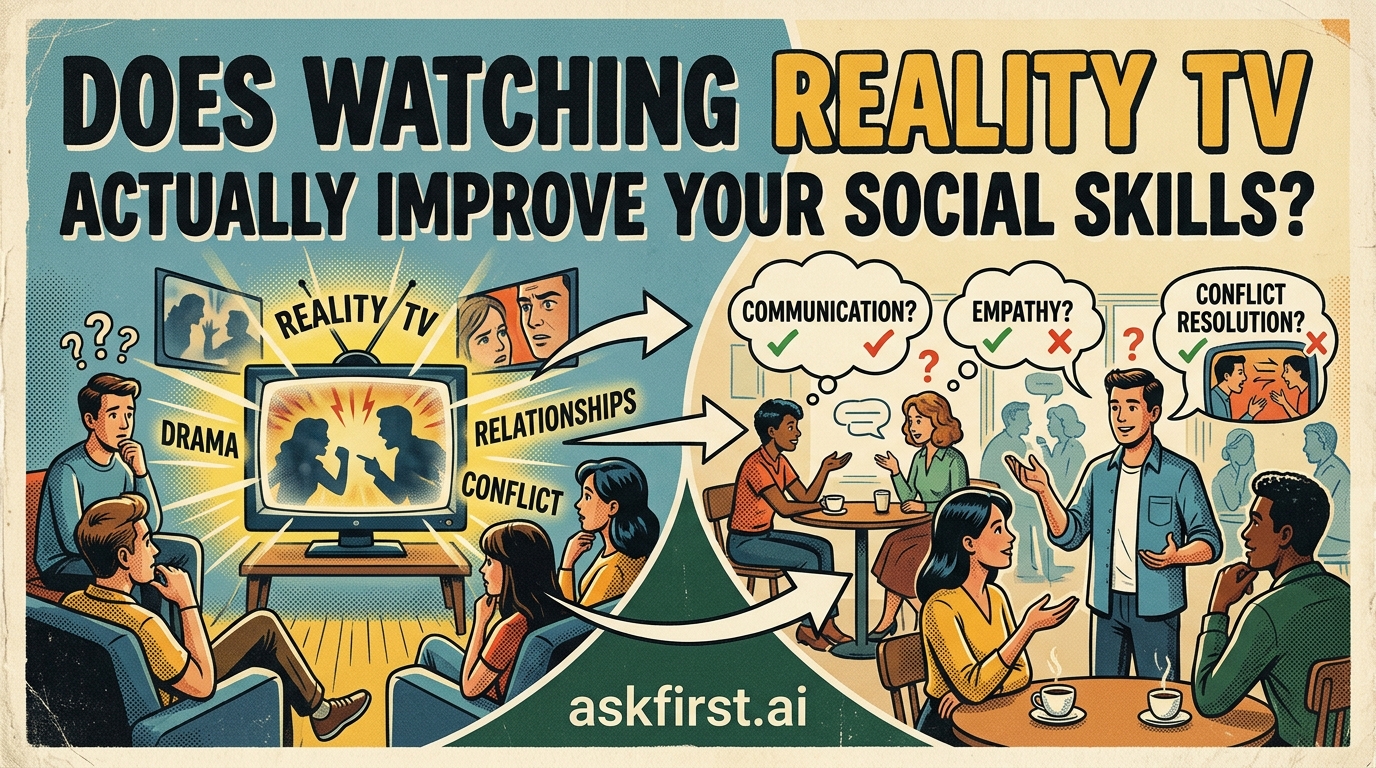
The Paradox of Parasocial Interaction: Reality TV and Social Dynamics
For decades, reality television has been dismissed as a shallow form of escapism or a "guilty pleasure." However, modern psychological research suggests that the consumption of reality programming—which centers on unscripted, human-driven interpersonal conflicts and alliances—may serve as a complex training ground for navigating real-world social landscapes. By observing human behavior under manufactured stress, audiences are essentially engaging in a form of vicarious social simulation.
Understanding Social Cognition through Observation
At the core of social intelligence lies the ability to infer the mental states, intentions, and emotions of others—a psychological framework known as 'Theory of Mind.' Reality television serves as a laboratory for this specific cognitive function. Because participants in shows such as Survivor, The Traitor, or Big Brother are placed in high-stakes, socially volatile environments, viewers are granted a unique vantage point to witness how interpersonal strategies unfold. When a participant negotiates a trade or manages an emotional outburst, the viewer is forced to process these social signals, analyze the outcome, and synthesize the logic behind the interaction.
- Deconstruction of Social Cues: Viewers become adept at reading micro-expressions and non-verbal body language.
- Strategic Empathy: Watching individuals navigate power dynamics encourages viewers to practice perspective-taking, a crucial component of EQ (Emotional Intelligence).
- Conflict Resolution Analysis: By watching others resolve (or fail to resolve) disagreements, individuals can mentally prototype their own responses to similar workplace or interpersonal conflicts.
The 'Social Laboratory' Effect
Psychologists have noted that watching reality TV acts as a form of social 'rehearsal.' In environments like The Office (while scripted) or reality-based relationship shows, the exaggerated behaviors of the cast provide a hyperbolic version of social challenges. When a viewer watches a reality star navigate a social faux pas or a complex negotiation, the brain engages in 'mirror neuron' activity. This mirrors the cognitive load of actually participating in the event, allowing the brain to strengthen its neural pathways associated with social assessment without the associated risk of real-world consequences. This is essentially a 'low-stakes' simulation that prepares the subconscious for future interpersonal hurdles.
Debunking the Myth of Passive Consumption
One common criticism is that reality television consumption is a passive, mindless act. However, media psychology suggests otherwise. Viewers often engage in active, critical evaluation of cast members. This process—analyzing motivations, predicting behavior, and critiquing social strategies—is intellectually demanding.
- The Predictive Modeling Process: When a viewer asks, "Why did they say that?" or "That strategy is going to backfire," they are conducting sophisticated social predictive modeling. This mental exercise correlates positively with the ability to navigate complex office politics and romantic dynamics.
- Increased Emotional Vocabulary: By observing a wide array of personalities in high-pressure situations, viewers expand their understanding of emotional states. Being exposed to diverse communication styles forces the viewer to conceptualize feelings that they might not have otherwise categorized, which directly enhances the ability to communicate one's own needs in real life.
Critical Considerations and Limitations
While the cognitive benefits are measurable, it is essential to distinguish between 'functional observation' and 'social displacement.' If television viewing replaces direct interpersonal contact, the skill acquisition stagnates. Real-world social skills require feedback loops that cannot be found in a one-way television broadcast.
- The Feedback Loop: In real life, actions have immediate social consequences. In reality TV, the screen prevents actual engagement. To truly translate these skills, a person must apply the observations made on screen to their own interactions.
- Hyper-Reality vs. Authenticity: The "reality" portrayed is often manipulated through editing, production interference, and casting choices. Understanding that these social interactions are crafted to maximize drama is in itself an advanced social skill—media literacy. Recognizing that what is shown is a compressed, sensationalized version of human behavior prevents the viewer from adopting unhealthy or manipulative strategies as models for their own lives.
Conclusion: The Tool for Social Literacy
Watching reality television can serve as a potent tool for refining one's social toolkit, provided that the viewer remains a critical and active participant. By treating these programs as case studies in human behavior, psychology, and strategic interaction, viewers can hone their ability to read others and refine their own communication methods. Just as a chess player studies Grandmaster games to improve their strategy, an individual can use reality television to understand the complex, ever-shifting rules of human engagement. It is not about mimicking the drama, but about understanding the undercurrents of the social dance.