The Societal Paradox: Why Exhaustion Triggers Judgment Over Empathy
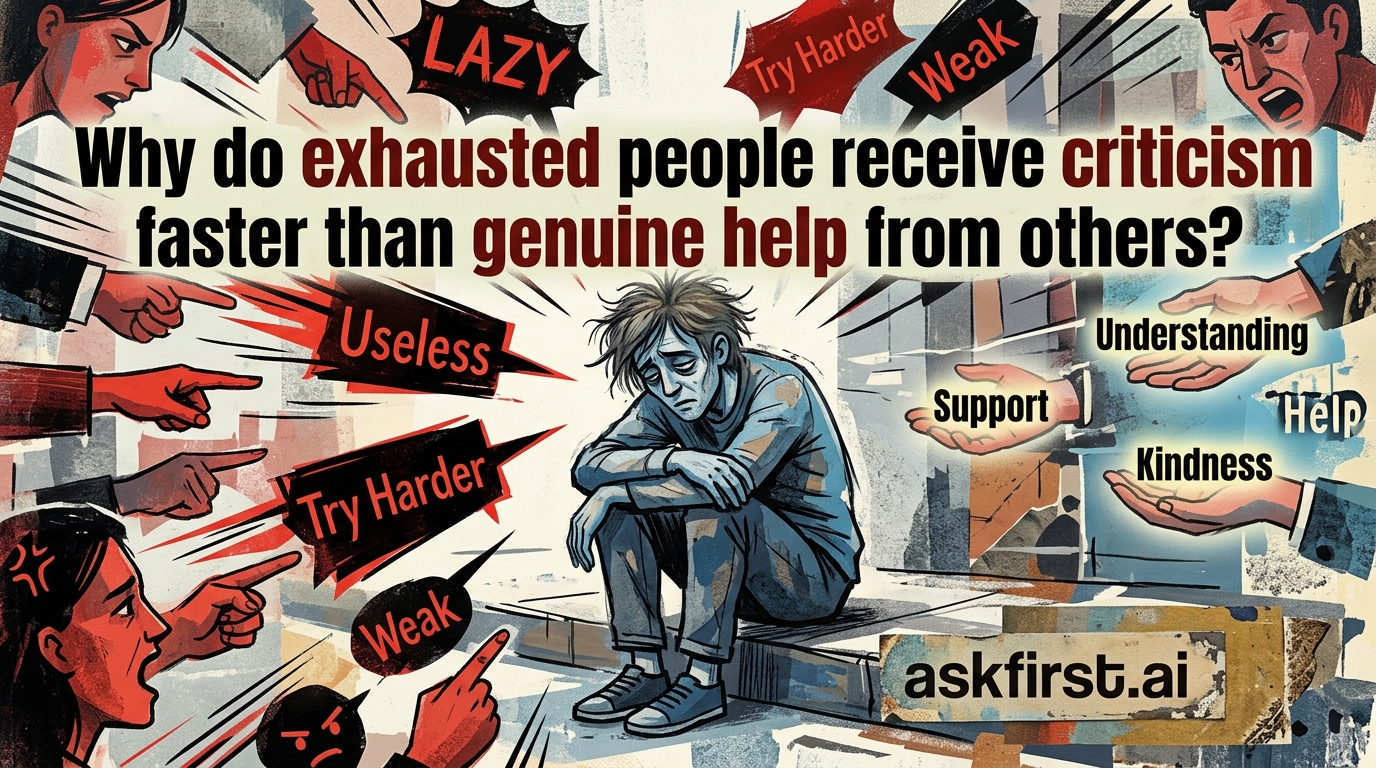
In the modern landscape of high-performance culture, the display of exhaustion is frequently met with a chilling lack of sympathy. Instead of the outstretched hand of support, those who are visibly depleted often encounter skepticism, irritation, or outright criticism. This phenomenon is not merely an individual character flaw but a deeply rooted psychological and sociological mechanism. Understanding why exhausted individuals are perceived as "failures" rather than "people in need" requires an exploration of evolutionary psychology, the culture of performative productivity, and the cognitive biases that govern human social interaction.
The Evolutionary Trap: The "Social Burden" Bias
From an evolutionary standpoint, human beings are wired to prioritize group survival. In ancestral environments, a member of the tribe who lacked the energy to contribute to hunting, gathering, or defense was often perceived as a liability. This biological imperative has left a lingering cognitive residue: we are conditioned to view low energy as a lack of fitness or a potential threat to the collective's stability.
As evolutionary psychologist Robin Dunbar notes in his seminal work Grooming, Gossip, and the Evolution of Language, humans operate within complex social hierarchies where "social capital" is earned through contribution. When a person displays exhaustion, they are inadvertently signaling a temporary inability to contribute. Observers often interpret this not as a sign of burnout, but as a breach of the "social contract." We instinctively categorize the exhausted individual as someone who is "dropping the ball," triggering a defensive or punitive reaction rather than a compassionate one.
The Cult of Performative Productivity
In contemporary society, we live under what cultural critic Anne Helen Petersen describes in her book Can't Even: How Millennials Became the Burnout Generation as the "Cult of Optimization." We have conflated our self-worth with our output. When an individual expresses exhaustion, they are effectively holding up a mirror to the rest of society, reflecting the unsustainable nature of our collective lifestyle.
This creates a phenomenon known as "system-justification." To admit that an exhausted person deserves help is to admit that the system—the 60-hour work week, the constant digital connectivity, the pressure to "hustle"—is broken. It is far more comfortable for the observer to criticize the exhausted person for their "inability to cope" than to confront the reality that the environment is inherently toxic. By blaming the individual, society protects the status quo. It is a defense mechanism: "If I criticize them for being tired, I can convince myself that my exhaustion is just a result of their incompetence, and that I am somehow immune."
The Fundamental Attribution Error
A core principle in social psychology is the Fundamental Attribution Error, a concept popularized by Lee Ross in his studies at Stanford University. This bias occurs when we evaluate the behavior of others by attributing their actions to internal character flaws rather than external situational factors.
- When I am exhausted: I attribute it to the overwhelming workload, the lack of sleep, and the systemic pressures (Situational).
- When you are exhausted: I attribute it to your lack of discipline, your poor time management, or your inherent laziness (Dispositional).
Because we cannot physically feel the fatigue of another person, we ignore the context of their struggle. We see the result (lack of energy) and assume it is a choice or a personality deficit. This cognitive shortcut is fast and efficient, which is why criticism arrives so much quicker than empathy. Empathy requires the slow, deliberate work of imagining oneself in another's position; criticism requires only a snap judgment based on a superficial observation.
The Fear of Contagion
There is also a psychological dimension involving the fear of "emotional contagion." Exhaustion is often accompanied by cynicism, negativity, or a withdrawal from social expectations. Many people avoid offering help because they fear that by engaging with an exhausted person, they will be drained themselves.
In Brené Brown’s work, specifically Daring Greatly, she explores the concept of vulnerability. We are terrified of the vulnerability that comes with helping someone who is "down." If we help, we enter their world of struggle, which threatens our own carefully curated façade of stability. Criticism acts as a shield; it keeps the exhausted person at an arm's length, preventing their "weakness" from encroaching on our own carefully maintained boundaries.
Breaking the Cycle of Judgment
To shift the tide from criticism to support, we must actively challenge these default cognitive responses. Genuine help requires recognizing that exhaustion is often the result of high capability being pushed to the point of collapse. It is the "high-performers" who are most likely to burn out, not the lazy.
The next time you encounter someone struggling with exhaustion, consider the structural pressures they are under. Recognize that your urge to criticize is likely a byproduct of your own fear of being in their position. Empathy is a muscle that must be exercised; it is the deliberate choice to override the evolutionary urge to judge and the social urge to blame. By choosing to offer a hand, we do more than help an individual; we challenge the toxic culture of optimization that makes exhaustion a stigma rather than a human reality.