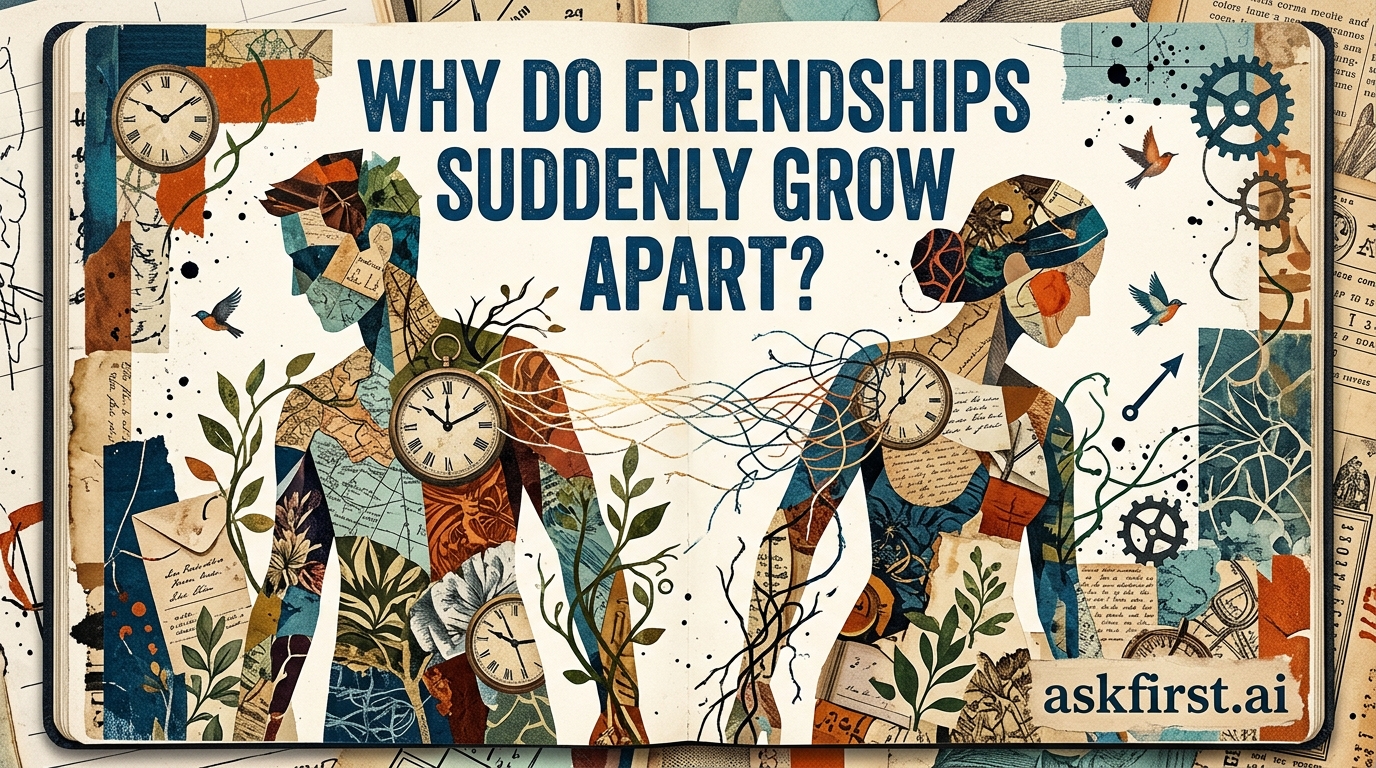
The phenomenon of friendships drifting apart is a universal human experience, yet it remains one of the most emotionally complex transitions in social psychology. It is rarely the result of a single, catastrophic event; rather, it is typically a gradual process of psychological and situational divergence. When two people who were once inseparable find themselves becoming strangers, they are usually navigating the quiet, inevitable erosion of shared context, values, and priorities.
The Erosion of Shared Context and Propinquity
At the foundational level, social scientists, most notably Leon Festinger in his seminal work Social Pressures in Informal Groups (1950), identified the concept of propinquity—the physical or psychological proximity between people—as the primary driver of relationship formation. In our youth, proximity is often mandated by school, neighborhood, or shared extracurricular activities. This creates a "forced" shared context.
As we age, this context disappears. When you no longer sit in the same classroom or work in the same office, the "incidental" interactions that sustain a friendship vanish. According to sociologists like Dr. William Rawlins, author of The Compass of Friendship, friendships are "voluntary" relationships. Unlike family or marital ties, they lack formal structure. Without the scaffolding of a shared environment, maintaining a connection requires deliberate, high-effort energy. When both parties stop investing that energy, the friendship naturally enters a state of atrophy.
The Divergence of Life Stages and Values
One of the most profound reasons friendships fade is the "life stage mismatch." Humans are highly sensitive to their environment and the developmental challenges they face. When one person enters a period of intense life change—such as marriage, parenthood, or a demanding career shift—their cognitive and emotional bandwidth is redirected.
Dr. Jeffrey Arnett, a developmental psychologist known for his theory of "Emerging Adulthood," notes that the twenties and thirties are periods of radical identity formation. If your friend is evolving into a version of themselves that no longer aligns with the version you knew, the "common language" of the friendship begins to fail. You may find that your values, political leanings, or lifestyle choices have drifted in opposite directions. This is not necessarily a moral failure of either person; it is a byproduct of human growth. As Aristotle theorized in Nicomachean Ethics, the highest form of friendship is the "friendship of virtue," where both parties help each other become better people. If you no longer share a definition of what "better" looks like, the bond loses its philosophical anchor.
The "Maintenance Deficit" and Emotional Neglect
Friendships are governed by an unwritten economy of reciprocity. In the book Friendship: A Darwinian Perspective by Beverly Fehr, the author explores how social exchange theory impacts our connections. We subconsciously track the "cost" and "reward" of maintaining a bond. If one person constantly initiates contact while the other consistently fails to reciprocate, a "maintenance deficit" occurs.
Over time, the initiator experiences "social fatigue." They begin to interpret the lack of effort from the other party as a sign of indifference. This leads to a protective withdrawal. For example, if you invite a friend to dinner three times and receive vague excuses without a counter-offer, your brain eventually categorizes that person as "low priority" to protect your own self-esteem. This is a survival mechanism: we naturally reallocate our limited social resources toward people who provide mutual validation and support.
The Role of Conflict Avoidance
Many friendships die not with a bang, but with a whimper because of a lack of "relational maintenance conversations." We are socialized to believe that discussing the state of a friendship is awkward or overly intimate. Consequently, when a rift forms—perhaps due to a minor disagreement or an unspoken hurt—we choose to let the friendship fade rather than address the tension.
This "slow fade" is often a form of conflict avoidance. By choosing not to confront the distance, we avoid the immediate discomfort of an argument, but we sacrifice the possibility of repair. Over months or years, the silence becomes permanent. By the time someone realizes they miss the friend, the gap has grown so wide that reconnecting feels like an insurmountable task.
Conclusion: Embracing the Seasonality of Connection
It is vital to recognize that not every friendship is intended to last a lifetime. Some connections are "seasonal," serving a specific purpose during a specific era of our lives. They offer us the community we need at that moment, helping us navigate a particular transition or teaching us a specific lesson about ourselves.
When we view friendships through the lens of seasonality, we can let go of the guilt associated with drifting apart. A friendship that ends is not necessarily a failure; it is often a natural conclusion to a chapter. By accepting that people change and that environments shift, we can honor the memories of past friendships while remaining open to the new, evolving connections that match our current path. As the writer C.S. Lewis suggested in The Four Loves, friendship is not about looking at each other, but about looking outward together in the same direction. When those directions diverge, the drifting is simply a part of the human journey.