The phenomenon of falling in love with fictional characters is a deeply ingrained facet of the human psychological experience. Whether it is a literary protagonist, a cinematic hero, or an animated icon, the emotional attachment formed between a real-world reader or viewer and a constructed persona is profound, measurable, and scientifically grounded. This experience, often referred to by psychologists as a parasocial relationship, transcends mere appreciation; it involves genuine physiological and emotional responses that mirror the complexities of real-world romantic or platonic love.
The Psychology of Parasocial Interaction
The concept of the "parasocial relationship" was first coined by sociologists Donald Horton and R. Richard Wohl in their seminal 1956 paper, Mass Communication and Para-Social Interaction: Observations on Intimacy at a Distance. They argued that mass media allows individuals to form one-sided relationships with media figures. Because our brains evolved in small social groups where everyone we interacted with was physically present, we struggle to distinguish between a face we see on a screen and a face we see across a dinner table.
When we consume a story, our brains activate the same neural pathways used for real-life social cognition. As noted by Keith Oatley, a professor of cognitive psychology at the University of Toronto, in his work Such Stuff as Dreams: The Psychology of Fiction, reading fiction is a "flight simulator for social life." We simulate the emotions and motivations of characters so intensely that our brains treat these characters as real social agents. Consequently, when a character suffers, we feel empathy; when they succeed, we feel pride; and when they possess traits we find desirable, we may experience the spark of romantic attraction.
The "Idealized Mirror" Effect
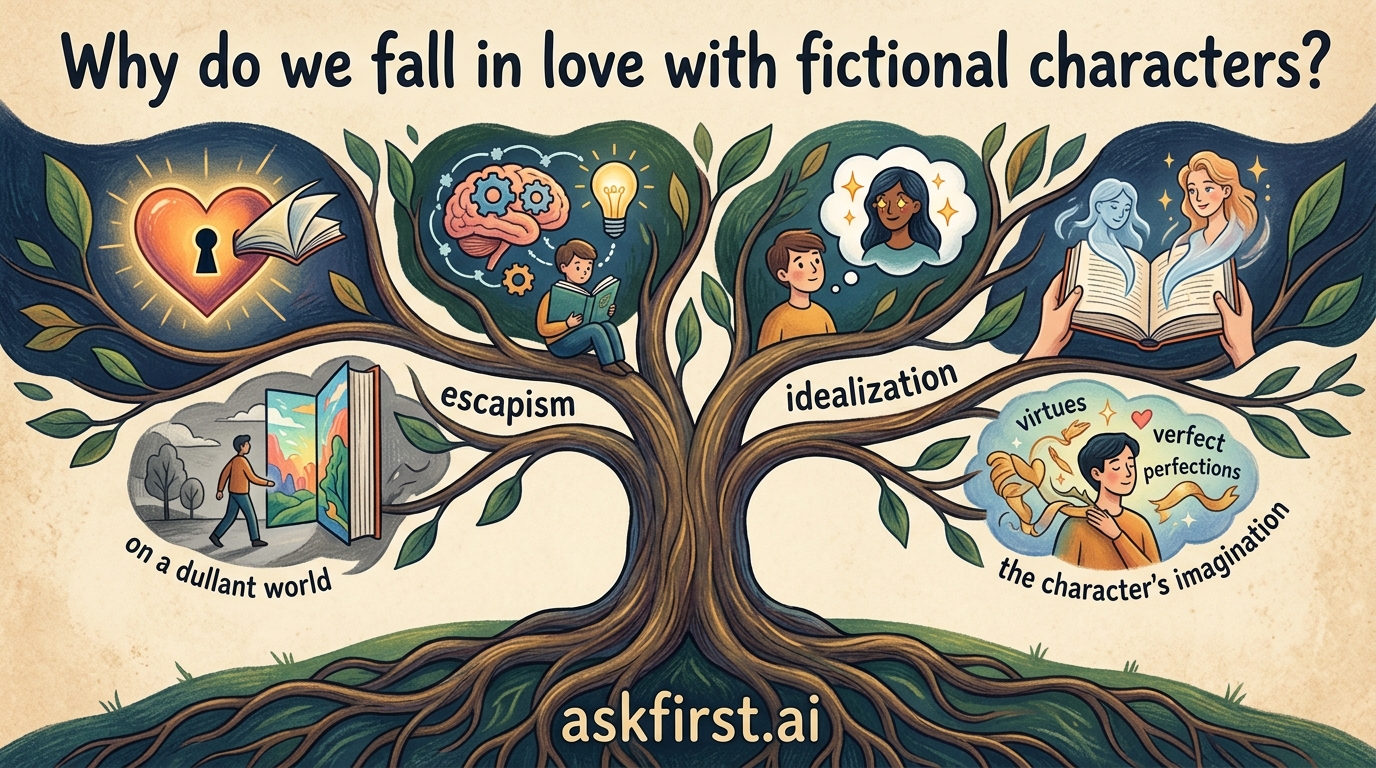
One of the primary reasons we fall for fictional characters is that they are often crafted to be the perfect vessels for our desires. In real life, human beings are messy, unpredictable, and flawed. Fictional characters, however, are curated. Authors like Jane Austen in Pride and Prejudice or screenwriters in modern fantasy epics deliberately cultivate traits in their characters—such as unwavering loyalty, biting wit, or tragic vulnerability—that align perfectly with our subconscious preferences.
This creates an "idealized mirror." We project our own values, insecurities, and unfulfilled needs onto these characters. Because we are privy to their internal monologues, their secret fears, and their most vulnerable moments, we achieve a level of intimacy with them that is rarely possible with real people in the early stages of a relationship. This "privileged access" to the character's soul fosters a sense of closeness that feels earned and secure, unburdened by the risk of rejection or the mundane friction of daily cohabitation.
Neurobiology and the Dopamine Loop
Falling in love with a fictional character triggers the same neurochemical processes as falling in love with a person. When we engage with a character we admire or crave, our brain releases dopamine, the neurotransmitter associated with reward and motivation. This creates a "loop" of anticipation. If you are reading a serialized novel or watching a weekly television series, the wait for the next installment keeps the brain in a state of heightened arousal.
Furthermore, the release of oxytocin—often called the "bonding hormone"—occurs when we witness characters experiencing deep emotional bonds or moments of profound connection. Because our mirror neurons fire when we observe these interactions, we vicariously experience that bonding. This is why fans often feel a sense of "grief" or "breakup" when a series ends or a character dies. The brain has been conditioned to produce these chemicals in the presence of that character, and their absence creates a literal physiological withdrawal.
The Role of Projection and Self-Expansion
Psychologist Arthur Aron’s "Self-Expansion Model" suggests that humans have a fundamental drive to expand their sense of self. We do this by incorporating the perspectives, identities, and traits of others into our own. Falling for a character is a safe way to explore different facets of our own identity. If a reader falls in love with a character who is courageous and bold, they are often subconsciously attempting to integrate those traits into their own personality.
We are not just loving the character; we are loving the version of ourselves that exists in the orbit of that character. This is particularly prevalent in fan culture, where individuals write fan fiction or create art, effectively merging their own creativity with the character's narrative. This active participation turns a passive consumption of media into a creative, symbiotic bond.
Conclusion: A Valid Emotional Experience
It is a mistake to dismiss these feelings as "fake" or "silly." While the object of the affection is a construct of language or light, the emotional labor and the neurochemical reality are entirely authentic. We fall in love with fictional characters because they provide a sanctuary where we can explore the depths of our own capacity for love without the consequences of reality. They serve as companions in our most private moments, teachers of our emotional range, and mirrors of our deepest aspirations. Whether it is the Byronic hero of the 19th century or the complex protagonist of a modern video game, these characters occupy a permanent, sacred space in the architecture of our memories.