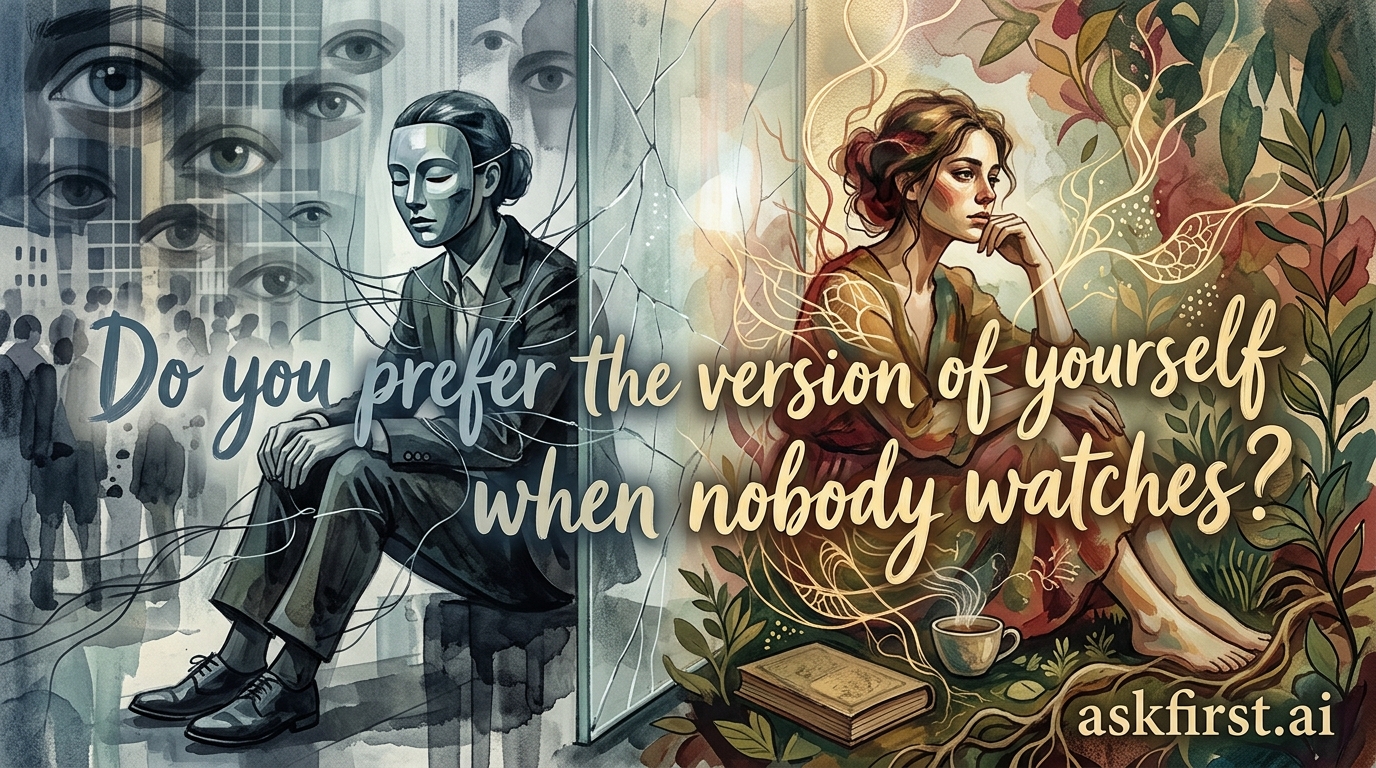
The Duality of Public and Private Persona
The human experience is defined by a perpetual tension between the public self, which is curated for social integration, and the private self, which exists in the absence of observation. Psychologically, this phenomenon is rooted in the concept of social monitoring and impression management. The version of the self that emerges when one believes they are unobserved is often referred to as the 'authentic self.' Research suggests that human beings act differently when they are alone because the cognitive burden of maintaining a social facade is lifted. When external expectations evaporate, the brain shifts from a defensive, performative state to a state of internal exploration.
The Science of Behavioral Inhibition
Sociological studies frequently cite the 'Hawthorne Effect' to explain how awareness of observation alters behavior. While this concept originated in industrial productivity research, it applies directly to personal development. When an individual is being watched, the prefrontal cortex—the part of the brain responsible for impulse control and social regulation—becomes hyper-active. This leads to what psychologists call 'normative behavior.' Conversely, in solitude, this inhibition diminishes. The version of the self seen in private is often more exploratory, experimental, and inherently more creative because the fear of judgment is neutralized. This state allows for a higher level of cognitive play, enabling individuals to test ideas, express complex emotions, and engage in reflective thought that is too risky or unconventional for public display.
Benefits of the Solitary Self
Cognitive Recharging: The private self is where the mind reconciles experiences. By processing information without the pressure of an audience, the individual enhances their capacity for critical thinking and long-term memory consolidation.
Emotional Regulation: In solitude, individuals can experience a full range of emotions without the societal expectation of remaining composed or 'positive.' This emotional release prevents the accumulation of latent stress and anxiety.
Authenticity Calibration: By engaging with the private self, one gains clarity on their personal values, preferences, and desires. Without this time, individuals risk living a life dictated entirely by external peer pressure or social trends.
Why the Unseen Self Matters for Long-term Growth
History demonstrates that many of the most profound innovations, artworks, and philosophical insights originated in moments of intense isolation. When nobody is watching, the constraints of current paradigms fall away. This version of the individual acts as an 'inner laboratory.' If the public self is the professional face provided to the world, the private self is the architect designing the future. Relying exclusively on the public persona often leads to burnout and a loss of personal identity, whereas embracing the private self fosters a sense of wholeness and integrity.
Balancing the Two Versions
To achieve true personal development, it is not about choosing one version over the other, but rather integrating the strengths of both. The goal is to move toward a state where the public self is a reflection of the private self's wisdom. Consider these strategies for harmonization:
- Prioritize Solitary Reflection: Set aside dedicated 'unobserved' time where digital devices are removed and social interaction is strictly avoided.
- Practice Radical Honesty: In private moments, perform self-inquiries regarding your motivations. Ask yourself if your public actions align with your inner convictions.
- Cultivate Intellectual Autonomy: Read, create, and explore subjects that hold zero social currency but offer deep personal interest.
Conclusion: The Value of the Hidden Self
Ultimately, the version of oneself that exists when nobody watches is not a secret life, but a sanctuary. It is the most honest iteration of an individual. By respecting and nurturing this private state, one builds a foundation of strength that is immune to the fluctuating opinions of the crowd. While the public self serves the purpose of navigating society, the private self is the primary engine of personal identity. Embracing the truth that your private self is just as valid, if not more significant, than your public persona is the first step toward self-actualization. When one recognizes that the absence of witnesses is not an invitation to act 'incorrectly' but an invitation to act 'authentically,' the barrier between internal potential and external reality finally begins to dissolve. This balance ensures that, regardless of who is watching, the actions taken remain consistent with a deeper, more refined sense of self.